After 27 Months of Moratoriums, Chatham Is Ready to Show Its Solar Law
A lay person's guide to understand the new solar plan. It also begs the question: does Chatham need a moritorium on commerical development on its historic dirt roads?
Twenty-seven months. That is how long the Town of Chatham has gone without accepting a solar application. Now, finally, residents get to see what all that waiting bought.
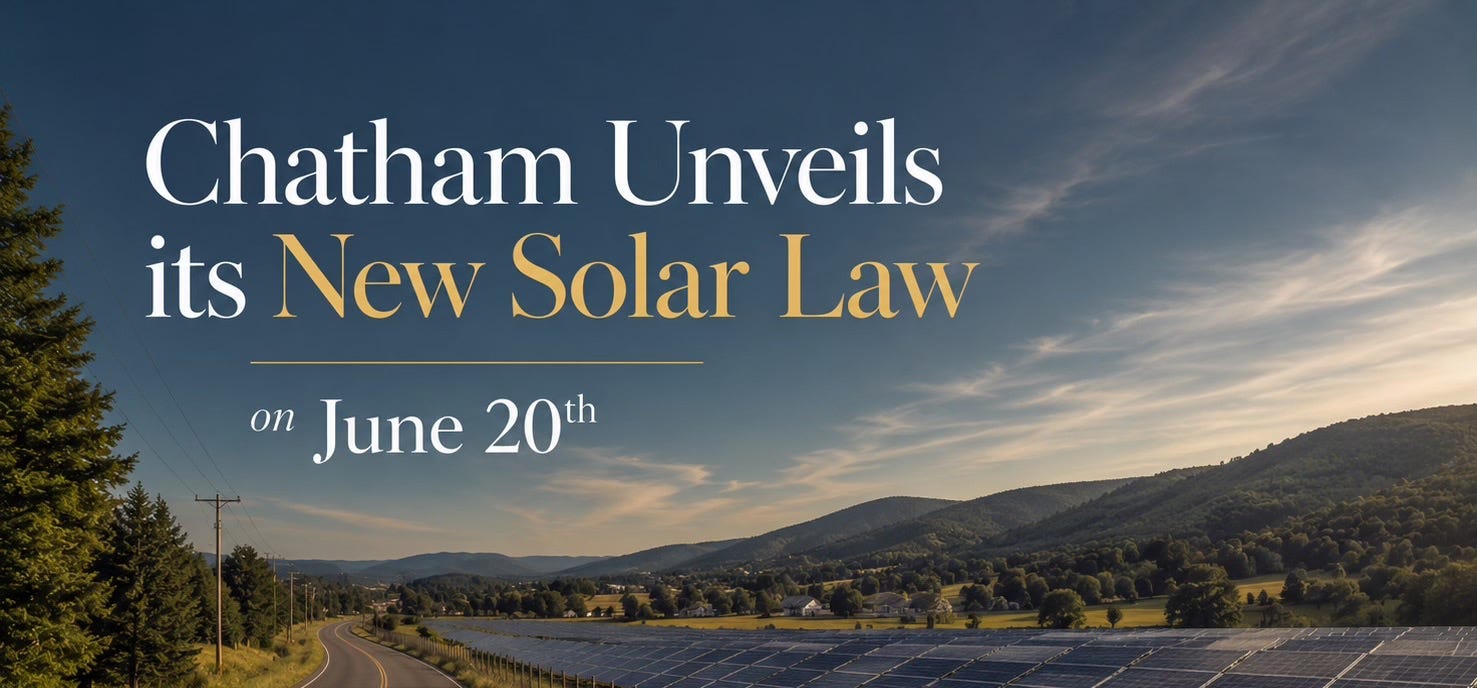
The town will present its draft solar law on June 20 at 2 p.m. at the Tri-Village Fire Company, 111 County Route 13, Old Chatham. The proposal, now in version 4.2, is the product of more than two years of study, drafting, public comment, and a moratorium that has been extended so many times it has begun to feel permanent.
It started on March 7, 2024. The Town Board adopted a six-month moratorium on the review and approval of solar energy array applications. The reasoning was simple. The town had no regulations governing solar development, larger projects were sniffing around the area, and the board wanted rules in place before anyone broke ground.
Six months became twelve. Twelve became twenty-seven.
The drafting fell to a four-member Solar Law Committee appointed in June 2024: Supervisor Donal Collins, Town Board member Angus Eaton, who chairs it, and citizen members Deborah Conrad and Lee Gagne.
The draft they produced attempts a familiar balancing act. Encourage solar for homeowners, farms, and businesses. Keep commercial solar fields off the farmland. Whether it succeeds is now the town’s question to answer.
The law sorts projects into tiers based on size and purpose. Here is what each tier actually means for the people who would live under it.
Tier 1: rooftop solar on an ordinary house. This covers rooftop, building-integrated, and small ground-mounted systems under 25 kilowatts. A typical home system runs 5 to 15 kilowatts, so most residential installations land here, meaning if you’re a homeowner thinking about panels on your roof, this law mostly won’t touch you. It’s permitted by right in every zoning district, exempt from site plan review, and approved through the state’s streamlined Unified Solar Permit. Doesn’t matter if you’re in Old Chatham, North Chatham, or out in the rural lands, with no special permit, no Planning Board hearing, just the state’s fast-track process.
Tier 1G: a bigger array, but still just for you. If you don’t have good roof exposure and want a ground-mounted system instead, Tier 1G covers larger systems serving a single owner. These can exceed 25 kilowatts but are limited to one acre and cannot be designed to generate more than 110 percent of the site’s electrical consumption over the previous 12 months. (An owner with multiple non-contiguous parcels in town can count them together, provided the electricity actually serves them, so if you own a few separate lots that all draw power from one array, their usage can be combined for the calculation.)
That 110 percent figure is doing a lot of work. The committee is drawing a line between systems built to power a home, farm, or business and systems built to function as power plants wearing a residential costume. Concretely: if your household used 8,000 kilowatt-hours last year, your array needs to be sized for roughly 8,800, not for three more houses besides yours. The extra 10 percent gives owners headroom. The cap stops anyone from building an oversized array and calling it personal use. The same 110 percent limit applies to lithium-ion battery capacity, so a battery bank paired with your system faces the same ceiling.
Tier 2R: solar on a big barn roof. This covers roof-mounted systems over 25 kilowatts, permitted by building permit, not a special use permit or full site plan review, in the hamlet, rural lands, business, and industrial districts. Putting big arrays on big roofs is the one thing everyone agrees on. For a farmer with a 10,000-square-foot dairy barn roof facing south, this is meant to be the relatively painless path.
Tier 2G: a larger ground array, with strings attached. This covers ground-mounted systems up to four acres, still bound by the 110 percent rule, but now requiring a special use permit and site plan review, and only in the rural lands, business, and industrial districts. It’s prohibited on active agricultural land, meaning land farmed within the past five years, unless the owner secures an Agricultural Dual Use exception. And no more than half the facility area can sit on the state’s most productive soil classes, so a four-acre array on a farm’s best cropland would need at least two of those acres on lower-quality ground, or the owner would need to go the dual-use route described below.
The agrivoltaics exception has teeth, at least on paper. A dual-use applicant must run an active Schedule F farm operation, meaning actually filing as a working farm with the IRS and not just grazing a token flock of sheep for the cameras, and pay for an agricultural monitor, and produce annual filings proving the farming is real. If the code enforcement officer finds the conditions are not being met in good faith, the permit is revoked and the panels come out within a year. So agrivoltaics is allowed under this draft, but it has to be genuine and continuous, or it disappears.
Tier 3: community and commercial solar, and the number that should get attention. Tier 3 covers projects up to 30 acres, serving multiple customers, allowed only in designated Solar Overlay Zones, only with a special use permit, and only after extensive Planning Board review including independent visual impact analysis, meaning neighbors’ sightlines get evaluated and not just the developer’s own renderings. The soil restriction tightens to 30 percent of the project area on the best soil classes.
And here is the provision that should get attention at the June 20 meeting: the town will approve no more than three Tier 3 projects. Ever. Once those three slots are filled, that’s it. No more large commercial solar in Chatham, regardless of site quality or how compelling a developer’s offer might be. For any landowner currently fielding calls about leasing acreage for a commercial array, getting in early, and being inside one of the designated overlay zones, could be the difference between this being viable or not.
Each Tier 3 project also requires a community benefit agreement with the Town Board covering, at minimum, 15 years of payments in lieu of taxes, inspection fees, and road restoration for any project accessed from a town road, so if a development brings heavy equipment down a town road during construction, the agreement is meant to cover the repair bill.
Tier 4: prohibited, full stop. Anything bigger than 30 acres is Tier 4, and Tier 4 is not allowed under any circumstance. The one asterisk: if the state ever overrides local zoning to site a massive project in Chatham anyway, which it can do for anything over 20 megawatts, that project would still have to meet Tier 3’s substantive requirements (soil limits, visual review, community benefit agreement), for whatever that proves to be worth.
The 30-acre ceiling is the most consequential number in the document. The draft’s findings state that while a majority of residents support solar, they do not support systems larger than 30 acres. The cap is that sentiment written into law.
The town-wide caps, and what they mean for forested land. Combined Tier 2G and Tier 3 development cannot consume more than 2 percent of each of the town’s four most productive soil classes, nor more than 2 percent of its forested land. Solar is also banned outright in designated Ancient Forest Areas, defined as woods never entirely cleared for agriculture. For anyone sitting on a wooded parcel, that designation is worth checking, since in a town with Chatham’s agricultural history, some long-undisturbed woodlots could potentially qualify, and if they do, solar there is off the table regardless of tier.
The philosophy is plain enough. Put panels on rooftops, parking lots, former mines, landfills, brownfields, and other land already disturbed. Keep them off the farms and out of the woods.
Battery storage on its own: not allowed. The draft also covers decommissioning (security bond at 115 percent of removal cost), fire safety, screening, dark-sky lighting, native pollinator vegetation, and abandonment. But standalone lithium-ion battery storage facilities, meaning batteries as the main use of a property and not paired with a solar array, are prohibited outright as a principal use.
Chatham is not alone in any of this. Towns across rural New York are fighting the same fight, trying to square renewable energy mandates with farmland preservation and some measure of local control.
And local control has limits. The draft itself notes that state law gives towns sole siting authority only for projects under 20 megawatts. Above that, Albany gets a say no matter what Chatham writes.
For now, June 20 is the moment. Residents get their first real look at the latest draft and a chance to weigh in on rules that could govern solar in Chatham for decades. After twenty-seven months of extensions, committee meetings, and revisions, the end of the process is finally in sight. Maybe.
©2026 | The Powell House Press All Rights Reserved | josh@thepowellhousepress.com