All Rise. The Tomato is in the Room.
There may be nothing better about summer than the arrival of the real tomato
The tomato is a fruit. This is the kind of fact people deploy to seem clever at dinner parties. It is also true. And those people are not clever. We learned this at Holy Spirit in the 6th grade.
Botanically, the tomato (Solanum lycopersicum) is a berry. It grows from a single flower’s ovary and carries its seeds inside, which is the entire definition. By every standard a botanist recognizes, it is a fruit. The United States Supreme Court disagreed. In Nix v. Hedden (1893), the Court ruled the tomato a vegetable for tariff purposes, on the reasoning that people eat it with dinner and not for dessert. Law and politics beat science. They usually do. The ruling was Trumpian before Trump, and before RFK Jr.
History does repeat itself.
The tomato belongs to the Solanaceae, the nightshades. The name sounds sinister and the family earns it. Its members include the potato, eggplant, pepper, and tobacco, alongside deadly nightshade (Atropa belladonna), which will kill you. The plants produce alkaloids as a chemical defense. In the tomato that compound is tomatine, concentrated in the leaves, stems, and unripe green fruit. The ripe fruit is fine. The rest of the plant is not salad.
Europeans held the grudge for a long time. The tomato came from South America, was domesticated in Mesoamerica, and arrived in Europe with the Spanish in the sixteenth century. Then it sat there, suspected, for the better part of two hundred years. The nightshade reputation did not help. Neither did the dishware. Tomato acid leached lead out of the pewter plates favored by the wealthy, who got sick and blamed the fruit. The poor ate off wood and were fine.

This matters because a lot of “ancient” Italian food is a New World import in old clothes. The tomato, the peperoncino, corn, the potato, and the common bean all crossed the Atlantic after 1492. Before tomatoes, Italians ate pasta dressed with cheese and sweet spices like cinnamon and sugar. The first Italian tomato sauce recipe dates to 1692, and its author called it Spanish-style. Polenta is the clearest case: before corn it was a porridge of millet, farro, or chestnut flour. Strip the Columbian arrivals out and the genuinely old larder remains. Bread and olive oil, olives, wine, chickpeas and lentils and fava beans, garlic and artichokes and bitter greens, eggplant (an earlier nightshade, by way of the Arabs), cheese, pork, salt cod, figs, citrus. The Caprese and the marinara could not exist before the ships came back.
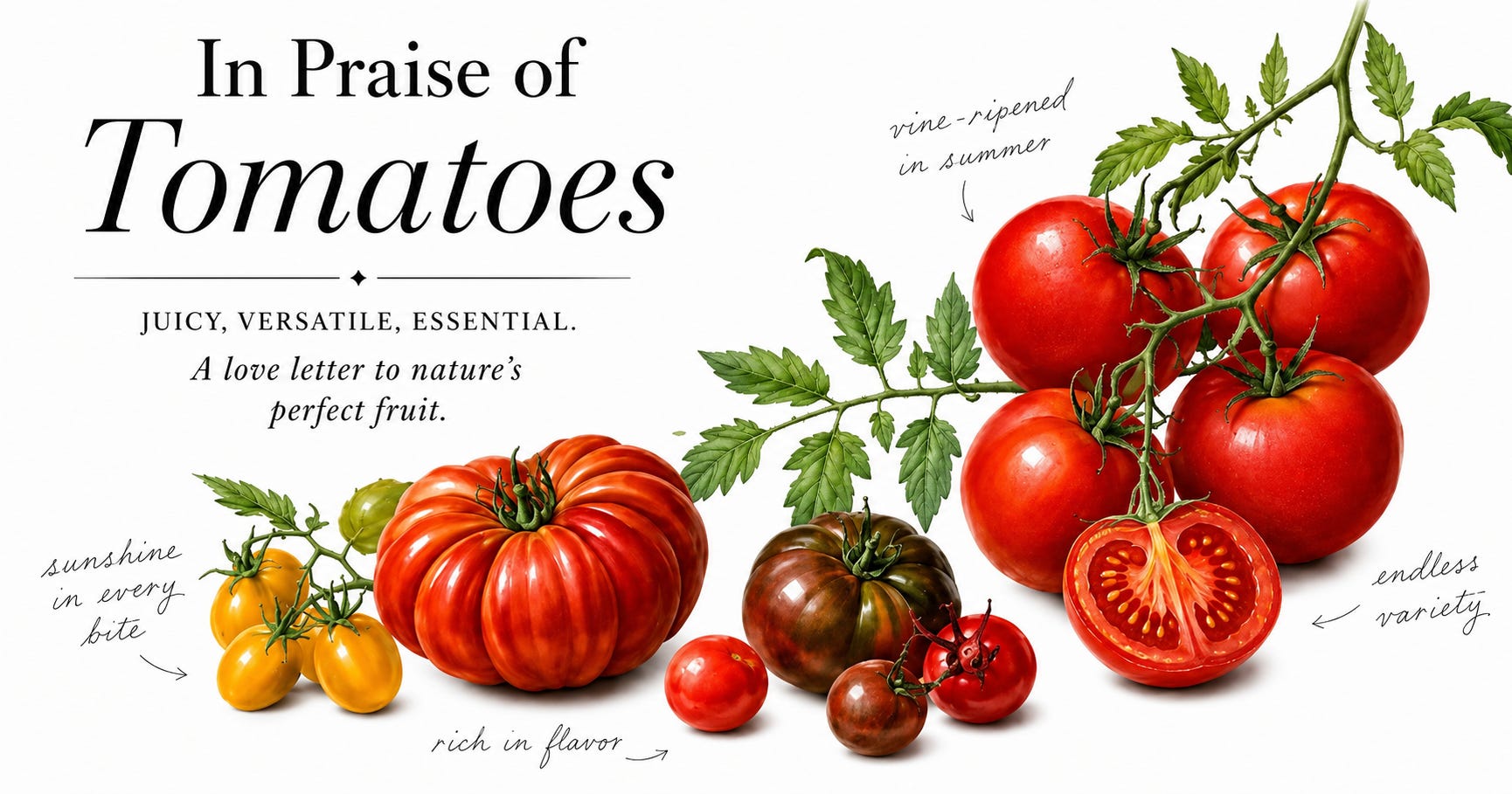
The tomato worth eating is the heirloom. These are the old open-pollinated varieties, grown from seed saved year after year, bred for flavor in the era before flavor was traded away. The Brandywine, the Cherokee Purple, the Green Zebra, the Mortgage Lifter. They are ugly. They crack at the shoulders, they bruise looking at them, they come in colors that look like a warning. They also taste like tomatoes, which is more than can be said for their descendants. The supermarket tomato is a hybrid bred for a different set of priorities: thick skin, uniform red, a shelf life measured in weeks, the ability to survive a cross-country trek. Flavor was not on the list. The heirloom keeps none of those promises and delivers the only one that matters.
The tomato sandwich is a minimalist exercise. Bread, mayonnaise, a thick slice of tomato, salt. That is the whole thing. Anything more is a different sandwich wearing the name. It works only in season, with a real tomato, the kind that drips down your wrist. The supermarket tomato in February is a different object entirely, mealy and pale, and it contributes nothing.
The mayonnaise is not negotiable. It is either homemade or it is Hellmann’s. Homemade is better, an emulsion of egg yolk, oil, lemon or vinegar, and salt, made in five minutes and worth every one of them. Hellmann’s (Best Foods west of the Rockies) is the only jar that earns a place near a good tomato. Do not email me about Duke’s. Everything else is sweet, or whipped, or pretending. The tomato is doing real work here. It deserves a solid partner.
The BLT adds two letters and a great deal of structure. Bacon, lettuce, tomato. Toasted bread, mayonnaise, the lettuce present mostly for crunch and the moral cover of a vegetable. The bacon does the heavy lifting, and the bacon has one rule: crispy, never burnt. Crispy shatters. Burnt turns bitter and ruins the whole project, and there is no recovering a sandwich built on scorched bacon. The tomato is still the point. Without a good one the BLT is just a bacon sandwich, which is not a complaint anyone has ever made out loud.
The BLT also takes well to improvement. Swap the mayonnaise layer for Boursin, the soft garlic-and-herb cheese, and the sandwich gains a richness it didn’t ask for and won’t give back. It coats the bread, it holds the tomato in place, it carries the garlic note that a BLT always secretly wanted. This is the rare upgrade that does not betray the original.

Then there is Melissa Clark’s sandwich, which is neither and both. Clark, the New York Times food writer, built hers by stealing from three traditions at once: the BLT, the tomato-and-sweet-onion tea sandwich, and the Catalan pan con tomate. She called the result Frankenstein. She meant it as praise.
The move that makes it is the bread. Toast hearty country bread. Rub one side of each slice with the cut face of a raw garlic clove, hard enough that the clove begins to disintegrate into the surface. Then rub the same bread with the cut side of a soft, very ripe halved tomato, pressing until the flesh sticks. Drizzle with good olive oil. Salt it. That is pan con tomate, and it is the foundation everything else sits on.
Spread mayonnaise over the tomato pulp. Lay sliced tomatoes on two of the slices, top with thin onion, salt again. Bacon is optional but why not? Close the sandwich with the other two pieces of garlic-and-tomato bread.
Clark’s instruction for eating it is one word: sink. The sandwich falls apart by design. Eaten over a plate it makes a mess. Eaten over the sink it makes the same mess somewhere drainable.
The garlic rub on the toast is brilliance.
Clark, like ATK is one of my favs.
The right tomato does not need much. It needs to be ripe, and it needs salt. Everything past that is preference.
©2026 All Rights Reserved | The Powell House Press | josh@thepowellhousepress.com.