American Guns and Paternal Love
The Grim Reality of America's Gun Problems, Caused by Money and the Perversion of the Second Amendment
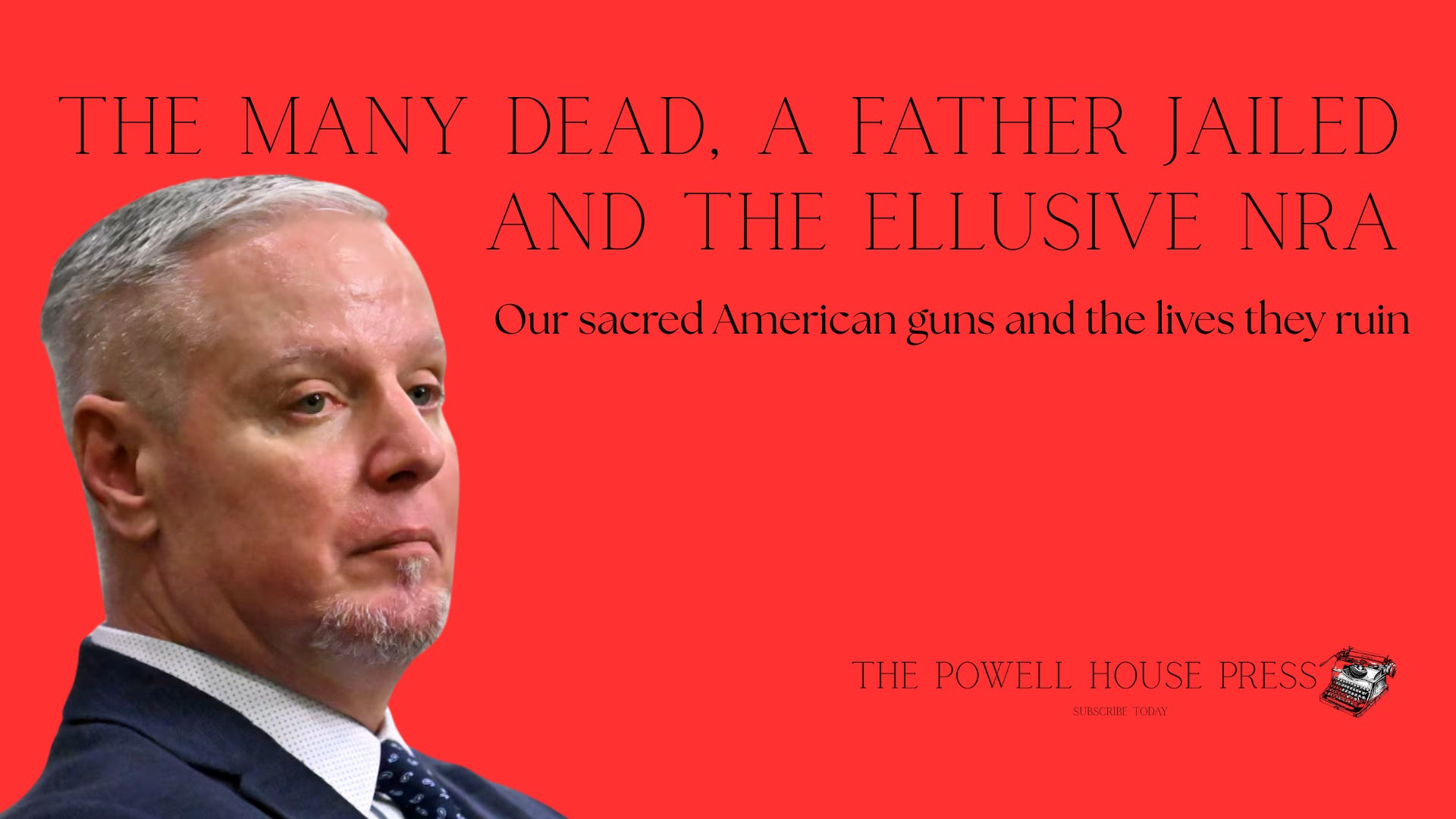
When the police arrived at the family home on the morning of September 4, 2024, Colin Gray did not wait for them to explain why they were there. Before a single officer could speak, he said three words: “I knew it.”
That admission, spontaneous, uncurated, wrenched out of him before his defenses could engage, is perhaps the most damning sentence ever spoken by a man who would spend the next several months in a courtroom insisting he had no idea.
Colin Gray, a 55-year-old construction worker from Barrow County, Georgia, is not a monster in the cinematic sense. He is something more mundane and therefore more frightening: a man who had every warning, every signal, every screaming alarm, and chose, repeatedly and deliberately, not to act. His 14-year-old son, Colt, had been exhibiting signs of severe mental illness for years. His bedroom walls were papered with photographs and newspaper clippings of Nikolas Cruz, the Parkland shooter who killed 17 people in 2018. Colt had corresponded with Cruz. He had sent Cruz money in prison. He had written him fan mail. He had told his grandmother he was having homicidal and suicidal thoughts. His own sister, a middle-schooler forced onto the witness stand to testify against her family, told the jury plainly that she believed her brother was capable of carrying out a school shooting. She believed, she said, that her father knew it too.
That is not hindsight. That is the trial record.
“I knew it.” Colin Gray’s first words to police upon their arrival at his home.
On the morning of the shooting, Colt texted his father: “I’m sorry, it’s not ur fault … ur not to blame for any of it.” Colin Gray was at his construction job. He did not call the school. He did not leave work immediately. He discussed with coworkers the firing of two employees. When his ex-wife Marcee urged him to go to the school, he eventually left, stopped at a QuikTrip to buy a “$1.79 beverage,” and drove home. Not to the school. Home.
This is the man who stood before a jury and argued he never saw it coming.
There is something almost operatically grotesque about the Christmas rifle. In November 2023, seven months after sheriff’s deputies had visited his home to investigate reports that Colt had threatened to shoot up a school, and mere weeks after his son had missed his entire eighth-grade year without Colin doing anything about it, Colin Gray drove to Mike’s Gun Room and spent approximately “$909” on a Sig Sauer AR-15-style semi-automatic rifle. He was buying his troubled, isolated, school-shooter-obsessing son a Christmas present.
He testified that the gun was meant to draw Colt away from video games and the internet. He described the day Colt shot his first deer as “the greatest day of my life.” He said the rifle would only become Colt’s outright when the boy graduated high school at 18.
What followed the purchase tells its own story. Colin Gray continued buying accessories for the weapon through June 2024: laser sights, ammunition, gun cleaning kits, tactical rail systems. All of it was later recovered at the Apalachee High School crime scene. He searched online for gun safes but never bought one. Prosecutors produced a gun lock, still in its original packaging, found in Colt’s closet. It had never been opened. It had apparently never even been considered.
He cited lack of insurance as a reason for not getting Colt into mental health treatment, while spending hundreds of dollars on gun accessories.
Meanwhile, Colt’s mother Marcee, who had her own serious struggles, including a later methamphetamine arrest, had nonetheless been sounding alarms that Colin consistently refused to hear. She had urged him, explicitly and repeatedly, to lock the guns in his truck. She had pushed for inpatient psychiatric treatment. She had identified a specific facility in Athens, Georgia. There were concrete plans to bring Colt there the Saturday before the shooting.
Colin Gray took his son to a guitar shop instead.
He also testified that he could not afford proper mental health treatment for Colt because he was still waiting for medical insurance from his new construction job to kick in. Prosecutors let that statement land. Then they pointed to the gun purchase receipt.
A construction worker who could not afford a therapist for his son somehow found nine hundred dollars for a semi-automatic rifle and hundreds more for accessories. The prosecution did not need to editorialize. The bank statements did it for them.
On the morning of September 4, 2024, Colt Gray boarded the bus to Apalachee High School with the AR-15-style rifle his father had given him for Christmas. He used a rolled-up poster board to conceal the barrel. He had apparently thought this through.
In his first-period class, he asked the teacher whether the school had done active shooter drills. She reported the question by email to a counselor and a vice principal, but not to the algebra teacher in whose classroom the shooting would begin. During the next period, Colt asked to go to the counselor’s office, then locked himself in a bathroom stall for twenty-six minutes. His mother, alarmed by a text, called the school. A case of mistaken identity, another student with a nearly identical name, caused school resource officers to look for the wrong boy.
Colt emerged from the bathroom wearing yellow plastic gloves.
What happened next lasted forty-one seconds. Richard Aspinwall, a teacher, was killed. Cristina Irimie, a teacher, was killed. Mason Schermerhorn, fourteen years old, was killed. Christian Angulo, also fourteen, was killed. Nine others were wounded.
Forty-one seconds. That is the distance between Colin Gray’s willful blindness and four funerals.
Assistant District Attorney Patricia Brooks prosecuted the case with surgical precision. Colin Gray, she argued, was not merely negligent. He was the man who handed his son the detonator. He was the only person in the chain with the access, the authority, the information, and the obligation to stop it, and instead he supplied the tools to carry it out.
The defense, led by attorney Jimmy Berry, tried its best with a near-impossible hand. Berry held up a photograph of Colt Gray and pointed to it. This, he told the jury, is the person who walked into a school and killed four people he didn’t even know. His father never saw it coming.
The argument might have carried some weight in a different case. It carried none here. Because “his father never saw it coming” was precisely what the prosecution had spent two weeks systematically demolishing. His sister had seen it coming. His mother had seen it coming. The warning signs were not hidden; they were hanging on the walls of the boy’s bedroom. They were in emails to a convicted mass murderer. They were in the psychiatric crisis that Marcee had been begging Colin to address. “His father never saw it coming” is not a defense. It is an indictment dressed up as an alibi.
The jury deliberated from 9:02 a.m. to 10:52 a.m. Not even two hours. They returned twenty-nine guilty verdicts: second-degree murder, involuntary manslaughter, cruelty to children. Colin Gray sat near his attorney, clenching his jaw, wiping tears, before being led away in handcuffs to face up to 180 years in prison.
Now we arrive at the part that the gun lobby does not want to talk about.
Colin Gray bought his son an AR-15 because in America, that is something a father can simply do. Not because the law required it. Not because the Constitution demanded it. But because a decades-long campaign of legal revisionism, political intimidation, and calculated mythology has convinced a significant portion of this country that the Second Amendment is not merely a constitutional right, but a sacred rite of passage. That arming your child is not just permitted but noble. A gesture of trust and tradition and American manhood.
This is a perversion of the amendment, of its history, of its purpose, and of the very concept of responsible gun ownership that the NRA claims to champion.
The Second Amendment was ratified in 1791. Its authors were thinking about militias and the mechanisms of a fledgling republic’s self-defense. They were not thinking about a 55-year-old man in Barrow County gifting a semi-automatic rifle to a teenager who had been sending fan mail to the Parkland shooter, whose bedroom was decorated like a manifesto, whose mother was screaming for psychiatric intervention. The Founders did not write a permission slip for this. The Constitution does not protect this.
The NRA did not create Colin Gray. But it built the world in which his choices were not just legal, but culturally celebrated.
What did build it, brick by legislative brick, dollar by lobbying dollar, was the National Rifle Association and the political apparatus it constructed over five decades. The NRA that spent the 1970s reorienting from a sportsman’s organization into a single-issue ideological machine. The NRA that poured tens of millions of dollars into the campaigns of politicians who then voted against universal background checks, against red flag laws, against safe storage requirements, against every modest, evidence-based measure that might have, that would have, placed an obstacle between Colin Gray and that rifle purchase.
The NRA that, after Parkland, after Uvalde, after Sandy Hook, dispatched spokespeople to call grieving parents crisis actors. That called background check legislation a “slippery slope.” That branded any discussion of gun safety as an existential attack on American freedom. That told millions of American fathers, for decades, that the most loving thing they could give their children was a firearm, and that anyone who questioned that was an enemy of the republic.
Colin Gray absorbed that message. He lived in Barrow County, Georgia, where, as the prosecution itself acknowledged during trial, Second Amendment rights are sacrosanct, and where charging a man for catastrophic parenting was a political act as much as a legal one. He lived in a county and a culture that told him guns are sacred objects, that to question their presence in a home is to be un-American, that locking up your weapons or reconsidering whether your mentally unstable child should have access to them is a capitulation to the liberal agenda.
He had been marinated in that worldview his entire life. And so, when his son showed every sign of violent crisis, Colin Gray’s cultural programming told him that the gun was not the problem. The gun was the solution. It was the bonding tool. It was the path back to connection. The rifle was love, expressed the only way the NRA’s America had taught him to express it
Four people died for that lesson.
The Colin Gray conviction is only the second time in American history that a parent has been found criminally responsible for enabling a child’s access to a weapon used in a school shooting. The first were James and Jennifer Crumbley, the parents of Ethan Crumbley, who killed four students at his Michigan high school in 2021. The Crumbleys were convicted of involuntary manslaughter and sentenced to 10 to 15 years.
Gray’s case goes further. He is the first parent charged with second-degree murder in such a case. The potential sentence, up to 180 years, means he could die in prison before his son’s trial is even scheduled.
Former U.S. Attorney Michael Moore has already predicted that the case’s ramifications may extend well beyond what anyone in that Barrow County courtroom was contemplating. Legal observers are watching closely. The gun lobby is watching more closely still.
The gun lobby will call the conviction government overreach. They will call it an attack on the Second Amendment. The jury took less than two hours.
They will, of course, call it an attack on the Second Amendment. They will find a politician to say so on television before the week is out. They will argue that holding parents responsible for arming violent children is a step toward holding all gun owners responsible for the violence their weapons enable. They will be right that it is a step in that direction. They will be wrong that this is something to fear.
Because what the NRA has spent decades arguing is that gun ownership is a right without consequence, a freedom without responsibility, a sacrament that cannot be touched by the laws that govern every other lethal object in American life. What the Colin Gray verdict says, and what the Crumbley verdict said before it, is that this is false. That rights come tethered to duties. That a parent who gives a semi-automatic rifle to a mentally ill child who has been reported to the FBI for school shooting threats is not exercising a constitutional right. He is enabling a mass murder.
Colt Gray, now 16, has pleaded not guilty to murder and aggravated assault. His trial has not been scheduled. The courts are awaiting a psychological evaluation. His next hearing is set for March 18th. His mother, Marcee, who begged Colin to lock the guns away, who identified the treatment facility, who saw all of it coming, declined to comment after the verdict.
District Attorney Brad Smith addressed the gallery after the verdict with the gravity of a man who understood exactly what had happened. “God gave us a duty to protect our children,” he said. “You just had to do one thing: take that rifle away, and this would have been prevented.”
That is the sentence that defines this case. Not the legal theories. Not the appeals arguments that are already being drafted. Not the Second Amendment rhetoric that will arrive, on schedule, from the lobbying organizations that made this world possible.
One thing. Take the rifle away.
Colin Gray could not bring himself to do it. He had been taught, by his culture and by the industry that shaped it, that the rifle was sacred. That it was love. That it was his right.
Now he will have the rest of his life, in a Georgia prison cell, to contemplate what a two-hour jury deliberation tells you about the strength of the case against you. And what a Christmas rifle, given in the name of love, tells you about the price of looking the other way.
Why Your Subscription Matters
Independent journalism answers to readers—not advertisers, corporations, or access-hungry editors. No story gets killed because it upsets a sponsor. No punch gets pulled because someone important made a phone call.
Your support makes possible sharp commentary, fearless satire, and reporting that follows the story wherever it leads. In an era of manufactured narratives and algorithmic blandness, that independence isn’t a luxury—it’s a necessity.
Subscribe to The Powell House Press. Or settle for content that tells you what someone else wants you to hear.