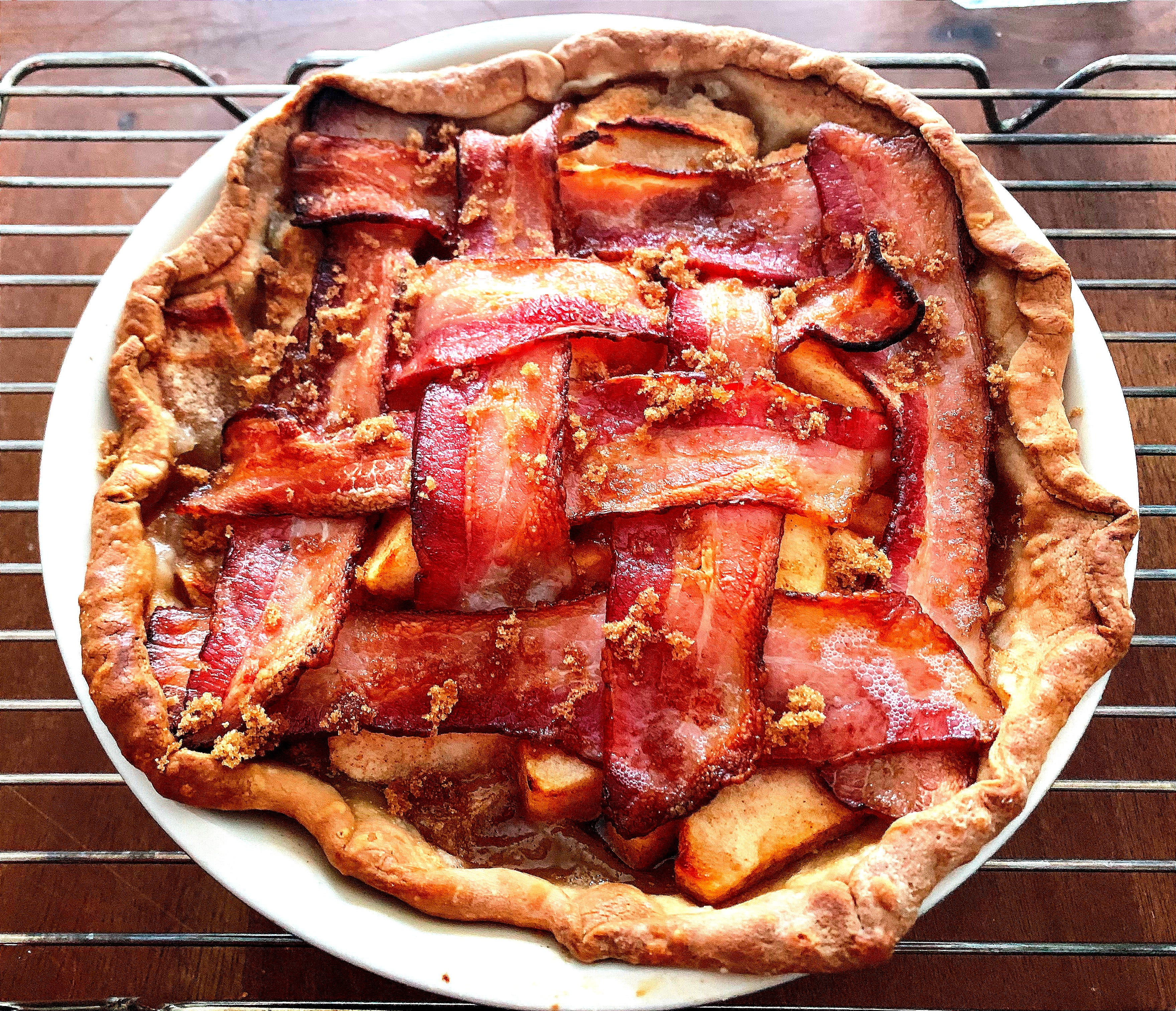
Apple Pie Has Three Failure Modes
And one of them is solved by bacon. FYI bacon makes everything better. It’s a fact.
I’ve been cooking and taking pictures of my meals for years. I love food and the science of cooking. Welcome to my new series on both.
I am not a huge fan of baking. As my friend Julie says, baking is science. She is right, and you have to follow recipes like you’re in a lab. However, if you know some basic chemistry, you can play around. A little.
Also, I am not a fan of super sweet foods so baking an apple pie never really interested me.
But this is different. It’s got a complex flavor that’s not too sweet but still feels like it belongs after the entree.
Most American apple pie has three failure modes. The bottom crust gets soggy. The filling runs like broth. The top is boring. Two of these are physics. The third is a failure of nerve.
This pie addresses all three. The reasoning, in order.
The Water Problem
An apple is roughly 85 percent water. A standard nine-inch pie holds about three pounds of apples, which works out to two and a half pounds of water held back by half a pound of flour and butter. The math is bad.
Most recipes pretend this isn’t happening. They toss apples with sugar, cinnamon, a tablespoon of flour, and send everything into a 350-degree oven for an hour. The sugar pulls water out of the apple cells through osmosis. The water pools in the shell. The flour, asked to do a job it is bad at, goes pasty and cloudy without absorbing nearly enough. The bottom crust, sitting in a half inch of warm liquid, surrenders.
The fix is to remove most of the water before the pie. The sliced apples get tossed with sugar, salt, and lemon juice and left to sit at room temperature for an hour. Three-quarters of a cup of liquid drains off into a bowl. That liquid simmers in a saucepan down to a third of a cup of thick syrup. The syrup goes back over the apples. The flavor stays in the pie. The water does not.
The technique is from Rose Levy Beranbaum’s The Pie and Pastry Bible (1998), later picked up and refined by Cook’s Illustrated (treasure) and others. It remains the cleanest solution to the soup problem.
The Thickener Question
The thickener decides whether the filling holds together or runs.
Flour is the default. Flour is bad. It clouds the juice into something the color of wallpaper paste and tastes raw if the pie is underbaked, chalky if it is overbaked. Cornstarch is sharper but it breaks down under sustained heat and at low pH. Apples are acidic. By the time a cornstarch-thickened apple pie comes out of the oven, the starch has surrendered and the filling weeps.
Tapioca holds. It survives the long bake. It stays clear. It has no flavor of its own. Instant tapioca (the same product your grandmother used for pudding) is the best version of it, with one drawback: it leaves visible gelatinous pearls in the cooled pie. Grinding the tapioca in a spice mill before it goes in kills the pearls. Three tablespoons of ground tapioca for three pounds of apples is the right number.
The Apple
Granny Smith is the right apple. The reasons are structural.
Apple cells are held together by pectin. In firm tart varieties (Granny Smith, Northern Spy, Pink Lady, Braeburn), the pectin is more cross-linked and the cell walls are thicker. In sweet soft varieties (Honeycrisp, Gala, Fuji, Red Delicious), the pectin is looser and the walls are thinner. Heat dissolves the loose stuff. A Honeycrisp pie is structurally a Honeycrisp sauce.
Granny Smith also has the highest malic acid content of any common supermarket apple, roughly twice that of a Fuji or Gala (one study clocked it at around 9.8 grams per liter, against the 5 to 6 typical of sweeter varieties). The acid does two jobs. It tastes sharper than sugar, which keeps the pie from collapsing into one-note sweetness. And it lowers the pH of the filling enough to slow the enzymes that break down apple pectin during cooking. Tart and firm are not a coincidence. They are the same chemistry.
Northern Spy is better if you can find one (firmer, more complex, harder to source). Pink Lady and Braeburn work. Anything called “Honey-” is for eating raw.
The Crust
The crust problem is a temperature problem.
Flaky pastry happens because solid butter, layered through the dough, melts in the hot oven and releases steam. The steam pries the dough apart into sheets. The steam comes from the water trapped inside the butter, which is about 18 percent of butter by weight. For this to work, the butter has to be solid going into the oven. Not cool. Solid.
The standard methods all warm the butter. Cutting cubes in by hand transfers heat from the fingers. A pastry cutter is better but still slow enough for the butter to soften. A food processor pulses the butter into pellets and tends to overwork the dough into paste.
The trick is a box grater. The butter freezes solid for an hour. The bowl and the grater chill in the freezer for ten minutes. The frozen stick gets grated directly into the flour on the large holes, with a toss every few passes so the shreds don’t clump back together. The whole operation takes fifteen seconds. The butter never warms. The pieces are uniform. Each shred gets coated in flour, which prevents reweld and keeps gluten development down.
This is not a new idea. Scone recipes have used it for years. Adapted to pie dough, it produces flakier results than any method involving cubes, in a fraction of the time.
The Bacon
The lattice is the unhinged part. It is also the best part.
Sweet apple pie is one-dimensional. Sugar, fruit acid, and cinnamon are not three flavors. They are three notes in the same chord. The traditional fix is a scoop of vanilla ice cream, which adds fat and dairy and another layer of sugar to the same chord. The fix here is salt, umami, and rendered animal fat, woven across the top of the pie in a tight lattice.
Bacon does three things on a pie. It bastes the top inch of fruit with rendered pork fat as it cooks. It contributes Maillard reaction flavors (the browned, savory, meaty notes of cooked protein) which apple pie otherwise has none of. And it builds a caramelized sugar crust on top of the meat from the brown sugar and maple, which is the same chemistry as the burnt-sugar tops of crème brûlée and tarte tatin.
The bacon has to be par-cooked. Raw bacon laid on a pie comes out flabby and translucent. Bacon cooked to full crisp snaps when you try to weave it. The middle ground is thick-cut bacon brushed on both sides with brown sugar, maple, black pepper, and a pinch of cayenne, baked on a wire rack at 350°F for twelve to fifteen minutes (rendered, partially crisp, still pliable). The lattice goes on the pie cool. The bacon finishes cooking and the sugar finishes caramelizing during the bake.
The Cool
The last failure mode is impatience.
Tapioca sets as the pie cools through about 150°F. A pie cut hot is soup. A pie cut warm is loose. A pie cut at room temperature, four hours after it came out of the oven, slices clean and stands up on the plate.
Four hours seems excessive. It is not. The cooling is not optional. The cooling is the recipe.
The Recipe
Granny Smith Pie with Candied Bacon Lattice Makes one 9-inch pie.
Filling
3 lb Granny Smith apples, peeled, cored, sliced ¼ inch thick
¾ cup granulated sugar
¼ cup light brown sugar, packed
3 tbsp instant tapioca, ground in a spice mill
1 tbsp fresh lemon juice
1 tsp ground cinnamon
¼ tsp freshly grated nutmeg
¼ tsp kosher salt
2 tbsp cold unsalted butter, cubed (for dotting)
Crust (single bottom)
1½ cups all-purpose flour
1 tbsp granulated sugar
¾ tsp kosher salt
10 tbsp unsalted butter, frozen solid
5 tbsp ice water (approximately)
Candied bacon lattice
10 slices thick-cut bacon
½ cup dark brown sugar, packed
2 tbsp pure maple syrup
½ tsp freshly ground black pepper
Pinch of cayenne
Method
1. The dough. Whisk flour, sugar, and salt in a large bowl. Chill the bowl and a box grater in the freezer for ten minutes. Grate the frozen butter into the flour on the large holes, tossing every few passes so the shreds don’t clump. Drizzle in ice water a tablespoon at a time, tossing with a fork, until a squeezed handful holds together but isn’t sticky. Press into a 1-inch disk, wrap, refrigerate at least an hour.
2. The apples. Toss the apple slices with both sugars, lemon juice, and salt in a large bowl. Let sit at room temperature 45 minutes to an hour.
3. The reduction. Drain the apples in a colander set over a saucepan (about ¾ cup of liquid). Simmer the liquid over medium heat until reduced to roughly ⅓ cup of thick syrup, about eight minutes. Pour back over the apples. Toss with the ground tapioca, cinnamon, and nutmeg.
4. The bacon. Heat oven to 350°F. Set a wire rack inside a foil-lined sheet pan. Stir together the brown sugar, maple, pepper, and cayenne. Brush both sides of the bacon generously with the mixture. Bake 12 to 15 minutes, until rendered and partially crisp but still pliable. Cool on the rack.
5. The shell. Roll the chilled dough into a 12-inch round on a lightly floured surface. Transfer to a 9-inch pie plate, easing into the corners. Trim the overhang to 1 inch, tuck under, crimp. Chill the shell 30 minutes.
6. The build. Raise oven to 425°F with a rack in the lower third. Mound the apple filling into the chilled shell. Dot with the cubed butter. Cut the par-cooked bacon strips lengthwise if wider than ½ inch and weave them across the top in a tight lattice. Trim and tuck the ends under the crust edge.
7. The bake. Set the pie on a foil-lined sheet pan. Bake at 425°F for 20 minutes, then drop to 350°F for 40 to 50 minutes more, until the crust is deep golden, the filling bubbles thickly through the lattice, and a paring knife slides through the apples without resistance. Tent the bacon with foil if it darkens too quickly.
8. The cool. Four hours minimum on a wire rack. Overnight is better.
Next up the profoundly comforting tuna-noodle casserole. Done right it’s a fu*king hug from childhood.
Why Your Support Matters
Independent journalism answers to readers—not advertisers, corporations, or access-hungry editors. No story gets killed because it upsets a sponsor. No punch gets pulled because someone important made a phone call.
Your support makes possible sharp commentary, fearless satire, and reporting that follows the story wherever it leads. In an era of manufactured narratives and algorithmic blandness, that independence isn’t a luxury—it’s a necessity.
Subscribe to The Powell House Press. Or settle for content that tells you what someone else wants you to hear.
©2026 All Rights Reserved | The Powell House Press | josh@thepowellhousepress.com


WOW!!!! Just WOW!!!