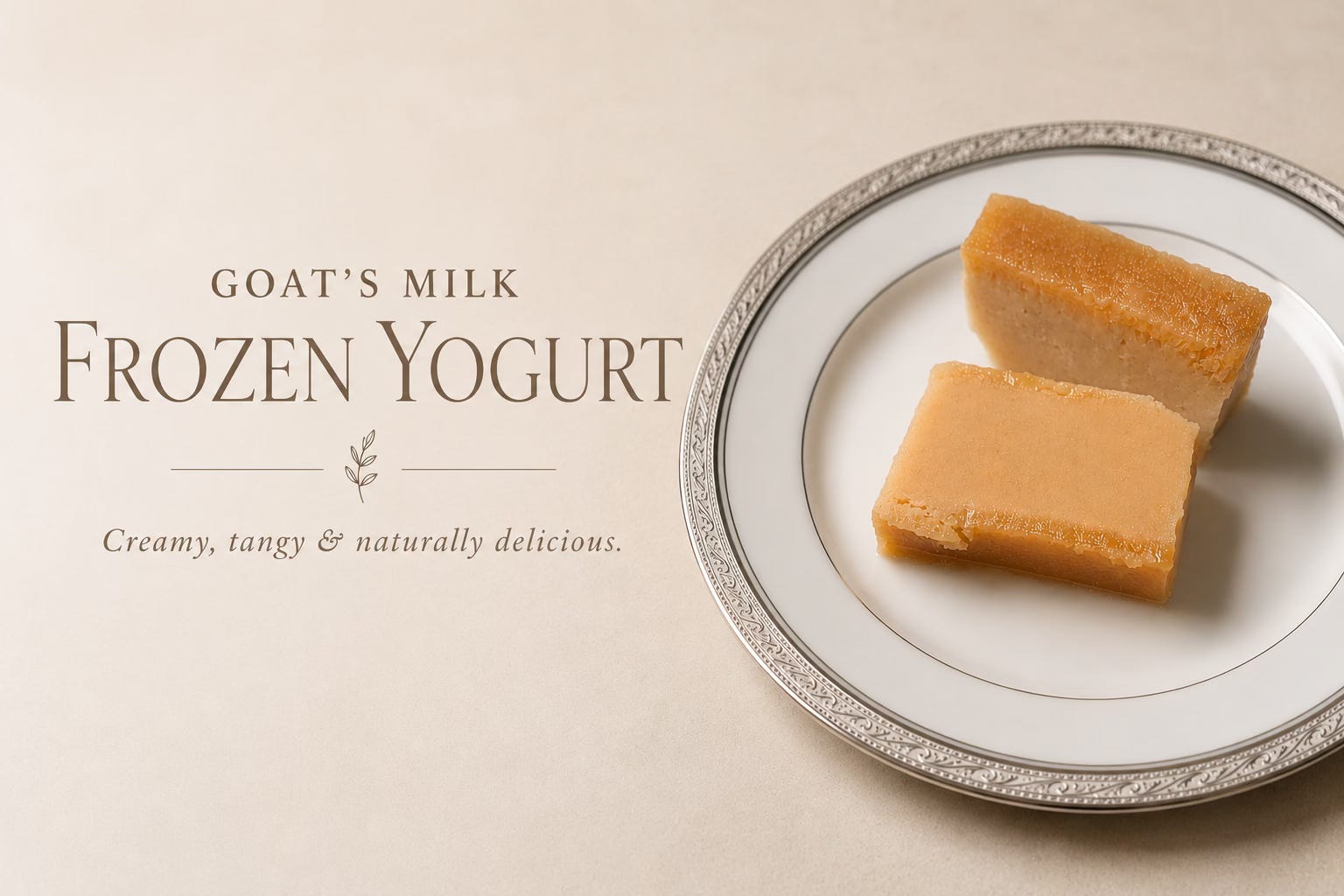
Baby It's Hot: Make Goats Milk Frozen Yogurt
Your goats milk yogurt is runny. He's the why and what to do with it.
You made goat milk yogurt. You opened the maker. It poured. Most people decide right there that they failed. They didn’t. Goat milk yogurt is supposed to be thin. What’s in the jar is chemistry, not error, and it happens to be the best possible start for a frozen dessert.
The runny is the milk, not you. Casein makes yogurt thick. It’s the protein that knits into a gel as the milk ferments, trapping water inside the network. Goat milk carries less alpha-s1 casein than cow milk does. Less of that protein means a looser net, and a looser net holds less water, so the yogurt stays soft. Fat does the rest. Goat milk fat globules are smaller and stay suspended through the milk. Good for digestion. Good for mouthfeel. Bad for structure. The gel never firms up the way cow milk’s does.
The fermentation itself runs like any other. Bacteria eat lactose, make lactic acid, the acid drops the pH, the proteins coagulate. In goat milk the matrix is just flimsier. It can’t hold the moisture. So whey weeps out and you get the pour. Temperature and time matter too. Culture too cool or pull it too early and the bacteria never make enough acid to set anything. But that’s not what’s happening here. Even done right, goat milk yogurt runs thinner than cow.
Making it is simple. Heat a quart of goat milk to 180°F, stirring so it doesn't scorch, then pull it off the heat and let it cool to 110°F. Whisk in 2 tablespoons of plain yogurt with live active cultures, or a culture packet per its directions. Cover it and hold it warm at around 110°F for 6 to 8 hours. A yogurt maker works. So does a warm oven with the light left on, since the bulb throws off just enough heat to hold the temperature (an incandescent bulb, not an LED, which stays cold). So does a cooler with a jar of hot water. Then refrigerate. It will still pour. That's the milk, not the method.
Or use the runny. Thin yogurt is a liability in a bowl with granola. It’s an asset in a churn. It blends without lumps, freezes smooth, and keeps the tang that goat milk does better than anything else in the dairy case. Add cream. Add peaches. You get a frozen yogurt loaf you slice instead of scoop. Creamy. Semi-sweet. Sharp at the finish, the way cultured goat milk always is.
Start with the peaches. Take 2 cups of fresh peaches, peeled and sliced, and combine them in a saucepan with 2 tablespoons of sugar and 1 tablespoon of water. Simmer over medium-low about 10 minutes, until the peaches soften and give up their juice but still hold some shape. Off the heat. Cool completely. Reserve ½ cup for the topping, then refrigerate all of it until cold.
For the base, whip the 1 cup of heavy cream to soft peaks first. Whipping beats air into it, and the air is what makes the finished loaf cut clean and feel creamier on the tongue. Then whisk 4 cups of goat milk yogurt smooth and fold the cream in gently, keeping as much of that air as you can. Fold in 1½ cups of the chilled peaches. Chill the whole mix one hour, then churn it in an ice cream maker per the manufacturer, 20 to 30 minutes, to soft-serve.
Line a standard loaf pan with parchment, leaving overhang on the long sides for a sling. Scrape the churned yogurt into the pan and smooth the top. Spoon the reserved ½ cup of peaches across the surface and let the juice swirl in on its own. Don’t stir. Freeze 2 to 4 hours, until firm. To serve, lift the loaf out by the sling, set it on a board, and slice with a sharp knife dipped in warm water between cuts. Slices, not scoops. It reads like a semifreddo. Peach on top, tangy cream underneath.
The math is simple. One part cream to four parts yogurt. The cream raises the fat, and fat gets in the way of ice crystals. Fewer crystals, smoother loaf. The peaches bring sugar, and sugar lowers the freezing point, which is what keeps the loaf sliceable instead of solid. The lactic acid from the fermentation brings the tang, the only thing standing between this and every other sweet frozen brick. The sharpness is the point.
The texture everyone tries to fix is the texture that makes this work. The runny yogurt was never broken. You just hadn’t added cream yet.