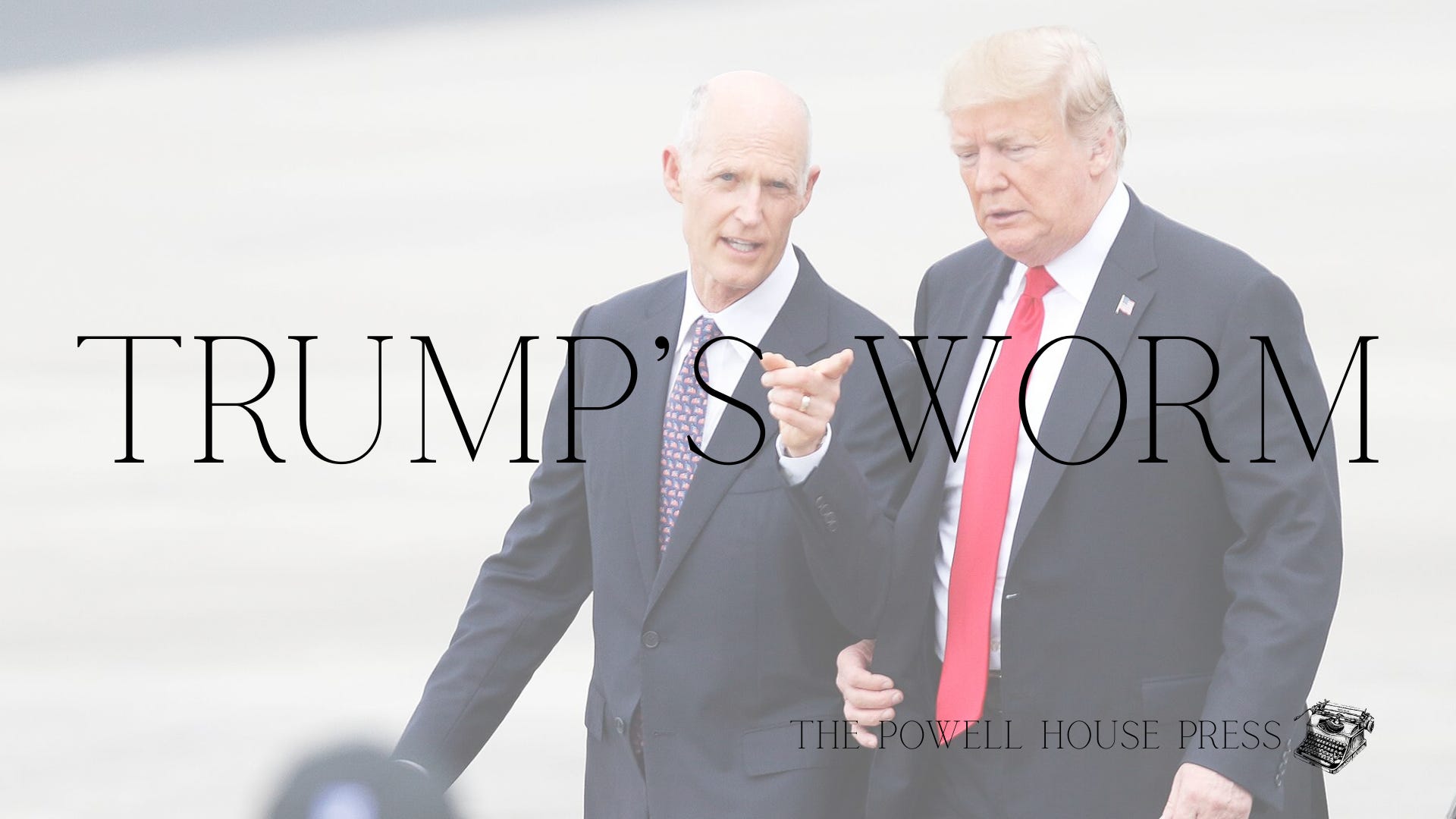
Before Ken Paxton, There was Rick Scott: Trump’s Comfort with Criminals isn’t New
Florida Senator and Trump fan is a case study in what is wrong with the the GOP
Rick Scott is the senior United States senator from Florida and one of Donald Trump’s most reliable allies in Congress. He is also the former chief executive of Columbia/HCA, a hospital company that pleaded guilty to 14 federal felonies and paid roughly $1.7 billion in fines for what was, at the time, the largest healthcare fraud case in American history.
The company admitted, in open court, to operating as a criminal enterprise during the years Rick Scott ran it. Scott was never charged. He resigned in July 1997 with approximately $10 million in cash, $300 million in stock, and a consulting agreement. He has spent the twenty-eight years since insisting he did not know.
This is the man. This is the through-line. Everything else in his political career is downstream of that posture: he was in charge of the thing, and he did not know about the thing, and the proceeds are still his, and the accountability belongs to someone else. It is a defense Donald Trump would later refine to its logical extreme. Scott got there first.
Scott was born in 1952 in Illinois and raised in modest circumstances. He served in the U.S. Navy, earned a business degree from the University of Missouri-Kansas City, and a law degree from Southern Methodist University. He practiced law in Dallas. In 1987 he co-founded Columbia Hospital Corporation with two hospitals in El Paso. In 1994 it merged with Hospital Corporation of America to form Columbia/HCA. By the mid-1990s it operated more than 340 hospitals, 135 surgery centers, and 550 home health locations across 37 states and two foreign countries. It was the largest for-profit hospital chain in the country and one of the most aggressive corporate growth stories of the decade.
It was also, as the federal government would later establish in court, breaking the law on an industrial scale.
On March 19, 1997, agents from the FBI, the IRS, and the Department of Health and Human Services served search warrants at Columbia/HCA facilities in El Paso. The raids were the culmination of years of whistleblower complaints from inside the company. By July they had expanded to multiple states. Federal investigators eventually documented a coordinated pattern of conduct including inflating diagnoses to extract higher Medicare reimbursements (upcoding), billing for medically unnecessary services, classifying marketing and lobbying expenses as patient care, paying physicians kickbacks for referrals, and submitting fraudulent home-health claims.
The board of directors forced Scott out on July 25, 1997. The departure was framed as voluntary. It was not. The same board that pushed him out paid him roughly $310 million on his way to the parking lot.
The criminal case against the company proceeded without him. In December 2000, Columbia/HCA, by then renamed HCA, pleaded guilty to 14 corporate felonies and paid $840 million in fines, penalties, and civil damages. In 2003 it paid another $881 million. The combined $1.7 billion was, the Department of Justice said, the largest healthcare fraud recovery in U.S. history at the time. Two whistleblowers split $100 million.
Scott was never criminally charged. He has said since that he was not aware of the fraud, that he opposed settling with the government, and that the board overruled him. He has produced no evidence for any of those claims beyond his own assertion.
Five months before the company’s guilty plea, on July 27, 2000, Scott sat for a sworn deposition at his offices in Stamford, Connecticut. The case was a civil contract dispute brought by Nevada Communications Corp. against Columbia/HCA. It had nothing on its face to do with Medicare. It was about a telecommunications agreement.
Scott invoked his Fifth Amendment right against self-incrimination 75 times.
His attorney, Steven Steinbach, explained on the record why. “Under normal circumstances Mr. Scott would be pleased to answer that question and other questions that you pose today. Unfortunately because of the pendency of a number of criminal investigations relating to Columbia around the country, he’s going to follow my advice, out of prudence, [and] assert his constitutional privilege against giving testimony against himself.”
The Fifth Amendment, as a matter of law, can only be invoked when a truthful answer might expose the witness to criminal prosecution. Scott’s lawyer was therefore informing opposing counsel, in writing, that truthful answers to ordinary questions in a contract case might tie his client to the criminal investigations of his former company.
Scott then declined to answer when asked whether he was currently employed. He declined to answer whether he was a current or former employee of Columbia/HCA. He declined a series of routine questions about the contract dispute itself. He declined to answer whether a separate lawsuit Columbia had filed against Florida Software Services had been designed to obscure Columbia’s improper billing practices.
The man who has spent more than two decades telling the public he knew nothing about the fraud at his own company would not, under oath, confirm that he had worked there.
After the resignation, Scott moved to Naples, Florida, and launched an investment firm. In 2001 he co-founded Solantic, a chain of urgent-care clinics, which he later sold. In 2009 he founded Conservatives for Patients’ Rights, a nonprofit that spent millions opposing the Affordable Care Act. The law expanded the federal healthcare programs his former company had been prosecuted for defrauding. Scott funded the opposition to it.
In 2010 he ran for governor of Florida as a Republican outsider. He spent more than $70 million of his own money. He won narrowly.
As governor he cut state spending. He reduced public health funding. He weakened environmental regulation, including water-quality enforcement that critics linked to subsequent algal bloom crises. He oversaw an aggressive purge of Florida’s voter rolls, which courts and federal officials partly blocked. On healthcare, he refused to expand Medicaid under the Affordable Care Act. The decision denied coverage to between 800,000 and one million low-income Floridians. The man whose company had defrauded Medicare on an industrial scale now turned down federal healthcare dollars for the working poor of his own state, citing concerns about federal overreach.
Scott was elected to the Senate in 2018, defeating incumbent Democrat Bill Nelson after a recount. He won reelection in 2024. It is in the Senate that the second lens of his career, his role as a Trump loyalist, has come into full focus.
Scott voted against certifying Pennsylvania’s electoral votes on January 6, 2021. He defended Trump through both impeachments. In 2024 he skipped Senate proceedings to attend Trump’s New York criminal trial as a show of support, and publicly compared his own legal history at Columbia/HCA to Trump’s prosecution, suggesting both were examples of overreach by the state. The comparison was instructive. Trump had just been convicted of 34 felonies. Scott’s former company had pleaded guilty to 14. The two men were, in Scott’s framing, fellow victims.
In February 2022, as chair of the National Republican Senatorial Committee, Scott released an 11-point “Plan to Rescue America.” Two provisions drew national attention. First, that all federal income earners (including the lowest-income Americans currently exempt) should pay some federal income tax. Second, that all federal legislation should sunset every five years and require reauthorization. The sunset language, as written, would have applied to Social Security, Medicare, and Medicaid. Scott initially defended it. After sustained criticism from his own party leadership, he amended the plan to exclude those programs. The original language had not. The instinct, once again, was to put Medicare on the table.
In November 2022, Scott challenged Mitch McConnell for Senate Republican leader. He lost 37 to 10. In November 2024, after Trump’s reelection, he ran again. He campaigned explicitly as the Trump candidate. Elon Musk endorsed him on X. He was knocked out in the first round of voting with 13 votes. John Thune won. Scott has continued, since, to position himself as Trump’s most loyal Senate operator: pushing the administration’s agenda on defense, on China, on Florida politics (he endorsed Trump-backed Byron Donalds for Florida governor in 2025), and on the broader project of restructuring the federal government to be smaller, more politically pliable, and more friendly to the men who run it.
The Trump-Scott affinity is not coincidence and it is not opportunism. It is recognition. Both men built their public personas as wealthy businessmen who survived major legal exposure by maintaining that whatever happened, they personally did not know about it. Both men converted their fortunes into political power. Both men describe the institutions that investigated them as corrupt, persecutory, and broken. Both men have, as policy, sought to weaken the federal capacity to investigate people like them.
Scott was Trump-aligned before Trump was a politician. He demonstrated the model. A businessman whose corporate empire functions as a criminal organization (per its own guilty plea), who keeps the proceeds, who reframes prosecutorial scrutiny as political harassment, and who then enters elected office to dismantle the systems that scrutinized him. Trump did not invent that template. He scaled it.
The criminal organization Scott ran is now, after various rebrandings, HCA Healthcare, the largest for-profit hospital chain in the United States, with revenues of more than $70 billion a year. It continues to be sued, audited, and investigated for billing practices. Scott continues to vote on Medicare policy. He sits on Senate committees that oversee federal healthcare spending and national defense procurement. He raises money. He gives interviews. He attacks government corruption with a straight face and a Trump endorsement in his pocket.
The throughline is not subtle. The man who ran a company that pleaded guilty to 14 felonies, who took the Fifth 75 times rather than confirm under oath that he worked there, who refused as governor to extend healthcare coverage to a million people in his own state, who proposed putting Medicare on a five-year expiration clock, is now one of the loudest voices in the Senate defending Donald Trump and helping to dismantle the federal architecture that enforces the laws people like them break.
He is not a marginal figure in the Trump coalition. He is one of its purest expressions
Why Your Support Matters
Independent journalism answers to readers—not advertisers, corporations, or access-hungry editors. No story gets killed because it upsets a sponsor. No punch gets pulled because someone important made a phone call.
Your support makes possible sharp commentary, fearless satire, and reporting that follows the story wherever it leads. In an era of manufactured narratives and algorithmic blandness, that independence isn’t a luxury—it’s a necessity.
Subscribe to The Powell House Press. Or settle for content that tells you what someone else wants you to hear.
©2026 All Rights Reserved | The Powell House Press | josh@thepowellhousepress.com.


I guess we differ on the defintion of "criminal". Perhaps because you might have some degree of CARB syndrome: https://carbsyndrome.com
No, I think it's a case study of why your opinions are so warped!