
Chatham and the Fine Art of Almost Informing the Public (be sure to read the update at the end of the article)
Last month the town promised to post agendas and all correspondence to the public prior to Town Board meeting. Who knew “prior” was so…nebulous.

Well, they tried. Or did they. It’s the eternal question in Chatham governance, isn’t it: the gesture toward openness, followed swiftly by the retreat into fog. That’s the entire issue behind Bashford Road. Not being in the know.
Last month Chatham’s own website makes the promise, in a reassuring bureaucratic prose: Agenda packets, it says, are made available to the public prior to Town Board meetings, intended to help residents stay informed about matters before the Board. A lovely sentiment. The kind you’d frame or needlepoint onto a pillow.
Except here we are, the morning of the meeting, and the packets are nowhere to be found. Not a whisper. One begins to wonder what “prior to” means in Chatham. An hour before the gavel drops? Like church bulletin you get as you walk into mass?
Correction Note: The incomplete packet was posted under “agenda” on the calendar at some point late in the day 7.15.26
There is something almost quaint about a town in 2026 unable to manage what any mid-size PTA handles without incident: getting an agenda into people’s hands 72 hours before a meeting that concerns their own community. Not exactly the Manhattan Project.
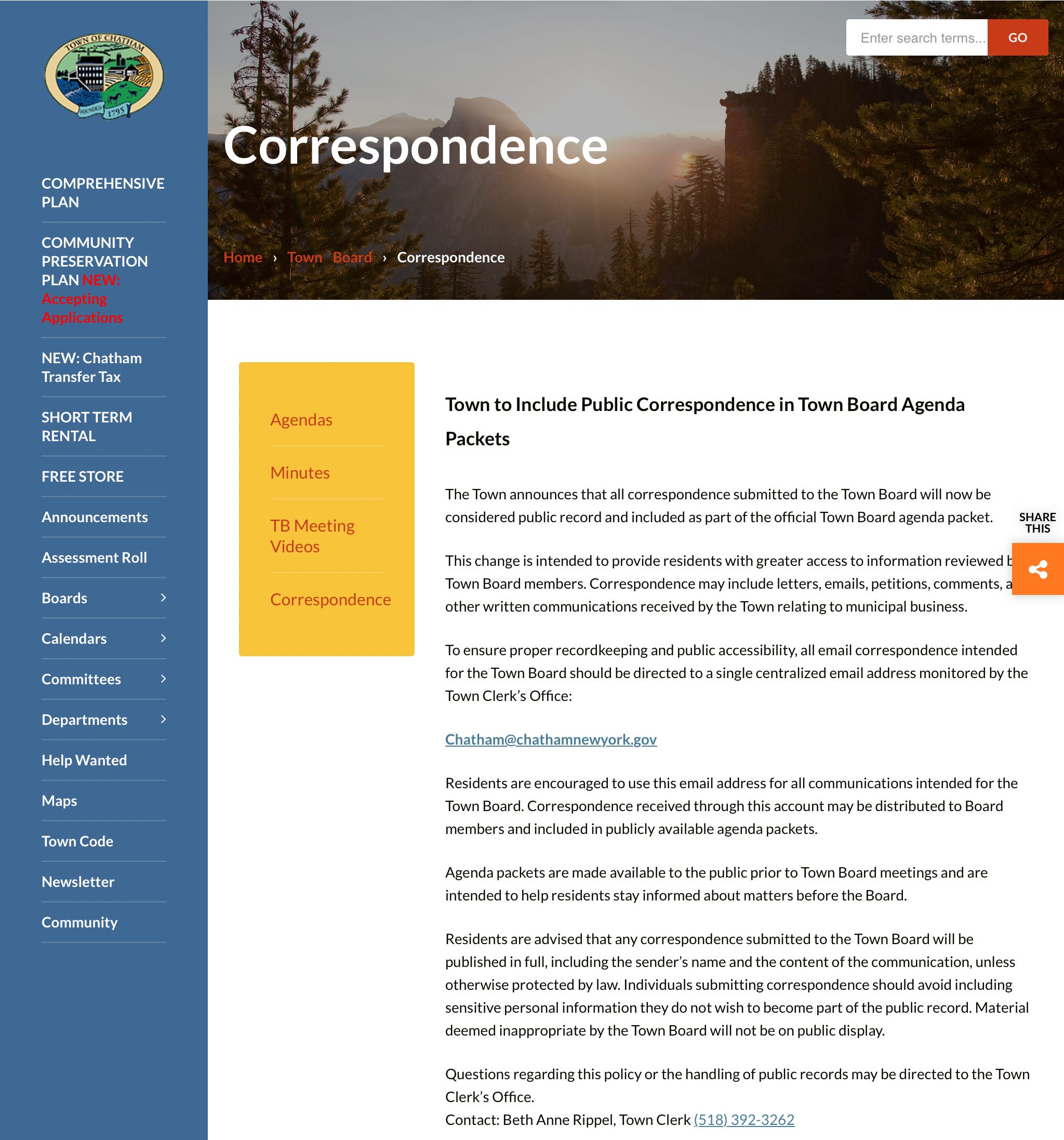
The whole point, the entire premise, was to let people know what’s coming so they could show up if it mattered to them. That was the policy. That was the pitch.
Meanwhile, people plan their dinners with more rigor than this Board plans its own disclosures. Which raises the real question: does the board actually want engagement, or does it merely want to have said it wanted engagement? I’ll note, not without a certain satisfaction, that more people read the Powell House Press than tune into these meetings, be it online or in person combined. That’s not apathy. That’s a market responding rationally to a product that isn’t being delivered. Would people go to the Crandell without knowing what playing?
There is no earthly reason the town couldn’t post its agenda and documents the Monday before. If something urgent arose later, fine, call it a “burning issues” addendum, post the update online as it happens. This isn’t complicated. It’s the sort of thing a reasonably competent office manager solves before lunch. Instead, the current approach functions less like a policy and more like a deterrent, a quiet, bureaucratic incentive toward non-attendance and disengagement.
You can wave the signs. You can post the memes about transparency. But sentiment without mechanism is just decoration, and decoration doesn’t get anyone to the meeting on time.
We are, in case anyone at the Town Hall has forgotten, living in an age of instant messaging, email, and the smartphone in every pocket. The idea that a public board cannot manage even 24 hours’ notice under these conditions isn’t merely inefficient. It’s a small, quiet insult. Unless, of course, the mimeograph machine is down.
At this point, smoke signals would be an upgrade. At least you could see them coming.
But sure. You tried. Soon it will be something like “my dog ate the agenda.”
A shock however it was not. Old habits are very hard to break. Especially the bad ones.
###
UPDATE 6:57AM 7.16.2026: The agenda was posted on the “calendar” at some point yesterday. The promised correspondence? Well, those were listed, not in full and the letters themselves also not provided. Missing? You guessed it. The letter I wrote asking questions about the supervisor’s role in 509 Bashford Road and what plans the board might have to demand more compliance and future transparency.
Selective transparency is the policy. It seems no matter what, the town will not address, as one resident wrote, the elephant in the room.
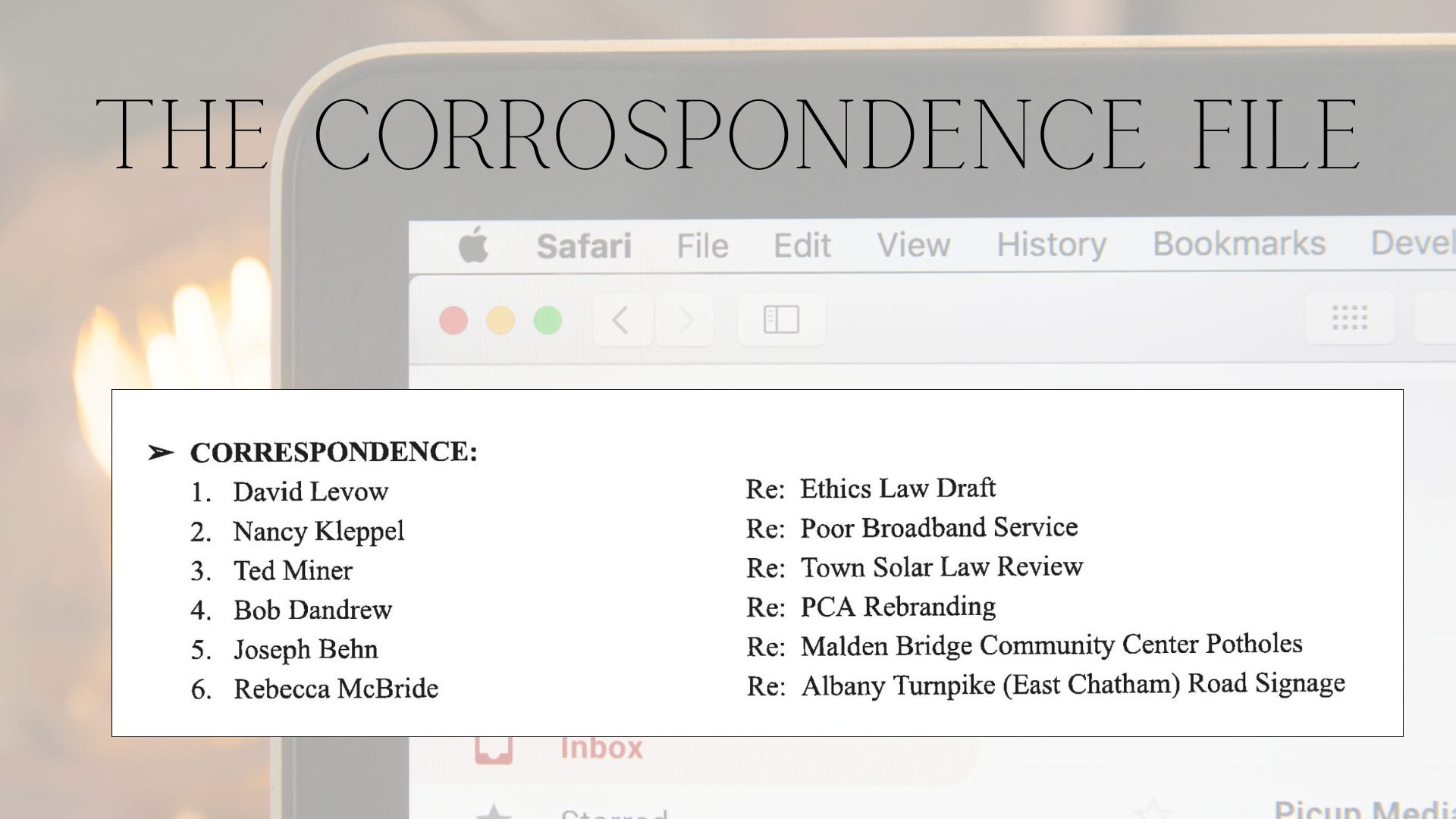
Makes a person wonder, what other emails did the town receive and decide not to make public?
If you missed it, there is the letter that I sent to the board:
THE POWELL HOUSE PRESS
July 9, 2026
Town of Chatham
Town Board
488 State Route 295
Chatham, NY 12037
Sent via email to Chatham@chathamnewyork.gov for inclusion in the public record
Re: 509 Bashford Road Tasting Room Application
Dear Town of Chatham:
I am writing on the record to the entire board. I have done this before and received no response concerning the proposed tasting room at 509 Bashford Road. I have asked these questions repeatedly. I am asking again now, under the town’s new policy of posting all correspondence publicly.
Some background on the level of public interest in this matter: the town has received 46 letters and a petition with 237 signatures, all opposing the project. There is no letter of support in the file, and none was supplied to me in the documents the town provided in response to my FOIL request.
I would ask the board to respond to the following questions:
1. Conflict of interest. In response to a FOIL request, it was discovered that John Wapner raised the issue of a conflict involving Mr. Collins related to his relationship with Dr. Williams in August 2025. This was raised well before the Williamses submitted their application to include their property in an Ag District (a decision made by the county Board of Supervisors, on which Mr. Collins sits). Mr. Collins did not address the conflict at that time. He has claimed, in the winter of 2026, that he recused himself. When, exactly, did that recusal occur, and where is the written record of it? Recusals must be on the record and in writing, and neither the town nor the county has produced one in response to two FOIL requests. How will the Town Board address this, and prevent future ethical lapses?
2. At the February 19, 2026 Town Board meeting, there was public outcry over the inclusion of 509 Bashford Road in an Agricultural District. The 303-b application cited Mr. Collins as the tenant farmer. Mr. Collins was also notified, as Chatham Town Supervisor, as required by law, that the Williamses were seeking this designation. This raises the following questions:
a. When a fellow board member asked why Mr. Collins had not reported this in his “County Report” at the previous board meeting, his reply was: “I didn’t have to.” This contradicts Town Board Resolution 72-24, in which the board explicitly required the Town Supervisor to report back on county business affecting the town. How will the board address this violation, and prevent similar ones going forward?
b. Mr. Collins claims he recused himself at the county level, which shows he knew about both the application and the conflict. The 303-b application contained representations that were not factual. Mr. Collins knows, for example, that there are no cattle at 509 Bashford Road. Why was this discrepancy not brought to the county’s attention? Is it appropriate for a luxury estate, with only a small fraction of its property used for hay and an even smaller fraction for grape production, to be included in a designated agricultural district?
c. Mr. Collins has himself acknowledged deficiencies in the county’s notice process. The county, however, did provide notice of this application to the town, as required by law. Knowing the community’s concern about this issue, and having himself acknowledged the flaws in the notice being used, why did Mr. Collins not share this development with his fellow board members and the community, given his awareness of the community’s concern about a commercial enterprise developing at 509 Bashford Road? What measures, if any, will the town take to notify its citizens of significant county-level changes affecting the town?
d. This issue goes back years. Another board member, Wapner, raised both the conflict and the public interest at stake as early as August 2025. Mr. Collins knew, said nothing, and let the application proceed in silence, only surfacing what he knew after the fact and only in response to public pressure. How does the board believe notice procedures need to change, and what does it intend to do about a supervisor who sat on information the community had every right to have?
3. The inclusion of the property in Agricultural District 10 now gives the property owners significant leverage to open their tasting room, a point the Williamses’ own lawyer raised in his appeal to the ZBA. How will the board respond if the Williamses go to Ag and Markets to bypass the ZBA?
4. Had this process gone through the proper channels, using for example the template set by Silver Bros. on Shaker Museum Road, it would have allowed for proper public comment and spared private citizens the cost of legal counsel. That cost is damage in itself. What steps will the town take to avoid matters like this in the future?
5. Related to question 4, pursuing the same project simultaneously through:
a. The Planning Board, without providing its required materials;
b. The building department; and
c. The county
in order to avoid legal and regulatory requirements resembles “segmentation,” which becomes a costly battle for the town. What safeguards will be put in place to prevent this in the future?
6. There is significant concern about the soil and environmental impact of this development. Vineyard operations are pesticide-intensive, and 509 Bashford Road sits on DEC-regulated wetlands. The process the Williamses used resulted in a SEQR review being waived, meaning no Environmental Assessment Form, no Negative Declaration, and no public environmental record was ever produced for this project. What are the board’s plans to protect public health and the water supply for neighboring residents on and around Bashford Road if this enterprise proceeds? It should be noted that the Planning Board itself raised this exact question and never received an answer, and the property has now been folded into an agricultural district, affording it those protections without ever undergoing SEQR review. What is the board’s plan to remedy this?
I look forward to the board’s response, on the record.
Respectfully,
Joshua Powell
The Powell House Press