Elon Musk’s Deadly Dismantling of Global Health
America’s decline seems to be bottomless
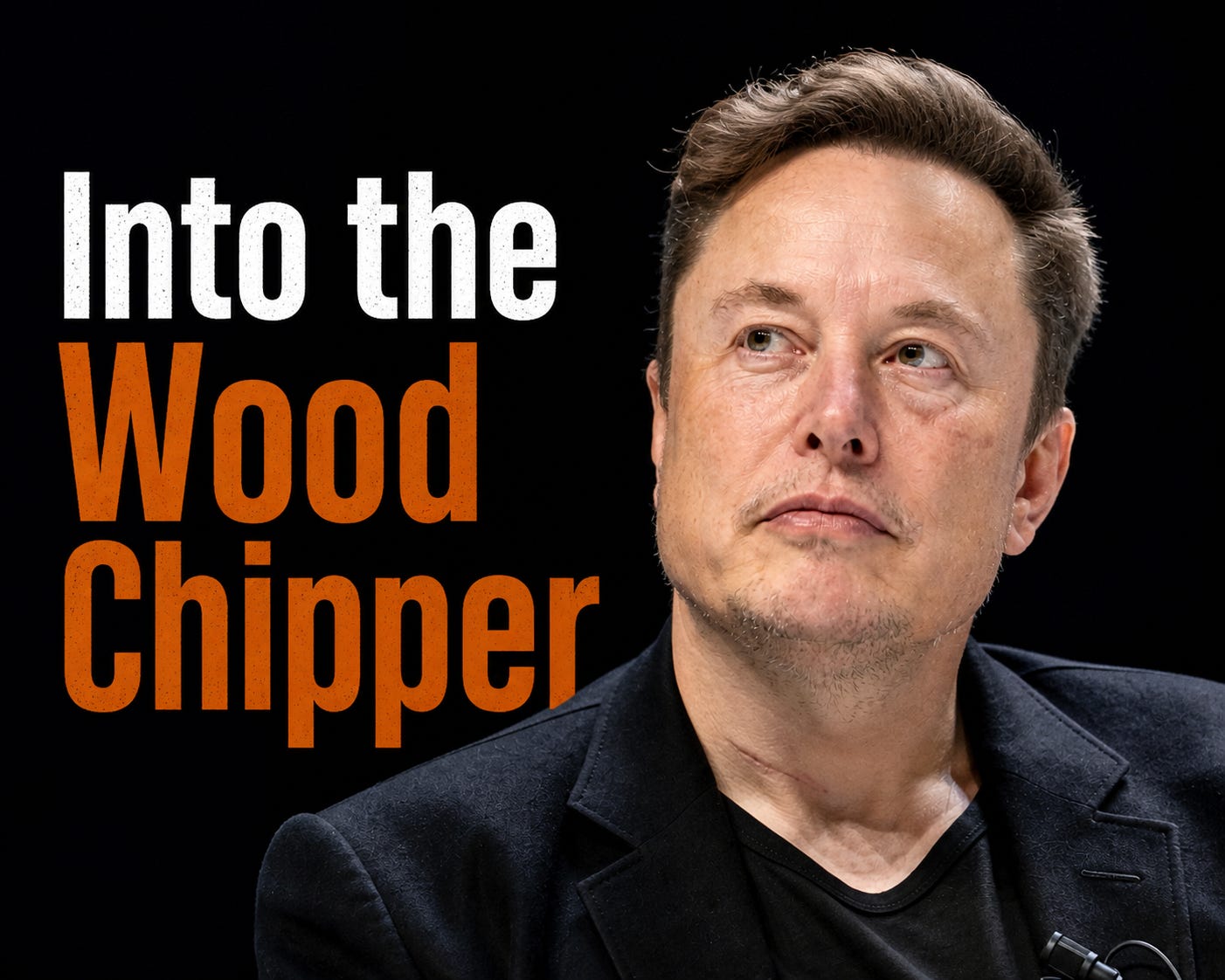
Why is it that when I am feeling at my lowest, and the past few days have been awful for me, I’m denied the one fucking thing that would help -- sleep. And in this unrelenting state of wake what do I do? I reach for Nicholas Enrich’s memoir Into the Wood Chipper. Because nothing reorders the gut quite like an inside account of the world’s richest man dismantling, over a single weekend, the U.S. agency that had been keeping the world’s poorest children alive.
The man is Elon Musk. He is also, by any sober reckoning, the most dangerous private citizen alive.
Not dangerous in the comic-book way. Not dangerous because he tweets too much, or builds rockets, or owns a social network. Dangerous because he has now demonstrated that an unelected billionaire with no relevant expertise and no oversight can shut down a sixty-year-old federal agency over a weekend, kill close to a million people in the doing, and walk away unscathed. Dangerous because he has shown the rest of them that it can be done.
Enrich had the front-row seat. Top global health official at USAID. Director of policy, programs and planning at the Bureau of Global Health. Acting assistant administrator by January 2025. Four administrations of unglamorous work: HIV prevention, malaria nets, malnutrition treatment, polio vaccines. His book takes its title from a tweet.
The tweet went up in the small hours of February 3, 2025. “We spent the weekend feeding USAID into the wood chipper,” Musk announced to his followers on X. He added that he could have gone to some great parties instead. He had not.
The agency he had just dismantled had, over the previous two decades, saved 92 million lives on a budget under one percent of federal spending. He did not know that. He had not asked. He preferred wood chipping.
Within a week of inauguration, sixty senior career officials were on administrative leave. The agency’s name was unscrewed from the Washington facade and photographed in a pile on the sidewalk. Within two months, 83 percent of USAID programs had been canceled. Ten thousand employees were gone or going. The political appointees Musk installed did not appear to know what the place did. The new chief of staff, Joel Borkert, told Enrich he had assumed USAID’s global health work was “just, you know, abortions.”
The actual programs included PEPFAR, George W. Bush’s signature AIDS initiative, credited with saving 26 million lives and enabling nearly 8 million babies to be born without HIV. Musk cut it. He later acknowledged a “little mistake” had been made and that they had fixed it. They had not. Lifesaving medicine sat in warehouses, expiring.
In Gaza Province, Mozambique, USAID had funded a hospital preventing HIV transmission from mothers to their infants. Musk killed the grant. He then announced publicly that the money had funded condoms for Gaza, the Palestinian territory, in the Middle East. It had not. It had funded a hospital in southern Africa. He never bothered to learn the difference. The babies remained infected.
Fourteen million unnecessary deaths projected over five years. Nearly a million already, mostly children. Enrich’s whistleblower memos, released in March 2025, went viral and were cited in a Supreme Court case on the legality of USAID’s dissolution. Enrich was placed on administrative leave for his trouble. The agency was not saved.
Bill Gates, who has spent the past quarter-century pouring his Microsoft fortune into the diseases USAID was fighting, summarized it for the Financial Times in May 2025. “The picture of the world’s richest man killing the world’s poorest children,” he said, was not a pretty one.
Musk responded from a stage at the Qatar Economic Forum in Doha. He called Gates a liar. He demanded that any aid group claiming to help children produce, in his phrase, a “show orphan.” None did. Musk took this as evidence of fraud, rather than as evidence that producing a dying child for billionaire inspection is not standard practice in international development.
He killed the children. Then he asked to see the bodies. When the bodies were not produced for him, he said the bodies did not exist.
A coda for the record.
Musk did not invent the electric car. He did not invent the lithium-ion battery, developed across decades of federally funded research. He did not found Tesla. Martin Eberhard and Marc Tarpenning founded Tesla in 2003. Musk arrived as an investor and elbowed his way to the title. The company survived its near-bankruptcy on a $465 million Department of Energy loan. SpaceX, which he did found, has billed NASA something north of $20 billion, on rockets descended from designs the U.S. government paid to perfect. PayPal was Peter Thiel and Max Levchin’s team. Twitter he bought. Starlink uses spectrum allocated by the FCC.
He invented none of it. He bought, branded, marketed, leveraged. The fortune that lets him kill children was built, dollar for dollar, on technologies produced by other people, much of it on the public dime.
It was a chilling read. The man belongs in a jail cell.
Why Your Subscription Matters
Independent journalism answers to readers—not advertisers, corporations, or access-hungry editors. No story gets killed because it upsets a sponsor. No punch gets pulled because someone important made a phone call.
Your support makes possible sharp commentary, fearless satire, and reporting that follows the story wherever it leads. In an era of manufactured narratives and algorithmic blandness, that independence isn’t a luxury—it’s a necessity.
Subscribe to The Powell House Press. Or settle for content that tells you what someone else wants you to hear.
©2026 All Rights Reserved | The Powell House Press | josh@thepowellhousepress.com