
Fusion Voting: How to Win an Unwinnable Election
Just ask Jeanne Veillette Bowerman, Chatham For All, and Connect Ghent: they know how to play the game.

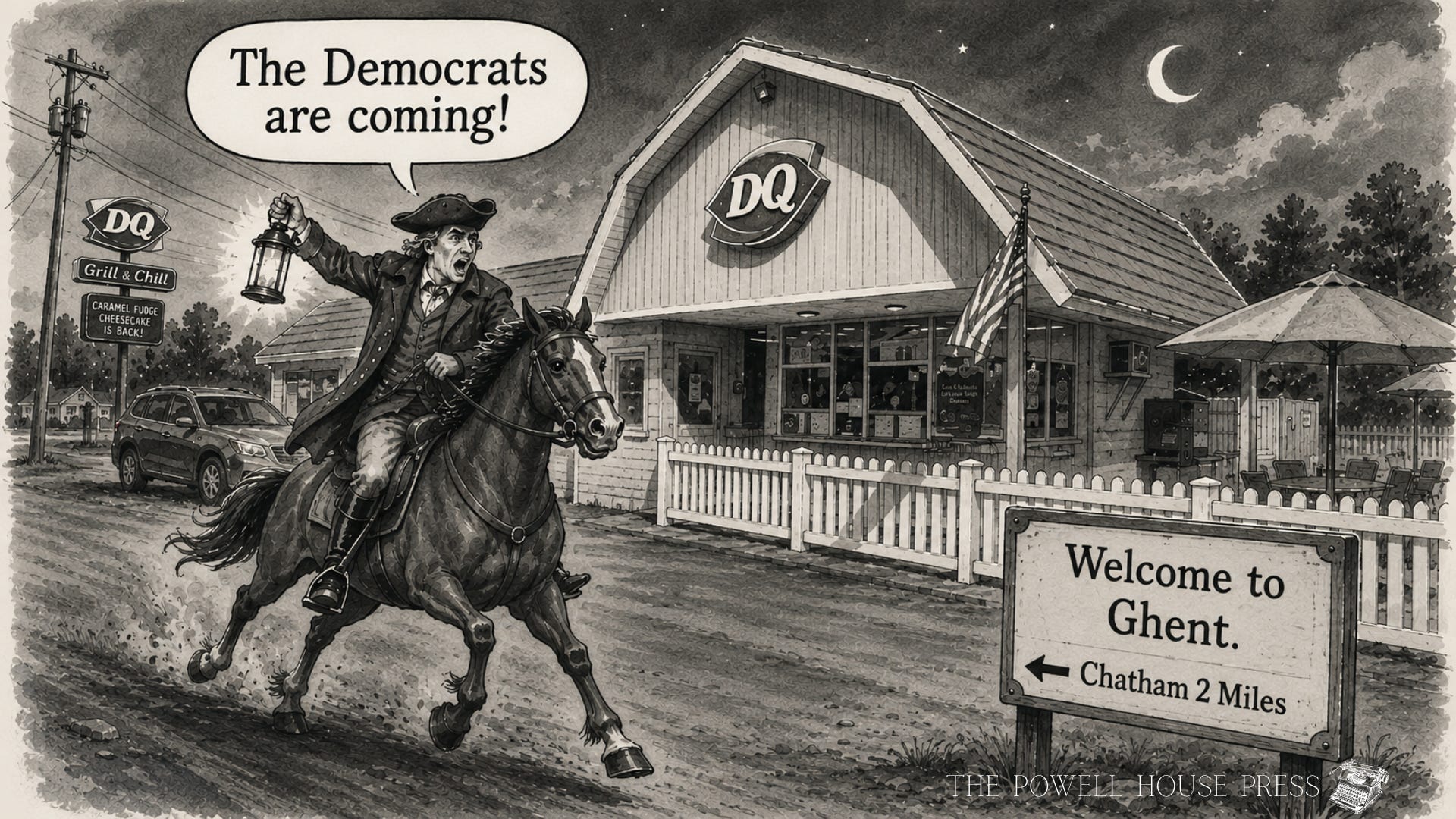
In New York’s Columbia County, the reliably red landscape has been turning purple, and the old Republican guard wants no part of it. Its answer is not to run better candidates or bring in new blood. The answer is on the ballot, dressed up as alternative, nonpartisan parties. Behind the new names and the more genteel branding sit the same candidates, backed by the same cast of small-town characters.
It is called fusion voting, and it lets a candidate appear on the ballot more than once. Same name, two rows, and the votes from both get added into one total. Only a handful of states still allow it, and only New York and Connecticut use it with any regularity. Usually it runs like this: a minor party nominates whoever the major party has already nominated. The Working Families Party lines up behind the Democrat, the Conservative Party behind the Republican. The candidate ends up holding two lines, and every vote on either one lands in the same pile.
Now and then that second line is what actually decides a race. Kennedy lost New York’s straight two-party count to Nixon in 1960 by better than twenty thousand votes and still took the state and its forty-five electoral votes, carried there by roughly four hundred thousand votes on the Liberal Party line. Pataki knocked off a three-term Mario Cuomo in 1994 running on the Republican and Conservative lines together. Three New York congressional seats went Republican in 2022 only once the Conservative Party’s votes were folded in.
A New America study went through every congressional race in the two states from 1976 to 2022. It found the bump is bigger for Republicans, about five points against something closer to two for Democrats, even though a fusion line actually changes who wins only about one race in forty. Why the edge favors the GOP is not hard to work out. A voter can like most of what a party is selling and still balk at the candidate over one thing. Abortion is an example. The second line, the one with the softer name, works as a permission slip. It gives the voter who leans right but cannot stomach that single issue a way to back the candidate without backing the party.
This is where the two local outfits come in. Chatham has Chatham For All. Ghent has Connect Ghent. Both talk a good game about people over politics and staying out of the national food fight, and both would like you to believe they are alternative between the major parties. They are not.
Chatham For All calls itself nonpartisan. The donor list says otherwise. Old Chatham attorney Carl Chiappa, its largest donor, has put $394,595 into Republican races since 2020. Donal Collins, the Republican Town Supervisor, took the group’s endorsement, and it helped him win by a sliver, just 35 votes. Donald Tubbs gives to outfits like Never Surrender, Inc., part of the Trump National Committee JFC, which includes the Republican National Committee. Michael Blasl has written checks to Chris Gibson and to WinRed. Frances Veillette, mother of Jeanne Veillette Bowerman, has bankrolled Trump, Tim Scott, WinRed, Mitch McConnell, and Texas Senator John Cornyn. Bowerman herself gave to WinRed, conveniently under her maiden name.
Chatham For All works hard to stay opaque and to keep its story straight. That alone makes Ms. Bowerman worth a closer look, along with her relationship to the group, not because she has done anything wrong, but as a case study in how groups like this and their players can manipulate a political landscape.
Bowerman is at every town hall meeting, and she is a staunch defender of Supervisor Collins. She came to his defense when he was caught with his pants down, so to speak, over an undisclosed business relationship with the owners of Fox Hill Estate and Vineyards. That one produced a run of articles, a case before the ZBA, and eventually Collins’s recusal. It is still not resolved. What is striking here is not just Collins’s blatant conflict, but how hard he was defended by Bowerman, a woman who calls herself a nonpartisan independent. That pose is the leverage these third parties have. That it is a false flag rarely gets said out loud, and when you do say it, get ready for a tar and feathering.
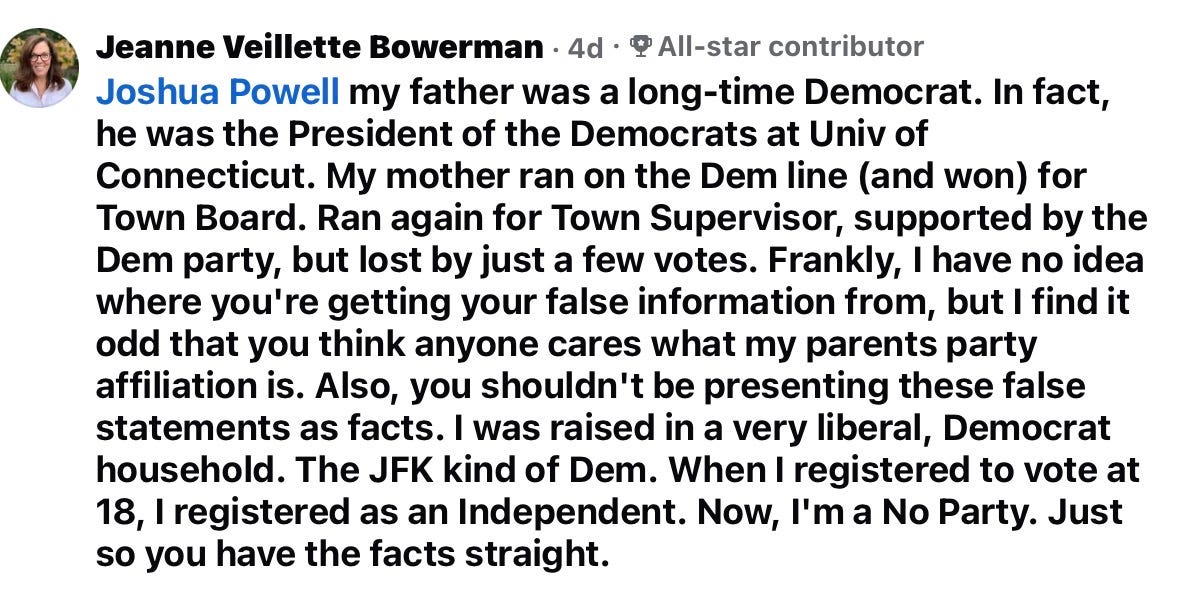
Last week, in my article The Scammers, I laid out the origins of Chatham For All, and it was discussed on Facebook. In that thread I detailed the political pedigree of Bowerman’s family, because another reader brought it up. What came out was how far she will go to mislead people about her family’s involvement in Republican politics. I had said her mother was once a democrat (she is also active in Chatham politics) and her father was a republican.
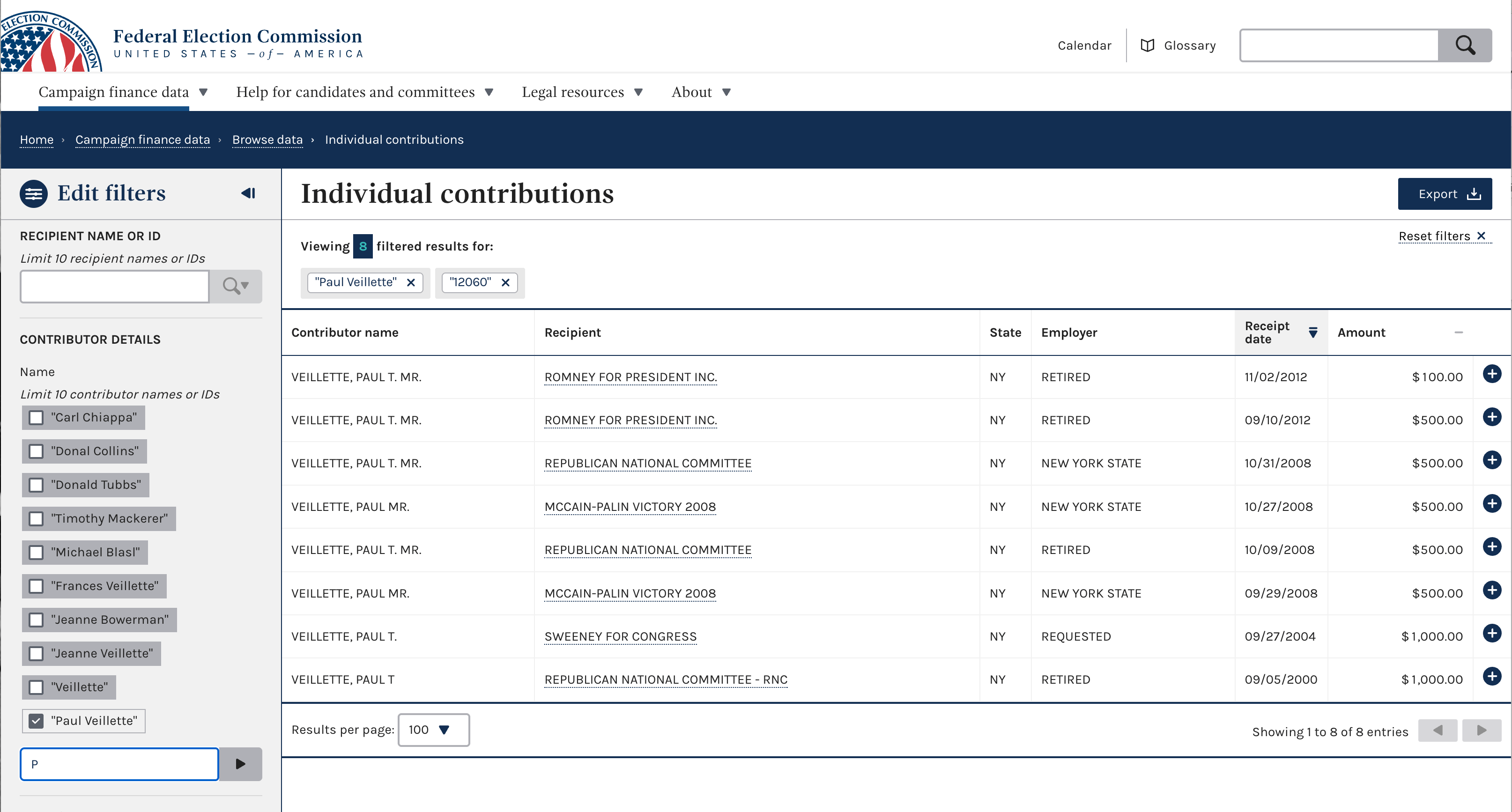
Out came the familiar bark that I didn’t know my facts. Her mother ran as a Democrat, she said. Her father was a lifelong Democrat. Proof, she offered, of a left-leaning, bipartisan home. Call it a lie, or, more precisely, not the whole story. Her mother’s money went to the Republicans named above. Her father’s did too. Paul Veillette put his money where his politics were, and for decades that was solidly Republican.
This is Chatham For All in practice, and Bowerman’s claims are the whole trick. You dress your politics up as something they are not. It buys a moderate sheen and not much else. When a self-styled moderate like Bowerman votes for a candidate like Donal Collins, nobody reads it as partisan. They read it as sensible, which is exactly what it is meant to look like. This is Chatham For All.
Down Route 66, Ghent runs its own shadow Republican party, Connect Ghent, with the same aw-shucks billing: “a nonpartisan community organization.” Different pig, same shade of lipstick. Its itemized donors read like a roll call of the Columbia County GOP, county supervisors Matt Murel and Holly Tanner among them, plus a scattering of other Republicans. It backed Deputy Town Supervisor Dan Barufaldi. The group’s website is all fluff and no policy. Three posts, total. Two carry no byline: a limp piece on nonpartisan local politics and a meditation on a storm and the value of leaning on one another. The third has a name on it, Mrs. Barufaldi, Dan’s wife. That is where it gets interesting.
Her post is a letter throwing Connect Ghent’s weight behind Marie Meltz, a political newcomer, for the Ghent Town Board in November’s special election. Meltz reached the board by appointment, after Lynda Nielsen left her seat before the term was up. The appointment is strange. Meltz had never shown any interest in politics. Never sat on a committee. She and her husband own businesses in Ghent and Hudson, and she reads as republican lite, moderate. All good, right? Not really. Another woman wanted the seat: Penny Coulson-Sanchez. She is a democrat. While it is hard to pin down what party Mrs. Meltz identifies with, her contribution history clears up any ambiguity.
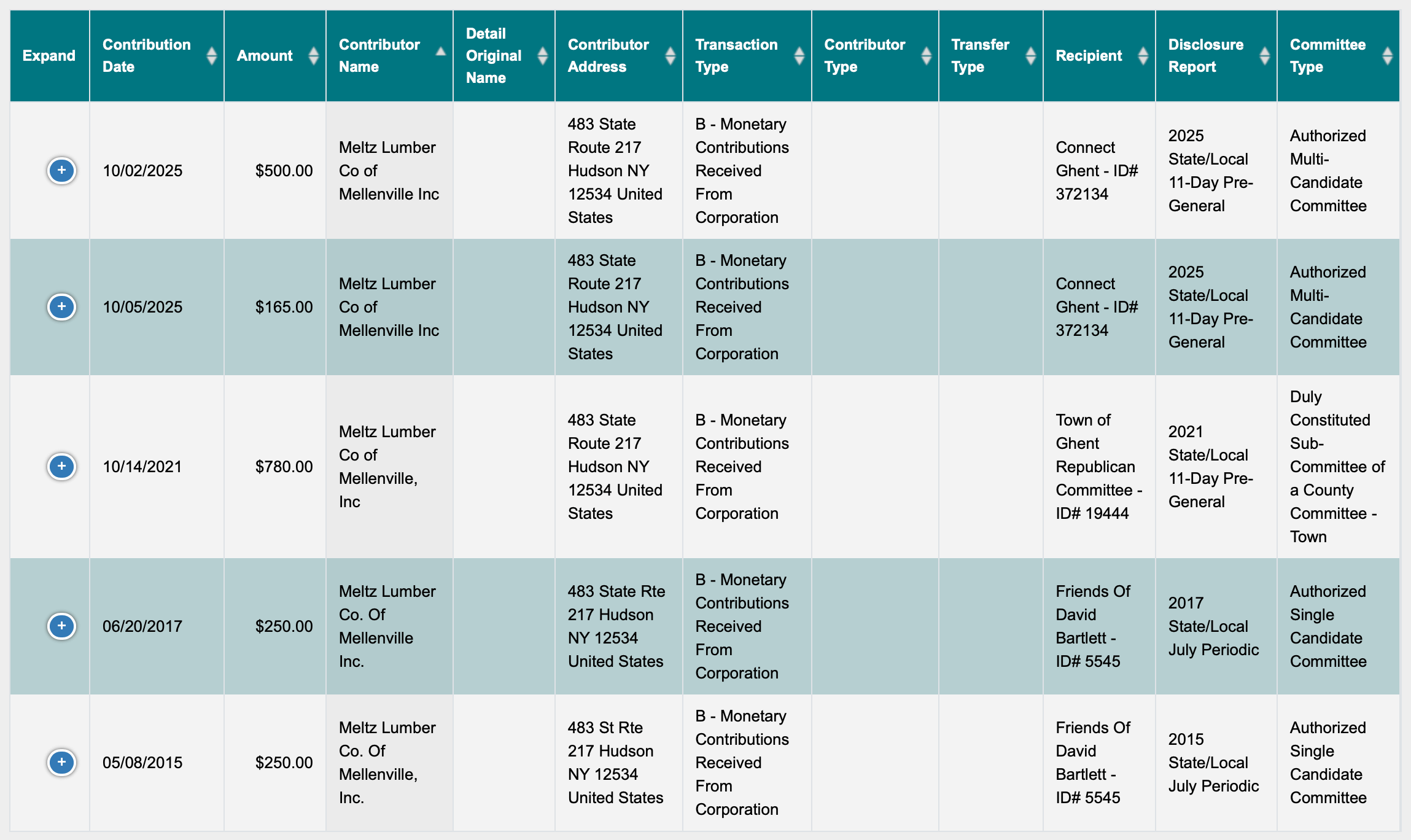
Fred Hutchison spoke up for her. So did Beth Lenahan, Nancy Straus, Leslie Korda, Eddie Allen, Barbara Peduzzi, Peter Stern, David O’Connor, and others. The minutes count twenty letters of support for Sanchez. The stronger case might be this: Coulson-Sanchez had actually run for a town board seat before and lost to fellow Democrat Carl Quinn, but she still had broad support, the kind you can measure. Meltz’s support could not be measured at all. She is a Republican, though, so it made more sense to hand her the vacant seat and set her up as an incumbent before the special election this fall.
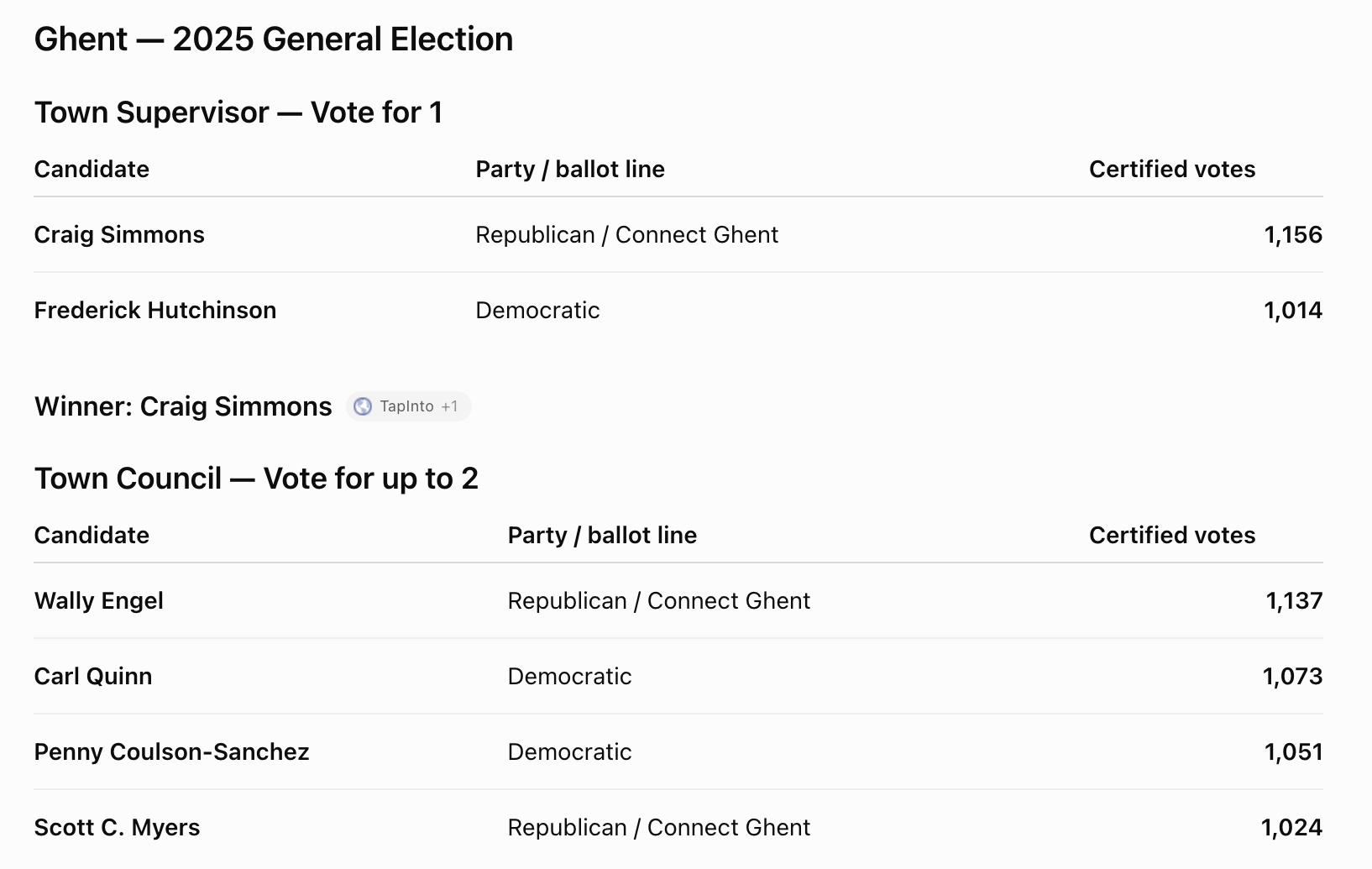
Both groups strike the same fanciful, above-it-all pose. Both are rooted in GOP politics and back only Republican candidates. And both deny being levers of the Republican machine, much the way Jeanne Bowerman denies her parents were Republicans. It’s a good trick, as long as nobody checks.
If Chatham For All or Connect Ghent had anything new to offer, a true political agenda or platform, they’d make sense. But these groups don’t have a slate of candidates. They advance only one brand of leadership (GOP), and they do get Republican candidates into office.
These groups also tell us something else. The Republican Party might just be losing its stranglehold in Columbia County. Carl Quinn won his election in Ghent, and the Democrats in Chatham now have a majority on the town board.
If you ask me, these groups are broadcasting more than their fake independent messaging. They are showing the community that they are desperate to shed the radioactive identity of being a Republican.
In other Columbia County news there is something “fishy” happening in Greenport. Check out the new publication The Greenport Perimeter.

©2026 All Rights Reserved | The Powell House Press | josh@thepowellhousepress.com
I never knew there was a Diary Queen there.