Hey Mike, Are You There? It’s Me, Jesus.
How Speaker Johnson prays away his constitutional responsibilities
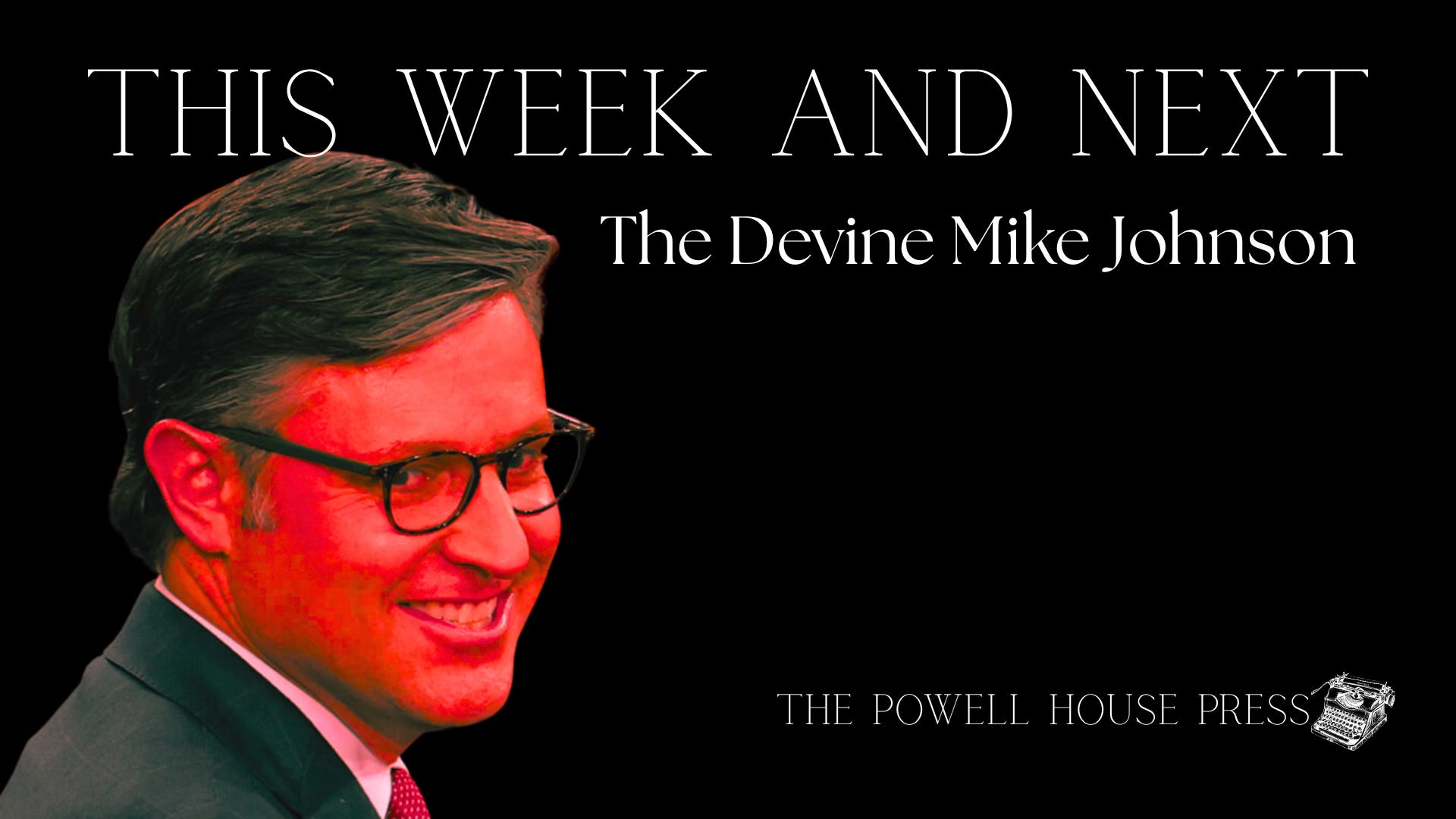
Speaker Mike Johnson. Look past the dewy skin. The practiced smile. The soft piety wrapped in the adolescent confidence of a high school boy who just got a hand job behind the bleachers in the shadow of Friday night lights. For a while, you want to wave it off. Let him have his moment. The assumption is that time will do what it always does, reduce him to what he is: another forgettable congressman from a forgettable district, dressed up in Warby Parker frames and a Jos. A. Bank suit, playing statesman in a city full of them.
It’s not that simple. He has enabled the United States into an undeclared war. He has the power to do something about it. He won’t. Understanding why is the story. It is a terrifying peek behind the curtain.
Johnson isn’t just a type. He’s a concentration of several troubling ones. He represents a particular strain of American public life where religion gets reshaped into something rigid and punitive, where the Constitution becomes a prop rather than a framework, and where the responsibilities of office run a very distant second to personal ideology. Washington has seen true believers before. It has rarely handed one the gavel.
From a distance, his personal life presents as orderly. Almost golden. Up close, it feels plated. Too smooth, too curated, ultimately fragile. Scratch it and the base metal shows through. It’s not what it seems.
The same applies to his family life, which reads as either paradox or outright contradiction, depending on the day.
Take the now-public arrangement between Johnson and his teenage son: an “accountability” app monitoring pornography use. On its face, moral discipline. Step back, and it’s hard to ignore how strange it is. Adolescence is precisely the period when privacy and autonomy begin to matter, when curiosity about bodies and sexuality is both normal and developmentally essential. Every serious clinician will tell you so. Johnson, apparently, does not consult serious clinicians.
This is not an argument that pornography is harmless. It isn’t. But in a world where young people are navigating substance use, mental health crises, and social collapse, this level of surveillance focused with such intensity on one aspect of a teenager’s private life reveals something about the surveyor as much as the surveilled.
More unsettling is that Johnson chose to make it public. What might have stayed inside the house became something else entirely. A disclosure that exposed his son to scrutiny during one of the most sensitive phases of development. That decision says as much as the monitoring itself. It is the act of a man who has confused righteousness with performance for so long he no longer knows the difference.
There is something worth naming here. A household that monitors a teenager’s pornography use, runs a counseling practice that catalogs sexual sin in forensic detail, and produces operating agreements grouping gay people alongside those who abuse animals — that household is thinking about sex constantly. Categorizing it, documenting it, watching for it. The preoccupation is total. At some point the surveillance becomes its own kind of fixation, and the distance between the monitor and the monitored gets hard to measure. A horny teenager, at least, isn’t charging by the hour.
Arrangements like that don’t emerge in isolation. They reflect a worldview that shapes not just parenting, but marriage, work, and identity. In Johnson’s case, that worldview is a total system, and it reaches into every corner of life. Nowhere is that more visible than in the professional path of his wife.
Kelly Renee Lary Johnson began as a schoolteacher, earning a degree in elementary education from Louisiana Tech University before shifting into counseling. She later operated a faith-based practice, Onward Christian Counseling Services, offering guidance to individuals, couples, and families through a “biblically based” model incorporating temperament theory common in certain Christian counseling circles. It sounds credentialed. It sounds clinical. It is neither.
Her titles, “Licensed Pastoral Counselor” and “Certified Temperament Counselor,” come from the National Christian Counselors Association. These are religious certifications. Not state-issued mental health licenses. The distinction is not semantic. It is everything.
Legally, that places her work in the category of pastoral or ministerial counseling, not regulated clinical practice. She is permitted to offer faith-based guidance. She is not licensed as a psychologist or professional counselor under state law. Her services are not subject to the standards, oversight, or scope-of-practice requirements that govern licensed mental health professionals. A person in genuine crisis, sitting across from Kelly Johnson, has fewer legal protections than they would at a licensed therapist’s office. That is not an accident. It the money-making plan. All cash and no training.
That gap between the language of counseling and the reality of its regulation becomes more concerning when paired with the beliefs informing the practice. On her business’s website, a 2017 operating agreement groups homosexuality, bisexuality, and transgender identity alongside bestiality and incest as sinful and offensive to God, while staking out a hardline position on life beginning at conception.
Within that framework, the impulse to monitor and control behavior, especially sexual behavior, makes perfect sense. If the boundaries are that narrow, the perceived risk of deviation becomes enormous. Everything becomes a threat. Everyone becomes a candidate for correction.
When those beliefs are paired with the language of counseling and offered to the public for a fee, the potential for harm is not theoretical. The presentation suggests clinical authority. The foundation is explicitly doctrinal. That is a dangerous combination.
The pattern doesn’t stop at home.
Before politics, Johnson built his legal career around religious liberty advocacy. He worked with the Alliance Defending Freedom as both attorney and spokesperson, focusing on First Amendment claims tied to the free exercise of religion. His work touched on abortion, marriage law, and public religious expression, including involvement in defending Louisiana’s 2004 constitutional amendment defining marriage. He later founded Freedom Guard, continuing as chief counsel, representing individuals and religious organizations in disputes with government entities. Much of this practice centered on conscience objections, public religious expression, and conflicts arising in the wake of Obergefell v. Hodges. His work also included litigation connected to the Ark Encounter project, particularly around tax treatment. They didn’t want to pay.
Framed one way, this is constitutional law. Framed honestly, it is a highly selective interpretation of it, one that consistently elevates a specific religious viewpoint while colliding with the civil rights of others.
That same impulse, to formalize belief into structure, shows up even more clearly in Johnson’s attempt to build a law school.
Around 2010, he was selected as founding dean of a proposed law school at Louisiana College. The goal was a Christian law school grounded in a biblical worldview, training attorneys to approach the Constitution and public policy through explicitly religious principles. The ambition was not small. The execution was catastrophic.
The project ran into immediate structural problems. Louisiana College was experiencing internal governance disputes, leadership instability, and conflicts between trustees and faculty. The law school failed to secure accreditation, struggled with fundraising, and could not demonstrate the financial stability required to move forward. The situation deteriorated further amid allegations of financial mismanagement, leading to lawsuits and deeper institutional fracture. Johnson resigned as founding dean in 2012. No students. No accreditation. No program.
In another career, that kind of failure might have been definitive. Here, it became a pivot point. The faithful are nothing if not resilient.
Between 2012 and his election to Congress in 2016, Johnson returned to legal advocacy with Freedom Guard, maintaining ties to the Alliance Defending Freedom. His focus remained consistent. Then something else took shape: a rebrand.
Johnson began presenting himself more broadly as a “constitutional lawyer.” A label that carries neutrality and authority. In practice, his work remained anything but neutral. His legal efforts repeatedly sought to embed a particular religious framework into public law, often under the banner of freedom, with the consistent effect of narrowing it for others. He borrowed the vocabulary of the Founders and filled it with theology. Nobody much noticed.
The tension between how the work is described and what it does runs through his entire career.
It also surfaces in how he presents himself publicly. In an interview with Katie Miller, Johnson and his wife offer a glimpse into their dynamic. Sitting together, Kelly Johnson appears composed and firmly rooted in the same ideological framework that defines their professional lives. At one point, she compares the male brain to spaghetti. Johnson nods along, whether out of agreement or habit is unclear. The roles are settled. The script is familiar. The worldview is intact. It has all the warmth of a corporate training video and all the flexibility of concrete.
The personal, the professional, and the ideological all point in the same direction. Mike and Kelly Johnson have built a shared project, one that merges faith, authority, and public life into a single, tightly controlled paradigm paved with money. It is, in its way, impressive. It is also, in its way, terrifying.
The framework’s danger is what it does to truth. It allows falsehoods to be enshrined as fact. It serves a lawyer well when the laws answer to a higher authority than the courts. When the ultimate judge communicates legal interpretations through tongues and prayer rather than decisions and precedent. The complexities of the human mind and its pathos become devils and hobgoblins, not problems rooted in trauma and neuroscience. It is a binary world. Men, then women. A separate but almost equal paradigm where the friction it causes in the real world is simply prayed away.
It is a world with an artificial truth. This is the take-home.
Mike Johnson’s relationship with the truth is non-existent. The man created the “America First Award” and handed it to a president who has made billions off the office itself. He stood there with a garish gold-plated eagle while American troops deployed across the globe without a congressional declaration of war. A declaration that is his constitutional responsibility to bring to the floor. Instead he smiled for the camera and tossed a golden statue to his false god.
In a strange way it all makes sense. Jesus didn’t write the Constitution, so why should Mike have to play by those pagan rules?
In his twisted reality the United States is not at war. Trump is not getting rich. And he is a patriot.
This is who Mike Johnson sees in the mirror. Funny, I see a zealot in the Speaker’s chair.
Why Your Subscription Matters
Independent journalism answers to readers—not advertisers, corporations, or access-hungry editors. No story gets killed because it upsets a sponsor. No punch gets pulled because someone important made a phone call.
Your support makes possible sharp commentary, fearless satire, and reporting that follows the story wherever it leads. In an era of manufactured narratives and algorithmic blandness, that independence isn’t a luxury—it’s a necessity.
Subscribe to The Powell House Press. Or settle for content that tells you what someone else wants you to hear.
©2026 All Rights Reserved | The Powell House Press