JD Vance: The Devil in a Blue Dress Suit
The Convert Who Corrected the Pope
Take a moment — just one — to sit with the sheer, uncut audacity of it.
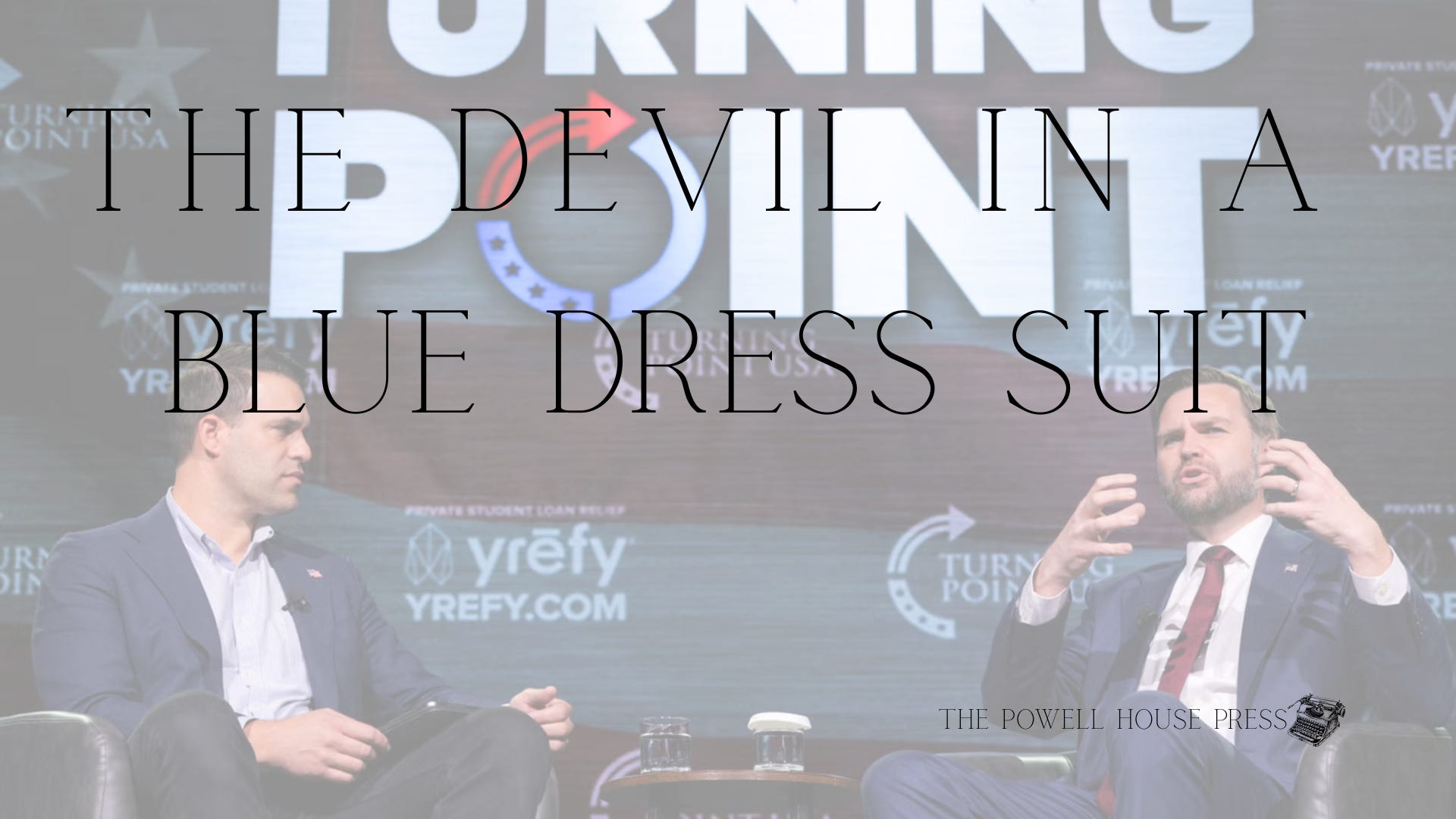
JD Vance, a man who discovered Catholicism roughly when he discovered that Catholicism polled well, who has apparently catalogued his conversion somewhere between “talking points” and “forthcoming memoir,” stood before a Turning Point USA crowd in Athens, Georgia and informed the Holy Father that his theology needed work. The Pope. The actual Pope. Corrected. By JD Vance. Out loud. Into a microphone. Before an audience. I am nearly too stunned to be scathing. Nearly.
The timing is what elevates this from ordinary political stupidity to something more terrifying. Donald Trump had just spent a weekend calling Pope Leo XIV, the first American-born pontiff in the two-thousand-year history of the Catholic Church, “weak on crime” and “terrible for foreign policy.” The global blowback was not merely bad. It was the kind of catastrophic, wall-to-wall, cross-partisan condemnation that makes presidential advisors drink at their desks. Faithful Catholics, European governments, people who hadn’t thought about the Vatican since their First Communion were unanimous in their disgust. Any aide with a functioning survival instinct would have pulled Vance aside and said: JD, whatever you do this week, do not walk into a rally and relitigate the Pope. Vance, apparently, does not have aides with functioning survival instincts. Or he does not listen to them. The result is identical.
The deeper problem is theological, in its way. There exists a particular species of new convert who arrives at faith the way certain people discover intermittent fasting: loudly, completely, and with an evangelical certainty that they now understand something the rest of us have been getting wrong. They confuse the intensity of their arrival with the depth of their comprehension. Vance is this person. His Catholicism is not a private conviction quietly held. It is a credential, a cudgel, a brand extension. I converted, therefore I may grade the Pope’s doctrinal accuracy. By this logic, every bewildered six-year-old who survived First Communion in South Boston is qualified to edit the Catechism. The Pope, to his considerable credit, does not appear to have been briefed on Vance’s theological authority.
What Vance actually said, delivered with the serene self-regard of a man who has never once suspected he might be wrong, was that the Pope needed to be “careful” when speaking about theology, in precisely the same way that Vance is “careful” when speaking about public policy. He said this. Straight-faced. At a Turning Point event. While his publicist was unboxing copies of his book about his profound Catholic faith. Pope Leo XIV, for his part, had already informed the press that he had “no fear of the Trump administration.” His Holiness was almost certainly not thinking of JD Vance specifically when he said so. The Vice President almost certainly did not notice.
And yet to leave it at tone-deafness is to let Vance off far too easily. What this performance reveals is not a gaffe. It is a structural absence at the center of a man who wishes to lead. Self-preservation is not a character flaw in politics. It is a prerequisite for competence. The politicians who accumulate genuine power, who survive long enough to matter, who are still in the room when the decisions that actually shape history get made, share one essential quality: they know when to shut up. They read rooms. They calculate odds. The Machiavellis and the Kissingers, whatever their crimes, understood with absolute clarity that you do not lose a fight badly on a Friday and then volunteer to lose it again the following Tuesday. Vance appears constitutionally unable to grasp this. The mechanism is not dormant. It is absent.
Consider what the record actually shows. This is a man who insulted the childless in a country where the childless vote, and then expressed surprise at the consequences. Who reached for Nazi analogies in immigration debates as a default rhetorical tic, not once but habitually, as if the Overton window were a toy he was entitled to move at will. Who now, having watched his boss spend seventy-two hours being incinerated on the world stage for attacking the leader of his own professed faith, walked directly into the flames and announced solidarity. This is not courage. Courage implies a calculation made and accepted. This is something more alarming: a man who genuinely does not process what is happening around him.
Because the conclusion that Vance’s career forces upon us is one that democratic politics finds genuinely uncomfortable to state plainly: self-awareness is not incidental to leadership. It is leadership. The ability to understand how your actions land, what they cost, who they alienate, when you are winning and when you are bleeding, is not a supplementary management skill you can outsource to a chief of staff. It is the operating system. Without it, you do not govern. You perform. And Vance’s performance has exactly one audience. Donald Trump watched the Athens speech with the detached satisfaction of a man who dispatched a subordinate into sniper range to confirm the snipers were loaded. They were. They always are. And Vance, loyal to the point of self-erasure, eager to the point of oblivion, marched straight into them.
The moment that will outlast everything else came near the end, when a voice from the crowd shouted that Jesus Christ does not support genocide. Vance agreed. Calmly. Reflexively. As if ratifying a point of arithmetic. The man who had spent the previous twenty minutes correcting the Pope’s theology nodded along, apparently without registering the canyon that had just opened under his feet, to the proposition that Jesus Christ does not support genocide. Then he moved on. No pause. No recognition. No apparent awareness that the heckler had just dismantled the evening’s entire ideological premise in nine words and Vance had handed him the key.
That is the thing about JD Vance that is genuinely, not rhetorically, dangerous. Not the individual blunder. Not the tin ear. Not even the bottomless appetite for humiliation in service of a man who treats loyalty as a stress test. It is the pattern. The inability to learn. The forward motion of someone who has mistaken momentum for judgment, performance for governance, and a book advance for a conscience. A person without self-awareness cannot correct course. A person who cannot correct course cannot lead. And a person who cannot lead but nevertheless occupies the second-highest office in the republic is not merely an embarrassment.
He is a warning.
Why Your Subscription Matters
Independent journalism answers to readers—not advertisers, corporations, or access-hungry editors. No story gets killed because it upsets a sponsor. No punch gets pulled because someone important made a phone call.
Your support makes possible sharp commentary, fearless satire, and reporting that follows the story wherever it leads. In an era of manufactured narratives and algorithmic blandness, that independence isn’t a luxury—it’s a necessity.
Subscribe to The Powell House Press. Or settle for content that tells you what someone else wants you to hear.
©2026 All Rights Reserved | The Powell House Press