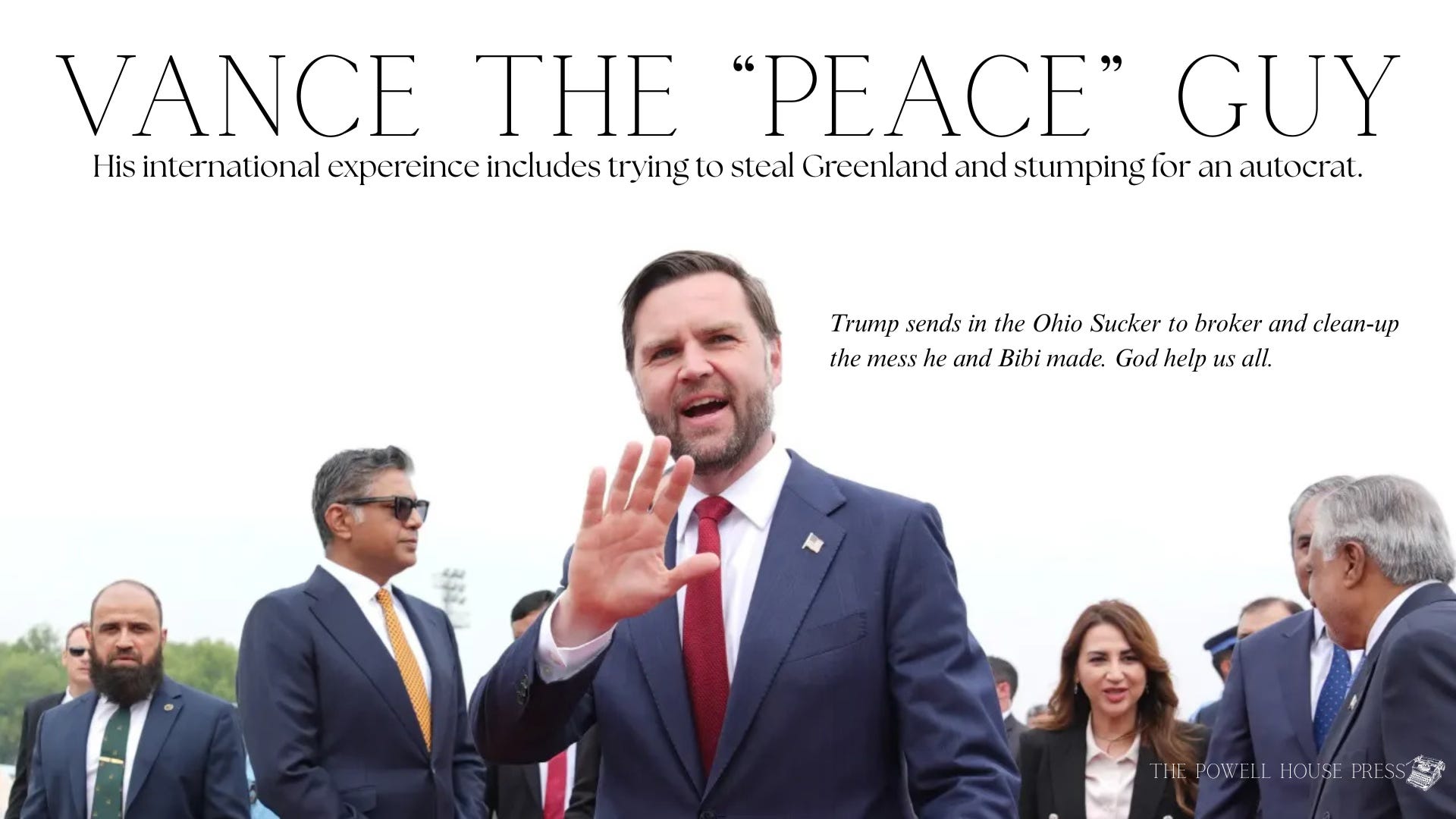
JD's in the Room
He called in from the Situation Room while Trump's war council partied at Mar-a-Lago. Now the skeptic owns the war.
He began his international career by trying to annex a friendly neighbor. Now J.D. Vance is being dispatched to make peace with an enemy. You couldn’t write a character arc this absurd, though the Vice President has proven over a lifetime of reinvention that he certainly would try.
Vance landed in Islamabad to negotiate a permanent end to the war with Iran, the most high-stakes diplomatic mission an American vice president has undertaken since the 1979 Islamic revolution. A fragile two-week ceasefire is technically in place, announced by Trump on Tuesday. Which means the talks happening right now are not about stopping the guns. They’re about whether the guns stay stopped. The war that roiled the Middle East, sent energy prices into the stratosphere, and choked the Strait of Hormuz was, reportedly, a war Vance never wanted. He called in from the White House situation room while Trump’s war council partied at Mar-a-Lago. He was the skeptic in the room who somehow ended up holding the bag.
“If it doesn’t happen, I’m blaming JD Vance,” Trump quipped at an Easter breakfast, drawing polite laughter from the room’s assembled apparatchiks. “And if it does happen, I’m taking full credit.” The joke, of course, was the job description.
Before we get to Islamabad, though, let us linger for a moment in Budapest, because the detour says everything.
Just last week, Vance was in Hungary doing the Lord’s work, specifically stumping for Viktor Orbán, Europe’s most prominent autocrat, before Sunday’s election. Standing on the stage of a soccer stadium, Vance declared Orbán “one of the only true statesmen in Europe” and called on Hungarians to vote for him to preserve “Western civilization.” Then, like a man determined to top himself, he held his phone up to the microphone and tried to call the President of the United States live on stage. The call went to voicemail. He tried again. This time Trump picked up and told the crowd: “I love Hungary and I love that Viktor.” The whole sequence — the awkward pause, the automated voice, the second attempt — was a perfect little parable for the Trump-Vance relationship, rendered in real time before five thousand Hungarian patriots.
Sunday’s result doesn’t look promising. Polls show Orbán trailing badly. Tisza, the upstart opposition party led by Péter Magyar, is ahead by double digits in most surveys. If those numbers hold, the man who was supposed to be MAGA’s model for Europe couldn’t even hold his own country. But we won’t know until tomorrow. What we already know is that the endorsement trip, Vance’s Hungarian Canossa, may amount to little more than a very expensive farewell party for an autocrat on his way out the door.
This is the same J.D. Vance who, as a senator, made principled speeches about how foreign nations should not interfere in the domestic politics of sovereign countries. That was before the reinvention. Before the conversion. Before the man who once privately called Trump “America’s Hitler” decided that America’s Hitler was, on reflection, his meal ticket. (To be precise: in a 2016 text message, Vance said he went back and forth between thinking Trump was “a cynical asshole like Nixon who wouldn’t be that bad” or “America’s Hitler.” Two characterizations, one text message, all of them inconvenient.)
Vance has always been in the business of self-manufacture. There was Liberal Vance, the Yale Law graduate and memoirist who wrote movingly about the forgotten white working class. Then Anti-Trump Vance, the pundit who floated Hitler comparisons in private while maintaining respectability in public. Then Silicon Valley Vance, the venture capitalist bankrolled by Peter Thiel (the tech world’s own Roy Cohn) who decided that populism was the next great investment opportunity. Then MAGA Vance, who strapped on the red hat so tightly it left a permanent mark. Each version has come with its own set of convictions, all of them expiring precisely when inconvenient.
So now Vance touches down in Pakistan carrying a poisoned chalice and a thin hand of cards.
Iran’s negotiators are not impressed. They control the Strait of Hormuz. They’ve survived the largest American-Israeli military campaign in living memory. They’ve watched Vance go to Budapest to campaign for a man who may be heading for the exit, and they’ve concluded, not unreasonably, that they can take their time. Iran’s 10-point proposal, which includes sanctions relief, reconstruction funds, and a protocol for reopening the strait, sets the table on their terms. The velvet hammer has been politely dropped.
Meanwhile, Trump has given Vance what he called “some pretty clear guidelines,” which, from a man who threatened that “a whole civilization will die tonight” in a Truth Social post and then announced a ceasefire two hours before his own deadline, is not exactly reassuring. Representing a mercurial boss is never easy. Representing this particular mercurial boss, in high-stakes nuclear-adjacent peace talks with an adversary that has been hardened by war, requires something Vance has never shown much evidence of possessing: genuine conviction.
That is the trap. Vance entered public life as a foreign policy restrainer, an America-Firster who warned against Middle East entanglements. He now has to sell a deal, or refuse one, on behalf of the war he reportedly tried to stop. A generous peace deal will enrage the MAGA faithful who smell weakness. Walking away from the table restarts a war that is polling badly and threatens to strangle the global economy by summer. There is no clean exit.
His presidential ambitions, which hum along just beneath everything he does, make the math more complicated still. The 2028 primary is already pricing in his performance here. To the hawks, he was never enthusiastic enough. To the libertarian wing, he was too loyal to a war president. He has somehow managed to annoy everyone without satisfying anyone. A neat trick, but not a winning one.
The spotlight in Islamabad is not the warm glow of a Budapest campaign rally or a Munich podium where he could scold Europeans about immigration. This is a different kind of light: unsparing, fluorescent, the kind that shows every crack in the foundation.
J.D. Vance has spent his entire career running toward the next version of himself. He’s been the Appalachian sage, the tech baron, the MAGA enforcer, the Europe-baiting nationalist, the would-be peacemaker. Each role came with a new book deal of the soul, a new dedication page to whoever was signing the checks.
But in Islamabad, there are no more reinventions available. There is only the man in the room, across the table from Iranian negotiators who have all the time in the world, representing a president who will claim the credit and assign the blame, in a war he never wanted, for a legacy he can’t yet define.
If it all falls apart, he’ll write another memoir. He’s had practice.
Why Your Subscription Matters
Independent journalism answers to readers—not advertisers, corporations, or access-hungry editors. No story gets killed because it upsets a sponsor. No punch gets pulled because someone important made a phone call.
Your support makes possible sharp commentary, fearless satire, and reporting that follows the story wherever it leads. In an era of manufactured narratives and algorithmic blandness, that independence isn’t a luxury—it’s a necessity.
Subscribe to The Powell House Press. Or settle for content that tells you what someone else wants you to hear.
©2026 All Rights Reserved | The Powell House Press