

Lindsey Graham's Last Dance
Suddenly, Donald Trump lost his loyal and most compromised soldier, leaving many of us wondering just what Trump knew about "Grahamnesty" that made him contort himself so completely?

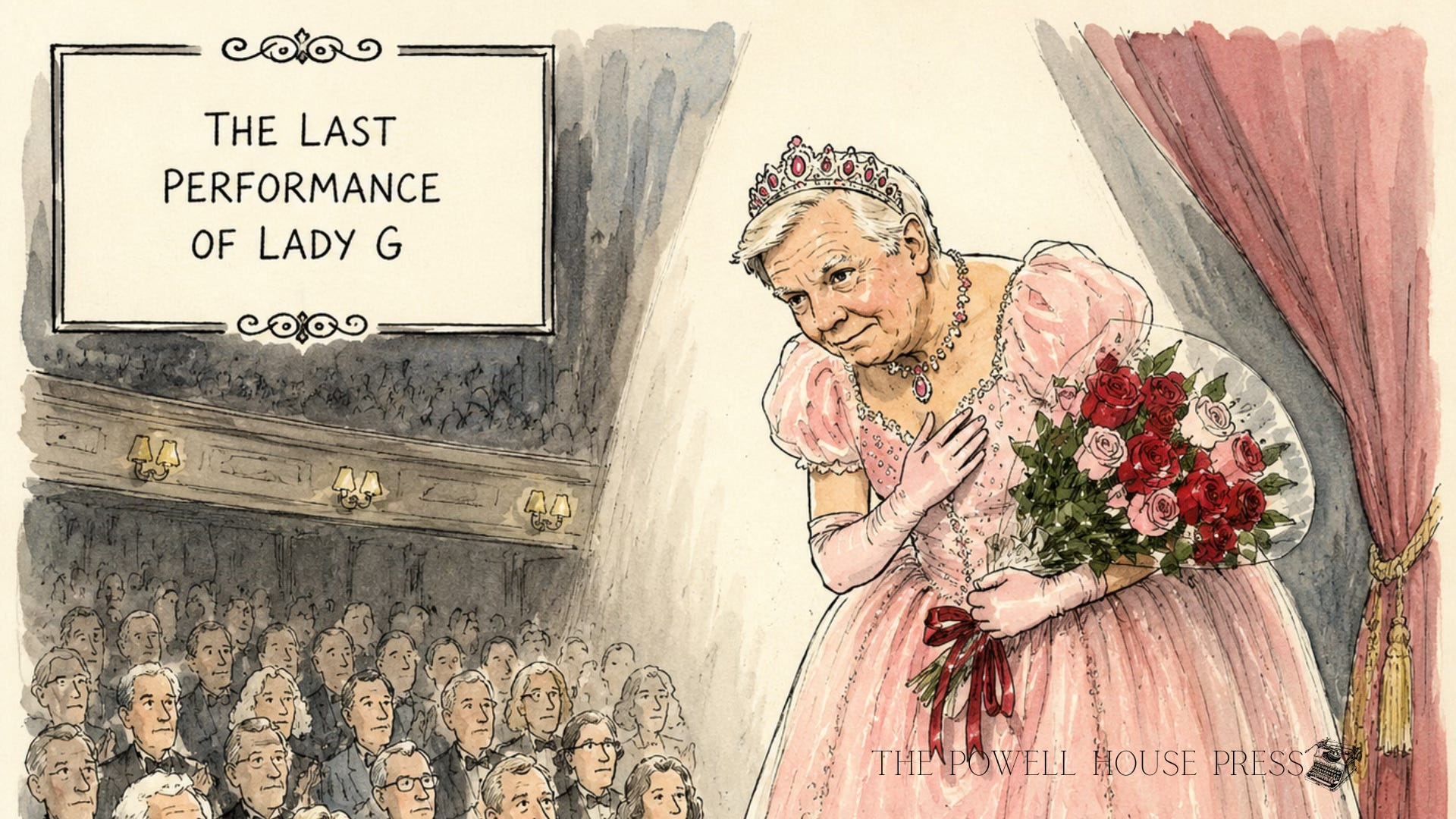
He spent a career auditioning for power. When his conscience died in 2018, he simply auditioned for a new director.
Nobody is composing an ode to Lindsey Graham this week, and if some brave soul tries, somebody should confiscate the pen, snap it in half, and salt the earth where the lyre stood. What we owe him is not a eulogy. It is an autopsy, without much hope of finding anything inside, because the man was, before he was anything else, an act. A very long-running theatrical equivalent of a dinner-theater Hamlet who forgot the soliloquies but kept the tights, surviving season after season only because nobody in the front row wanted to be the first to boo a man who might cry.
He played the good son who raised his orphaned sister without complaint. He played the earnest young lawyer, then the Air Force JAG officer, then the senator with the twang and the twinkle, the one who could make you laugh in a Senate hearing room, which is its own small magic trick and the only real talent he had left by the end. For a while, Washington rather liked this show. It had heart. It had a redemption arc before anyone needed redeeming. Even the right had a pet name for him ready to go, “Lindsey Grahamnesty,” Rush Limbaugh’s contribution, with Glenn Beck chipping in “Obama Lite,” and Graham nearly lost his own primary over it in 2014, a near-death experience for his career that taught him nothing except how to grovel more efficiently the next time. Chekhov’s gun, if Chekhov had written for Fox News. That gun stayed on the mantel for two more years, and then, somewhere around 2016, the writers changed, the spine left with them in lieu of severance, and nobody bothered to tell the audience, who by then were mostly there for the concessions anyway.
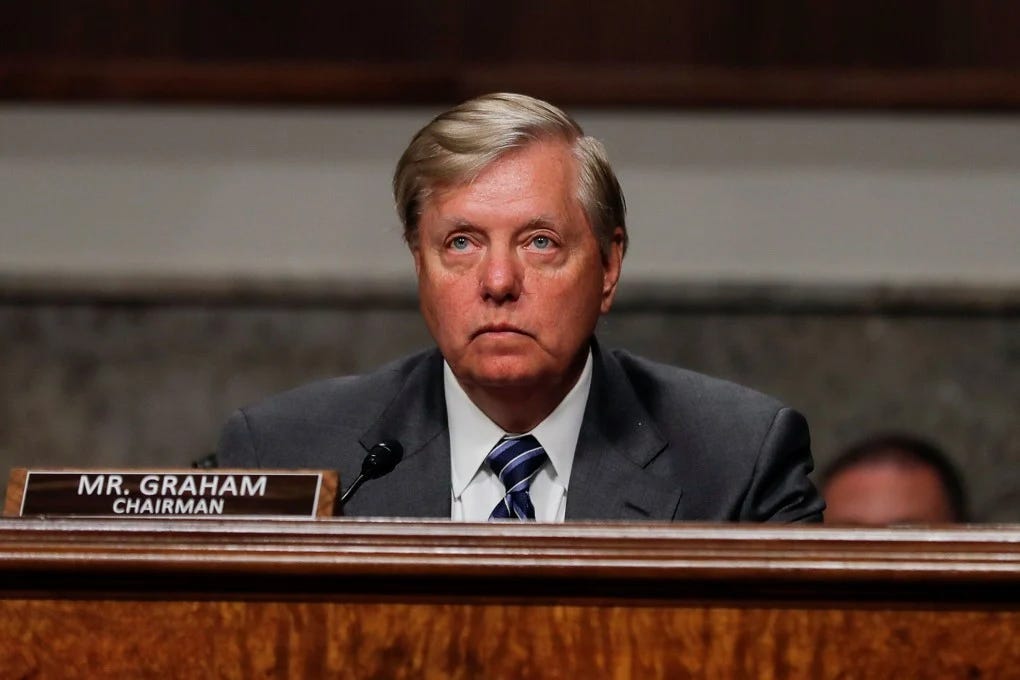
I have always thought the Chris Christie moment explained the whole sorry second act, and it is worth replaying. He named a name, on television, which in this town is the rhetorical equivalent of ripping a man’s toupee off at a state dinner and using it to wipe the gravy off your chin. On the “Overtime” segment of Real Time With Bill Maher, Christie described the great ongoing pantomime of the Republican Party, the senators who tell him, sotto voce, in the green room, how brave he is for saying what everyone privately believes, and then walk onto the set and pronounce Donald Trump the greatest president since Lincoln. Asked to name one of them, Christie did not hedge, did not soften, did not do the Washington shuffle. Lindsey Graham, he said, with the flat satisfaction of a man dropping a name he’d been saving for years, the way you’d finally return a casserole dish you never liked. One man, one line, and an entire career’s worth of self-regard collapsed into a single syllable of contempt.
It landed because Graham had written the material himself, in his own hand, like a man mailing his future indictment to himself out of sheer confidence nobody would ever check the return address. In 2015 he called Trump a jackass on CNN, and then again the next morning on CBS, for insulting John McCain, a war hero Graham actually seemed to admire back when admiring war heroes cost him nothing. He announced that his party had “gone batshit crazy.” He told Fox News, cameras rolling, that Trump was “a kook,” “unfit to be president,” the kind of sentence a man says when he still believes his own spine is load-bearing. In May 2016, a week before Trump sewed up the nomination, Graham posted a sentence to his own Twitter feed that he never once deleted, not even later, not even when it would have been so easy: “If we nominate Trump, we will get destroyed... and we will deserve it.” He wrote in Evan McMullin rather than vote for either major-party candidate. This was not a whisper campaign. This was a man standing in the town square with a bullhorn, and it makes what came next not a mystery but a confession, filed years in advance.
So here is the only question worth asking: was any of this conviction? Or was it coercion?
Exhibit A comes from Bob Woodward’s Fear, a one-on-one dinner in the White House Green Room during Trump’s first week in office, January 2017, before McCain died, before Kavanaugh, before a single humiliating round of golf. Trump did not ask Graham what he believed. Belief was never on the menu. He graded him, the way you’d grade a nervous intern. “You’re like 82 percent,” Trump told him. “I want you to be a 100 percent guy.” And Graham, for one single sentence of his remaining public life, had the nerve to push back: “Why would you want me to tell you you’re right when I think you’re wrong? What good does that do for you or me?” That is not the sound of a man falling in love. That is the sound of a man watching a loyalty oath get administered over appetizers, the same one James Comey says he choked down at a separate dinner that same season, and briefly, foolishly, believing his own objection would matter. Conviction does not need to be argued out of objecting. Graham objected, correctly, in the room, and then spent eight years complying anyway, outside it, like a hostage who not only keeps a diary nobody will read but starts writing thank-you notes to the kidnapper. That gap, between the one good sentence and the decade of groveling that followed it, is the whole obituary in miniature, and the cruelest part is that he wrote both halves himself.
The gun, such as it was, had been loaded years earlier, and not by Trump. “Lindsey Grahamnesty” and “Obama Lite” predate the Trump campaign by a country mile, punishment for Graham’s bipartisan work with McCain on immigration, and they very nearly cost him his seat in 2014. Trump did not need to manufacture leverage. Graham’s own voters had already gift-wrapped it and left it on the porch, and Trump, who has never once in his miserable life failed to smell a man’s weakness, simply picked it up and pocketed it. By 2024 Trump was practically narrating the arrangement himself, the way a loan shark describes a debtor who still thinks they’re friends: “I blame myself for Lindsey Graham, because the only reason he won in the Great State of South Carolina is because I Endorsed him.” Notice the capital E, Trump’s little vanity tic. Notice, too, that this is not a man describing a friend who came around. It is a rancher describing livestock.
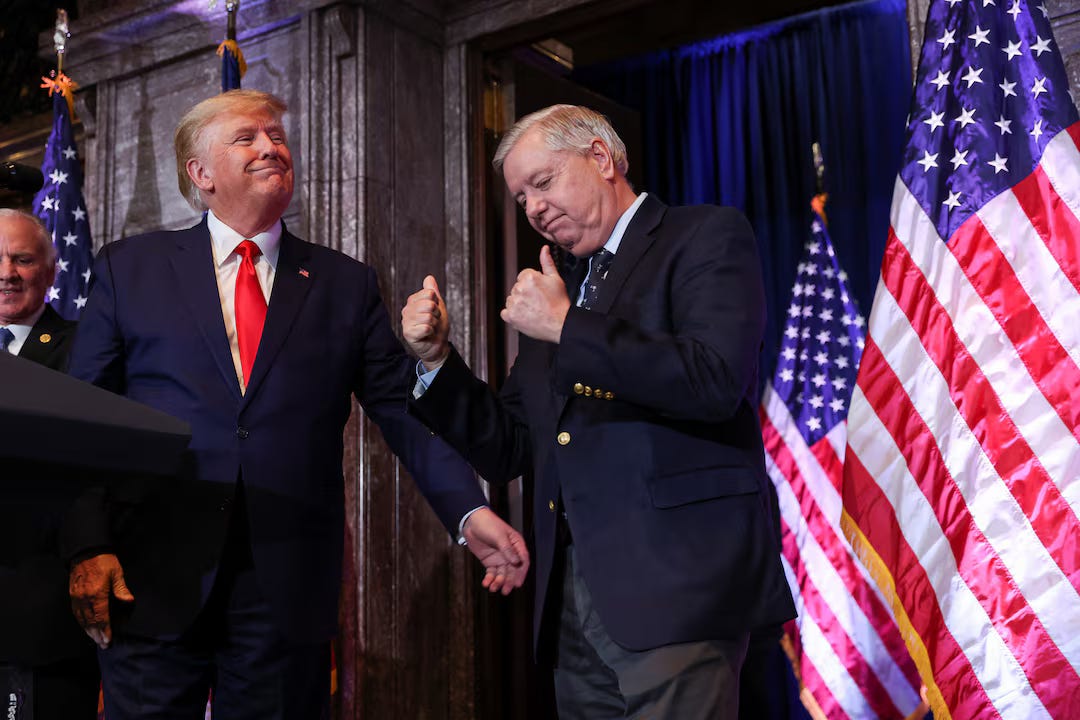
Then came the funeral, and the funeral sealed it. John McCain, Graham’s closest friend in the Senate, the closest thing Graham had to a conscience, died in August 2018, and the body was barely cold before the understudy started learning new lines. Within days, Graham was on Fox & Friends defending the president against the Russia investigation, a booking so fast you have to wonder if he’d kept the segment warmed up and idling in the driveway with the meter running. Within a week, he had smoothed over a funeral guest list so that Trump’s daughter and son-in-law could attend, a courtesy the McCain family had not exactly been begging to extend to the household of the man who’d mocked their father’s captivity, which means Graham spent the week of his best friend’s funeral doing advance work for his best friend’s tormentor. Asked, not long after, whether he was fishing for a job in the administration, Graham denied it with a line that told you more than any confession could have: “How do you say no in forty languages?” That is not a man who has been persuaded of anything. That is a starving man insisting, mouth full, napkin tucked, that he isn’t hungry and never was.
Two months earlier, Graham had offered the Associated Press his preferred origin story, the one he clearly hoped would stick to the wall like the cheap plaster it was. “I got to know him,” he said. “I’ve played golf with him. You know, play golf with somebody for three or four hours, you get to know them better. He’s funny as hell. He’s got a great sense of humor. There’s a method to the madness.” Measured against the Green Room dinner, that quote isn’t an explanation. It’s a hostage’s proof-of-life video, cheerful on the surface, chilling once you know what happened off camera. Eighteen holes did not erase what he told Trump to his face in January 2017. Terror did that. Golf was just the version safe enough to print in the Sunday paper.
The other theory making the rounds was that Trump was holding something over him, and that the something was Graham’s sexuality. It circulated around Washington for two decades and by 2020 it had a hashtag, a tabloid nickname, “Lady G,” and a detail about moles Graham supposedly called his “ladybugs,” which half of Twitter mistook for sworn testimony. Graham denied it flatly, telling the New York Times, memorably, “I ain’t gay. Sorry.”
If he was gay and Trump knew, I think most would agree he’d use it to his advantage. Humiliating men into loyalty is one of Trump’s oldest tricks, older than his Twitter account by decades. And whatever the truth was, that has never been a backstop to Trump exposing one’s underbelly.
And so we watched him fly closer and closer to the sun, or rather to something considerably more radioactive and far less romantic than a sun: Donald Trump. Proximity to Trump does to men without a core what it has always done. It ruins them, and then it makes them thank him for it. Lindsey grew visibly bloated. His eyes took on the permanent pink of a man who has stopped sleeping and started drinking more, the tell every Washington bartender learns to read for free. His speeches, which used to at least gesture in the direction of policy, curdled into talk radio filler, the audio equivalent of gas-station sushi, and he became, syllable for syllable, the race-baiting xenophobe he’d diagnosed in someone else a decade earlier, a bit of plagiarism so total he’d stolen from his own better self and never once been sued for it, possibly because the better self had no standing left. By 2024, asked on Meet the Press to respond to Mark Milley calling Trump a fascist, Graham said “he’s wrong” eight times in a row rather than let Kristen Welker finish a follow-up question, which isn’t a rebuttal, it’s a man drowning and calling it backstroke. His early biography, the orphaned sister, the honorable service, stopped reading like character and started reading like scaffolding, the kind a con man keeps freshly painted because the mark always looks up before he looks down.
In his final years, Graham did not merely support Israel. He auditioned for the role of its most bloodthirsty defender, understudy be damned, and rehearsed the audition on prime-time cable like a man who’d finally found a war big enough to hide inside. After Hamas’s October 7, 2023 attack, he called for Israel to respond “by any and all means necessary,” and within weeks he was cheerfully invoking the flattening of Berlin and Tokyo as the appropriate template for Gaza, a comparison so casually apocalyptic it should have ended a career rather than merely defined one, and would have, for a man with any career left to end. This was not foreign policy. This was a man auditioning for a walk-on part in someone else’s war because it made him feel, for a news cycle or two, essential, the way a stage-four ham always finds one more encore in him.
His final rewrite, though, the one history will find hardest to forgive, was of January 6th itself. The day after the Capitol was stormed, Graham stood in front of the cameras, visibly rattled, and called the rioters domestic terrorists who were, in his own words, not patriots, adding, plainly, that Biden and Harris had been lawfully elected. That version of Lindsey Graham lasted about three years, a decent run by his standards, longer than most of his marriages of convenience. By 2024, asked on Face the Nation whether he still stood by it, Graham allowed that it “depends on what the conduct is,” then pivoted, smooth as a Palmetto highway freshly repaved with other people’s money, into a defense of Trump’s immunity claim, insisting Trump had merely “given a fiery speech” and never personally breached the Capitol, as though that were the relevant legal standard for anyone else on the planet who isn’t Donald Trump.
Lindsey Graham was a compromised man who needed power the way other men need approval, not as an accessory to a life but as a replacement for one, and he spent it the way weak men always spend borrowed things, carelessly and lavishly, right down to the last dime. He told Trump, to his own face, in his own words, that the demand for loyalty made no sense. Then he spent eight years proving he’d meant it least of anyone who ever said it.
The Old South’s version of Icarus. Only his wings never burned. It was his soul that did.
