Made in China: How Trump Continues to Squander American Power
While MAGA remains faithful, the rest of the world is growing tired of Trump, his antics, and the people he surrounds himself with.
There is a kind of smile a host wears when the guests need the party more than the party needs them — gracious, unhurried, very slightly amused — and Xi Jinping was wearing it on the steps of the Great Hall of the People.
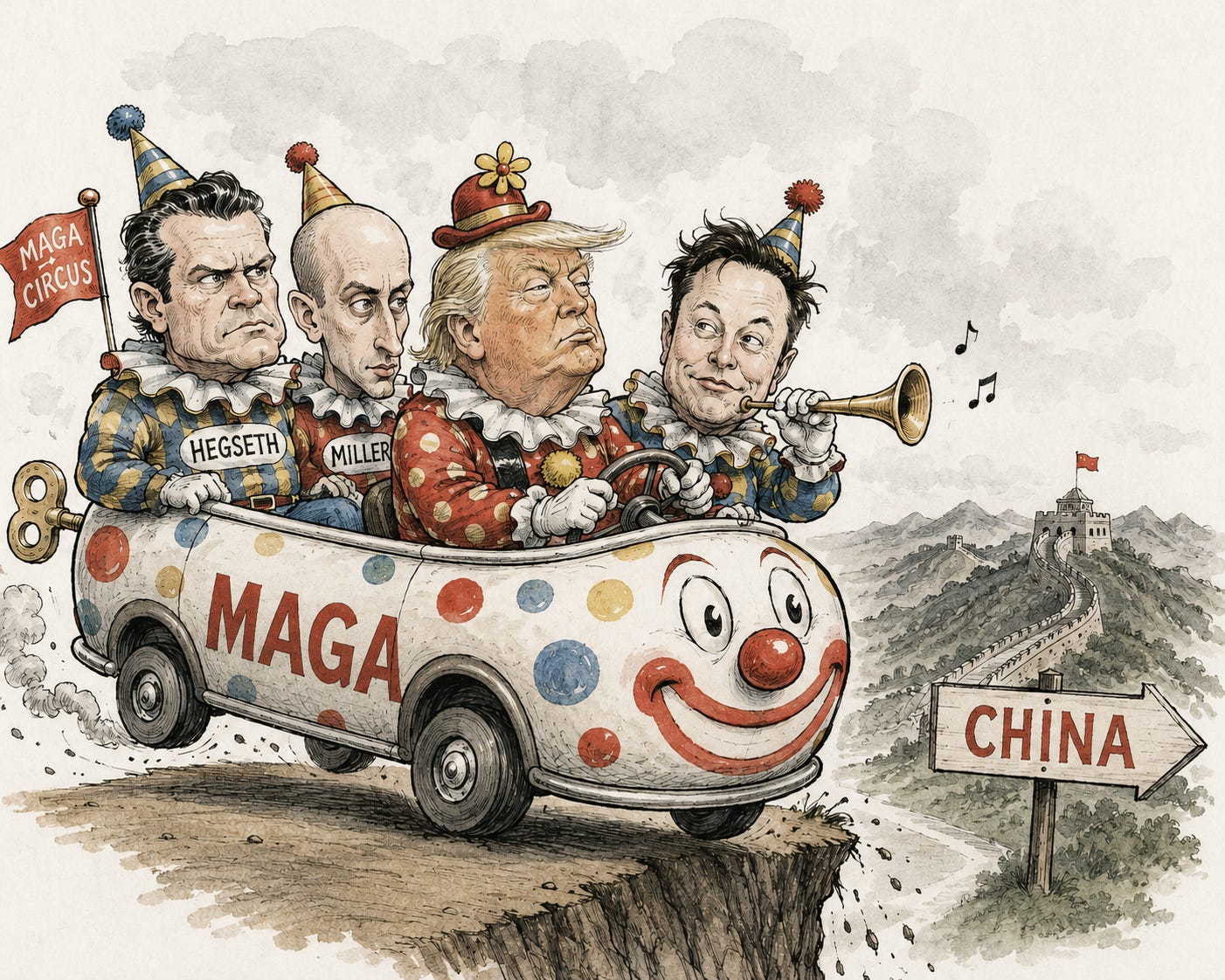
Donald Trump had come to Beijing, the first American state visit to China since 2017, and, being Trump, he had not come quietly, and he had certainly not come alone. He had come with a court. Trailing him was a procession of seventeen-odd chief executives whose combined fortune Forbes put at around $870 billion: Elon Musk, the world’s richest man; Tim Cook, whose entire luminous empire happens to be screwed together inside the very country he was visiting; Jensen Huang of Nvidia, Taiwan-born, not even on the original list and folded in only when he scrambled aboard Air Force One during its Alaska refueling; Larry Fink of BlackRock; Stephen Schwarzman of Blackstone; Jane Fraser of Citigroup; and the chiefs of Goldman Sachs, Boeing, Qualcomm, Mastercard, Visa. Around them, the cabinet: Secretary of State Marco Rubio, Treasury Secretary Scott Bessent, Trade Representative Jamieson Greer, and — startlingly, for a state visit — Defense Secretary Pete Hegseth. The White House’s Stephen Miller came too. And then, because no Trump production is complete without blood relatives and a man from the movies, Eric and Lara Trump and the film director Brett Ratner, lately the auteur of the documentary “Melania.” On arrival the party was sorted between the Four Seasons and the Kempinski, which is precisely the sort of detail that gives the game away. Even a court has its A-list and its B-list.
A grace note on Rubio, who is worth pausing over: Beijing sanctioned him years ago for his criticism of its human-rights record, and he was admitted this week, by several accounts, only after China quietly altered the official transliteration of his name. The human-rights man, waved through under what amounts to an alias. You could not invent it.
Trump, never one to underplay, announced that his first request of Xi would be to “open up” China so that “these brilliant people” could “work their magic.” Read that sentence again and feel it curdle. The president of the United States, on Chinese soil, intended to spend his opening move asking his host for favors — not for the country, but for the friends he had flown in on Air Force One.
This is the thing about a court: it is always, finally, a confession. And this one confessed to two rooms at once. To Xi, it confessed weakness — a president who needed things, trailed by people who needed more. To everyone else, and the whole world was watching, it confessed something less strategic and harder to launder: the character of the people now running the United States. Trump did not assemble a negotiating team. He assembled a tableau — wealth, force, family, and the man who keeps the story straight — and carried it to a regime that has spent five thousand years learning to read precisely this kind of room.
Begin with the wealth, because each of those glittering houseguests had arrived with a private shopping list and an ingratiating smile. Musk wants nearly three billion dollars of Chinese solar-manufacturing equipment; he wants his Shanghai gigafactory humming; he wants Beijing’s regulators to wave through his self-driving software. Cook wants the supply chain that holds his entire valuation hostage to keep purring. Huang wants to sell the chips. Trump — flattered, expansive, playing maître d’ to the richest dining room on earth — mistook their neediness for his leverage. He had it precisely backwards. The delegation was not a show of force. It was a target list, and he had handed it across the table himself: an itemized account of what each of these men wants and cannot get without Xi’s signature. A roomful of private interests is a roomful of places to press.
Then the force. The genuinely arresting name on the manifest was Hegseth’s, because no Pentagon chief had accompanied a president on a state visit to China since Nixon went in 1972. Defense secretaries make that trip, when they make it, on their own sober errands — not as part of a trade-and-investment jamboree, sharing a cabin with Musk’s solar order. The charitable reading is that Trump wanted the security relationship in the room and taken seriously. The truer one is that he had put it in the shop window. There was the defense secretary, with arms sales to Taiwan and nuclear posture reportedly on his docket, at the precise moment the president was musing aloud about whether the United States should keep arming Taiwan at all. Taipei and Tokyo and Seoul watched their own security being handled like stock. That is not strategic ambiguity. It is a price tag. Xi could be forgiven for taking notes.
And Miller? Stephen Miller is not a China hand. He is not a trade economist, not a diplomat, not a man with a single working line into Beijing. He is the administration’s hardest domestic edge, the ideological engine of the crackdown that is this White House’s truest devotion. His value on a state visit is not diplomatic; it is editorial. Miller travels with the president the way a network dispatches its showrunner to location — to make sure the footage cuts the right way for the audience back home. His presence is the confession that the trip was always, in part, a production: that somewhere between the Temple of Heaven and the state banquet there was a base to be played to and a story to be managed.
And the party of Trump? The GOP supplied no brake. Not a caution, not an objection, not one senior voice to say that a defense secretary does not belong at a billionaire trade fair, or that a state visit is not a campaign shoot. The week’s only friction came from a budget hearing over war spending — a hearing about something else entirely, which did not for a moment keep Hegseth off the plane. A governing party watched a foreign trip be staged as a production and called the result statecraft. The silence around the president was not neutrality. It was a vote.
Step back far enough and the picture resolves into something the cameras in Beijing did not need to retouch. A line of the richest people alive, the cabinet, and the president’s own son and daughter-in-law, filing into the Great Hall behind a man who had come to ask a favor. It looked like a tribute mission because, in every way a watching world could see, it was one. And it confessed the thing this administration takes the least trouble to hide: that the line between the public office and the private fortune has been rubbed away. A president spent a state visit lobbying a foreign ruler on behalf of named billionaires. The brand was populism. The cargo was a planeload of billionaires and the president’s own kin. There is a kind of corruption that still troubles to draw the curtains; this is the other kind. And every government that has ever sat through an American lecture on graft and good governance was, this week, quietly taking notes of its own.
That was the confession the world heard. Xi heard the other one.
He was not fooled for a second. He never is. At a moment calibrated for maximum elegance he delivered, in public, a warning that mishandling Taiwan would bring “clashes and even conflicts” and could pitch the whole relationship into “great jeopardy.” That is not the purring of a counterpart who feels outmatched. It is the voice of a host who has counted the house. As one analyst at the Center for Strategic and International Studies put it, China came to this summit far more sure of itself than in 2017, having spent the intervening year quietly neutralizing very nearly everything Trump threw at it. The tariffs came; Beijing retaliated within a day; the truce that followed was struck on something embarrassingly close to even terms.
So how does the most powerful country on earth arrive at the table this thin? Because Trump had already spent the swagger — impulsively, theatrically, everywhere but here.
Begin with Venezuela. In January, American forces swept into Caracas, seized Nicolás Maduro, and flew him to Florida, after which Trump cheerfully informed the world that the United States was “going to run the country.” Whatever one’s feelings about Maduro (somewhere between distaste and nothing at all is about right), the precedent went straight into the cement: a great power may now reach into its own hemisphere and pluck out a government it finds tiresome. You did not need to be a strategist to see what that handed Beijing. The nationalists on the Chinese internet saw it at once, and began asking, reasonably enough, why their government should not apply precisely the same logic to Taiwan. Trump had not merely left the script lying around. He had blocked the staging.
Then Iran, where the United States is at war, the Strait of Hormuz is shut, and the global economy is absorbing the energy shock — a war so consuming it shoved this very summit from April into May, and pulled American military weight out of the Pacific and into the Middle East. Trump arrived in Beijing needing Xi’s help to lean on Tehran. Needing. It is the single most expensive word in diplomacy, and he carried it in his luggage.
Then Russia, where Trump has passed an entire year as Vladimir Putin’s most indulgent negotiating partner, floating peace plans with the patience of a man courting a reluctant donor, while Russian missiles came down near the Polish border. Patience of that kind, unreciprocated, does not read as statesmanship. It reads as a tell. Every adversary now understands that American pressure is a mood, and moods pass.
Assemble it and the picture is almost comically coherent. Venezuela announced that spheres of influence are fashionable again. Iran proved the superpower can be stretched thin. The Russia courtship revealed that American resolve runs on a timer. And then Trump gathered up his court — the billionaires, the defense secretary, the message man, the family — and flew to the one capital on earth where all three lessons converge in a single pair of hands, and asked him to “open up.”
He had come, he believed, to hold court of his own: the dealmaker president, flanked by the masters of the universe and the instruments of American power, dazzling the Chinese into generosity. He toured the Temple of Heaven. Three hundred schoolchildren had waved flags at the airport. The banquet glittered. And through all of it Xi wore that host’s smile, the one that has already counted the house, because the week ran exactly opposite to the brochure. Trump did not hold court in Beijing. He was a guest at someone else’s — and he had arrived having told both his audiences precisely what they needed to know. He told Xi that the United States now needs China more than it can afford to say. He told everyone else that its government travels as a closed circle of wealth and blood, and is no longer embarrassed to be caught at it. A supplicant among supplicants. Better billing, worse hand, and a planeload of billionaires at his back — the shopping list, in the flesh, in case the man across the table had somehow missed what the trip was for.
Why Your Subscription Matters
Independent journalism answers to readers—not advertisers, corporations, or access-hungry editors. No story gets killed because it upsets a sponsor. No punch gets pulled because someone important made a phone call.
Your support makes possible sharp commentary, fearless satire, and reporting that follows the story wherever it leads. In an era of manufactured narratives and algorithmic blandness, that independence isn’t a luxury—it’s a necessity.
Subscribe to The Powell House Press. Or settle for content that tells you what someone else wants you to hear.
©2026 All Rights Reserved | The Powell House Press | josh@thepowellhousepress.com