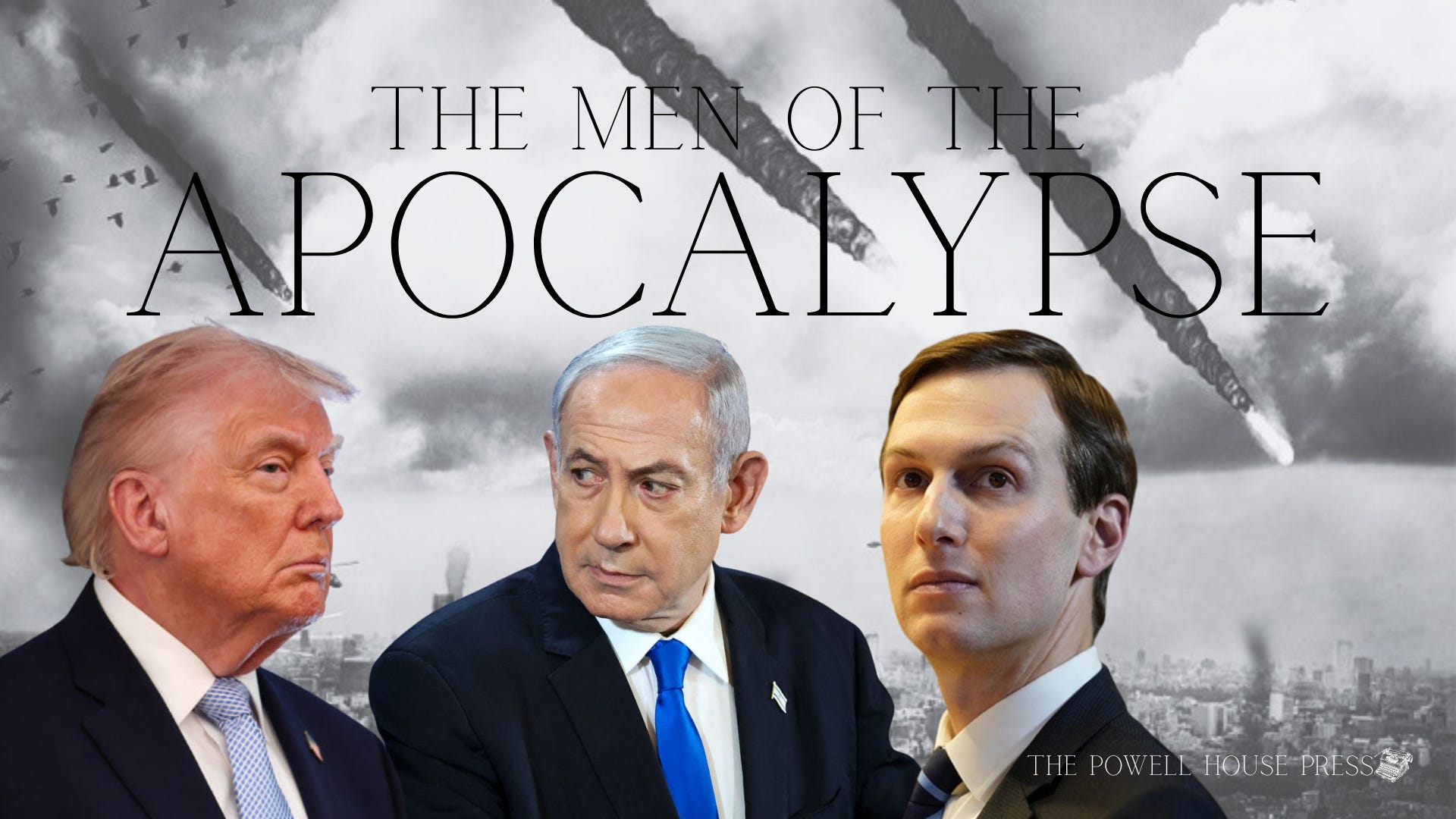
Netanyahu's Very Convenient and Timely War
There's a reason why "Bibi" needed a war and Trump, the ever-idiot was his stooge.
There is a particular genius, of the most morally repellent kind, in being simultaneously the most powerful man in a country and its most besieged defendant. Benjamin Netanyahu has spent six years perfecting this trick, and watching him work, one is struck less by the audacity of it than by how entirely the world has let him get away with it.
The charges, let’s not forget, are not trivial. This is not the stuff of parking tickets or zoning violations. Case 4000, the one that keeps Israeli prosecutors up at night, alleges that Netanyahu, while serving as his own communications minister, handed regulatory gifts to a telecom mogul named Shaul Elovitch in exchange for favorable coverage on Walla! News, a site Elovitch happened to own. Media coverage as currency. The headline practically writes itself, which is perhaps why he wanted to control the headlines. There is also the gifts affair: the cigars, the champagne, the jewelry, the whole perfumed arrangement with Hollywood producer Arnon Milchan. And a third case involving a newspaper proprietor and a deal that was never quite consummated but was apparently corrupt enough anyway.
Put it all together and you have bribery, fraud, and breach of trust. Put it all together and you have a decade in prison if the court ever gets around to finishing the trial.
The court has not gotten around to it.
War and the Machinery of Delay
The trial opened in 2020 and has, since then, been stalked by catastrophe with a thoroughness that would be remarkable if one believed in coincidence. COVID arrived first, as it did everywhere, and pushed the initial hearings back. Then came election-related postponements, because Israeli courts apparently feel that a prime minister’s democratic obligations must not be inconvenienced by his criminal ones. Evidentiary disputes followed. Witness scheduling conflicts. The glacial, grinding entropy of a defense team with every incentive in the world to run out the clock.
Then October 7, 2023 happened, and the trial acquired its most useful accessory yet: a genuine war. Israeli courts shifted to emergency footing. Hearings dissolved. The defendant, who controls the military and therefore the emergency, found himself temporarily liberated from the inconvenience of cross-examination.
By late 2024, the defense was requesting a ten-week postponement. A prostate procedure arrived in the schedule like a gift from the gods of delay, buying several more weeks. Netanyahu began his own testimony in October 2025, becoming the first sitting Israeli prime minister ever to take the witness stand as a criminal defendant, a distinction his supporters would have preferred he not achieve. Prosecutors began cross-examining him in June 2025. They were in the middle of it, pressing him on Case 4000, on a meeting he denies ever occurred, on the regulatory maneuvering at the heart of the bribery allegation, when Israel and the United States launched Operation Epic Fury against Iran on February 28, 2026.
The courts shifted back to emergency status. The cross-examination stopped.
When a ceasefire was announced on April 9, the Israeli courts declared the trial would resume today. Netanyahu’s lawyers filed a delay request on April 10, citing “classified security and diplomatic reasons connected to the dramatic events that have taken place in the State of Israel and throughout the Middle East.” A sealed envelope, allegedly containing the classified specifics, was delivered to the court for the judges’ eyes only.
The prosecution had not yet responded when the filing landed.
You have to appreciate the elegant symmetry of it. The ceasefire is declared Thursday. Friday morning, the delay request arrives. The man who decides when his country goes to war is also the man who benefits, in the most concrete legal sense, every time it does.
Friends in the Right Places
Here is where it gets, as they say, interesting.
Jared Kushner is the son-in-law of the President of the United States. He is also the husband of Ivanka Trump, the president’s daughter, a fact worth stating plainly since the entire architecture of what follows depends on it. His family’s connection to Netanyahu goes back decades. As a teenager, Kushner gave up his bedroom so Netanyahu could have a place to sleep during a visit to the Kushner home in New Jersey. The two families have been close ever since. That history now sits at the center of American foreign policy in the Middle East.
That relationship is now doing a great deal of work.
Kushner has no official title in the current administration. He is also, somehow, a nuclear negotiator, a Gaza peace architect, a ceasefire broker, and a man whom the President of the United States dispatches to the world’s most volatile flash points with the explanation “I have Jared.” In early 2026, he was formally appointed as Special Envoy for Peace. What law governs this appointment is not entirely clear. What governs Kushner’s involvement in the Middle East more generally is even less clear, because running alongside all of it, the diplomacy, the envoy work, the sealed meetings with Netanyahu, is Affinity Partners.
Affinity Partners is Kushner’s private equity firm. In March 2026, lawmakers sent letters to the White House noting that Affinity Partners appeared to be soliciting billions of dollars in investments from the very Gulf governments Kushner was simultaneously negotiating with on behalf of the United States. The conflict of interest is so complete, so perfectly circular, that it almost commands admiration. Almost.
Kushner himself, in a candid moment that has followed him ever since, described the Israeli-Palestinian conflict as “nothing more than a real-estate dispute.” He also observed, around the same time, that “Gaza’s waterfront property could be very valuable.” His father-in-law took that vision and ran with it, proposing at the start of his second term to seize Gaza, raze what remained of it, and rebuild it as a “Middle Eastern Riviera.” Kushner went to Davos in January 2026 to unveil the renderings. They showed high-rises, coastal tourism towers, luxury villas on shimmering water. The 2.2 million Palestinians who had been living there were not prominently featured in the plans.
Critics have called it ethnic cleansing dressed in architectural renderings. A U.N. commission had already determined that what Israel had done in Gaza constituted genocide. Kushner’s response to these observations has been, in effect, to continue holding meetings.
Trump has been lobbying Israel’s President Isaac Herzog to pardon Netanyahu. Not quietly, not diplomatically. Publicly, with the kind of pressure that in any other context would be called interference in a sovereign nation’s judicial proceedings. He said in March that Herzog had “promised him five times” to grant the pardon, and called the Israeli president “a disgrace” when it had not materialized.
Herzog declined to rush the process. Israel’s Ministry of Justice said it would be inappropriate to issue a pardon while the trial remains ongoing.
Netanyahu, for his part, called the trial an “absurd circus” in a press conference twelve days into the Iran war and said he needed to be “completely unencumbered” to focus on the region’s “tremendous opportunities.” He did not appear to notice the irony of a man facing bribery charges describing the geopolitical situation as an opportunity.
Or perhaps he noticed it perfectly well and simply didn’t care.
The Architecture of Mutually Assured Benefit
What one is looking at, assembled in full, is a structure of interlocking interests that is less a conspiracy than a shared orientation toward a single outcome: Netanyahu stays in power, the war continues, Gaza becomes a development opportunity, and the Affinity Partners pitch deck grows more compelling with every passing month.
Netanyahu needs the wartime emergency. It transforms a defendant in a bribery case into a wartime statesman. It makes delay requests seem principled. It keeps him in office past what the polls, which show his coalition losing the October election, suggest is his natural expiration date.
The Kushners need a friendly Israeli government. The reconstruction of Gaza, as they envision it, requires a partner in Jerusalem who shares their view of what Gaza is: not a place where people live but a coastline waiting to be developed. A Netanyahu facing prison and electoral collapse is a man who needs to remain in power by any means available. Such a man, one finds, tends to be cooperative.
Trump needs all of it to hold. His son-in-law’s financial interests intersecting with the foreign policy of his administration is not a new problem. It is simply a larger one.
And tomorrow Bibi is once again not going to court. And all the while the world burns so that corrupt men can continue their crimes against their own people and put the entire world at risk.
Why Your Subscription Matters
Independent journalism answers to readers—not advertisers, corporations, or access-hungry editors. No story gets killed because it upsets a sponsor. No punch gets pulled because someone important made a phone call.
Your support makes possible sharp commentary, fearless satire, and reporting that follows the story wherever it leads. In an era of manufactured narratives and algorithmic blandness, that independence isn’t a luxury—it’s a necessity.
Subscribe to The Powell House Press. Or settle for content that tells you what someone else wants you to hear.
©2026 All Rights Reserved | The Powell House Press