
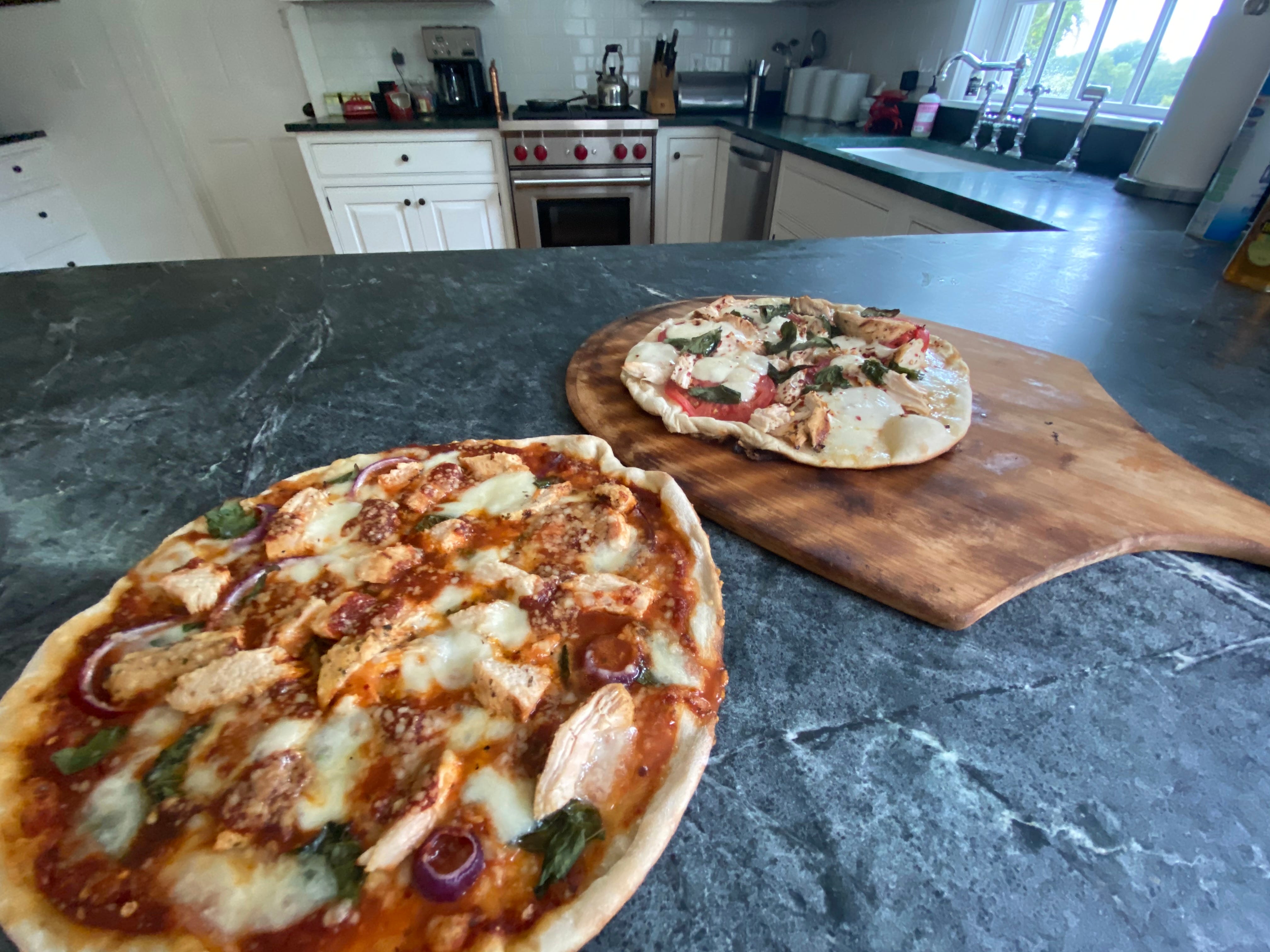
Pizza is the most popular food on earth and the most frequently ruined. Most of what goes wrong happens before a single topping lands, because pizza is a vehicle for sauce and toppings and the vehicle is dough. Get the dough right and the rest is assembly. Get it wrong and you have condiments on cardboard. Good dough disappears underneath what it carries, which is the entire trick.
So start there. Pizza dough is four ingredients. Flour, water, salt, yeast.
Wheat flour contains two proteins, glutenin and gliadin. Add water and they bond into gluten, the elastic network that traps gas during fermentation and steam in the oven. More protein means more gluten potential. Italian 00 flour (the “00” refers to grind fineness, not protein content, a fact butchered by most pizza blogs) usually runs 11 to 12.5% protein. American bread flour runs 12 to 14%. All-purpose lands around 10 to 11%, though King Arthur’s clocks in at 11.7%, which is why it punches above its category. Protein dictates style. Neapolitan wants moderate protein and a soft, blistered crust. New York wants higher protein for chew. Roman and Detroit, with their longer ferments and higher hydration, want stronger flour still.
Hydration is the lever. It is baker’s percentage: weight of water divided by weight of flour. A digital scale is required; volume measurements for pizza dough are malpractice. Neapolitan sits around 60 to 65%. New York similar. Detroit and Roman al taglio push 75 to 85%. Higher hydration produces a more open crumb and a crispier crust (more steam, more oven spring). It also makes the dough harder to handle. The tradeoff is real. Tap water is fine. Filtered if you live in Flint MI.
America’s Test Kitchen (one of my favorite resources) has a recipe that I like. Click here for exact measurements.
Salt and yeast are small numbers. Salt is typically 2 to 3% of flour weight. It tightens gluten, slows yeast, and makes the bread taste like food instead of paste. Skipping it produces dough that looks correct and tastes like nothing. Yeast is even smaller. Long cold ferments use 0.1 to 0.3% instant dry yeast. Same-day doughs go up to about 1%. The reason for the low number is that fermentation builds the flavor, not yeast quantity.
Fermentation is where the flavor lives. Give the dough 24 to 72 hours in the fridge and enzymes break starches into simple sugars. Lactic acid bacteria produce acids that give the crust character. Yeast off-gas builds structure. A four-hour same-day dough is a compromise. A 48-hour cold ferment is the actual thing.
The gluten network builds three ways. Time (autolyse: mix flour and water, rest at least 30 minutes, the proteins hydrate passively). Mechanical work (kneading, stretching, folding). Or both, which is what serious recipes do. The window pane test is the checkpoint. Pull a small piece thin enough to see light through. If it stretches without tearing, gluten is developed. If it rips, keep working.
Frozen pizza dough exists for nights when all of the above sounds like too much. Most full-service grocery carry it. Most of it outperforms a rushed same-day home recipe if it is thawed properly: overnight in the fridge, then 60 to 90 minutes at room temperature before stretching. There is no shame in in buying your dough.
If you want to make your own dough, a stand mixer is great but not required. People have made pizza by hand for a thousand years. They will continue to do so. Hand-mixing also gives the best tactile feedback, which is how Neapolitan pros learn to read hydration and gluten by feel. But for me the stand mixer is still worth using. High-hydration dough (70%+) is miserable by hand. The stuff sticks to everything, refuses to form a ball, and demands 15 minutes of slap-and-fold forearm work. A dough hook handles it without complaint. Consistency: the same machine running the same time at the same speed produces the same dough. Hand-mixing varies with how tired the mixer is. Volume: four dough balls in one session is trivial with a machine and tedious without one. The standard recommendation is one of the higher-end KitchenAid models. The entry-level Artisan strains on stiff doughs and has a documented history of stripping its nylon worm gears on dense pizza batches (the gears are sacrificial by design, which is comforting in theory and annoying at 11pm). Spiral mixers (Famag, Sunmix) are the next tier, for people who pass a certain threshold of obsession. They cost $400 to $1,500 and are better at this specific job than any planetary mixer at any price. Some bread makers also have pizza dough settings.
A rolling pin is fine. The internet will tell you it is a crime. The internet is overstating it. A pin degasses the dough, true: the gas pockets that would have puffed into a tall rim get pressed flat, and oven spring drops. For a Neapolitan cornicione, that matters. For most home pizza, it does not. Plenty of good pizza is rolled. Tavern-style, St. Louis-style, and Roman pizza tonda want a pin and sometimes a docker on top of it. Even a standard round benefits from a pin if hand-stretching keeps tearing holes or producing a lopsided oval. Roll from the center out, rotate a quarter turn, repeat. Leave the outer half-inch alone if you want any rim at all. Hand-stretching is still the better default for puffy styles (press from the center outward with fingertips or knuckles, drape the dough over the back of one hand, let gravity finish, then move it between hands in the Neapolitan schiaffo to thin it further). It takes 30 to 60 seconds, and dough that resists is under-proofed or too cold, which 20 minutes of rest fixes. But the pin is a tool, not a sin. Use it.
Pizza wants heat. Lots of it. The defining gap between home pizza and pizzeria pizza is roughly 350°F. Domestic ovens top out at 500 to 550°F. Most do not hit their stated maximum, because the thermostat reads ambient air rather than the cooking surface and because manufacturers build in conservative cutoffs. Neapolitan dough wants 850 to 900°F floor temp with similar dome heat. New York wants 550 to 600°F. The home oven can do New York. It cannot do Neapolitan. There is a hack involving the self-clean cycle, which runs the oven to 800°F+ with the door locked. The internet loves it. It is also a great way to crack an oven liner, fry a thermostat, void a warranty, and discover whether the smoke detector battery is fresh. Modern ovens detect door tampering and shut the cycle down. Older ones do not. Outcomes vary. Convection helps with heat distribution but does not raise the ceiling. A convection oven still maxes out at 550°F. Slightly more even, same wall.
Under the pizza, the choice is stone or steel. Both work by storing thermal mass and dumping it into the dough. The difference is how fast. A pizza stone (cordierite or ceramic) conducts heat at roughly 3 to 4 W/m·K. It holds temperature well, absorbs surface moisture (helpful for crisping), and has been the standard recommendation for forty years. It is also fragile under thermal shock (cold dough on a screaming hot stone can crack it) and slow to transfer heat once the pizza lands. A pizza steel conducts heat at roughly 45 to 50 W/m·K, more than ten times the stone. Bottom crust crisps faster, oven spring improves dramatically, and bake times in a home oven drop from seven minutes to four. A half-inch 14x16 steel weighs around 23 pounds. It costs $80 to $150. It will outlive the user. The Modernist Cuisine team put the steel on the map a decade ago. It deserves the recognition. For most home pizza in a conventional oven, a steel is a straight upgrade over a stone. Both need a long preheat. One hour minimum, on the top rack, set to broil for the last five minutes before launch. Thirty-minute preheats produce sad pizza regardless of what is under them.
The Breville Crispy Crust Pizza Maker is a clamshell countertop appliance: hinged top and bottom shells, heating elements in each, a 12-inch cordierite stone sandwiched between. It tops out at 572°F per Breville’s spec, with settings for thin, medium, and thick crust. The clamshell concept is sound. Heat from above and below at once, no peel work, the stone preheats faster than a full oven because the cavity is tiny. For people without counter space or budget for a $400 Ooni or a $1,200 Pizzaiolo, it occupies a real niche. The limits are also real. Hotter than a home oven, cooler than anything Neapolitan. The 12-inch ceiling caps pizza size and forbids the artisan reach for a 14-inch NY. The lid presses close to the toppings, which means cheese can scorch before the bottom finishes on anything thicker than thin-crust. Hydration that works at 500°F (~65%) can produce soggy middles in a clamshell because the bake is shorter and the bottom heat is more localized.
The outdoor grill is the cheat code. A gas grill with all burners on high and the lid closed will hit 600 to 700°F. A charcoal grill set up for high heat pushes 700 to 800°F. Both numbers beat the home oven by a comfortable margin and close most of the gap to a real pizza oven. The vehicle is a perforated pizza pan (aluminum or steel, holes punched across the surface), placed directly on the grates. The holes let heat and smoke contact the crust without the dough sagging through the bars. It is a heat-permeable cradle, not a stone. The bake is simple. Preheat the grill with the lid down for 10 to 15 minutes. Pan and pizza onto the grates. Lid back down. Six to nine minutes. The closed lid creates a dome effect: bottom heat from the burners, radiant heat reflecting off the lid. The result lands closer to a brick oven than anything a home oven produces. A few facts. Grills have hot spots, and a half-rotation midway through the bake corrects for them. The bottom chars faster than the top because the burners are right under it. Killing the center burner and shifting the pan toward indirect heat fixes the burn risk. Charcoal and wood add real flavor. Gas adds almost none. Weather counts (cold air drops grill temp meaningfully, and a 40°F day will lose 50 to 100°F at the cooking surface). The pan stores almost no heat. That is the design. For thin or medium crust, it delivers heat to the dough faster than a stone could. For thick or pan pizza, a steel or stone inside the grill works better.
Now for what goes on top. Four pizzas worth making, with quantities for a single 12-inch pizza on one dough ball (around 250g).
Pear, gorgonzola, and fig jam. Sweet fruit, funky cheese, jammy base. No tomato, no mozzarella. One dough ball, 2 tablespoons of fig jam, one ripe-but-firm pear (Bosc or Anjou) sliced thin, 4 ounces of gorgonzola dolce crumbled, a tablespoon of olive oil, and a handful of arugula, honey, and cracked black pepper as optional finishers. Stretch the dough. Spread the fig jam thinly, leaving a half-inch rim. Lay pear slices in a single layer. Scatter the gorgonzola and bake at 500°F+ for 6 to 8 minutes, or on a grill at 600°F+ for 4 to 6 minutes.
Classic pepperoni. The most popular pizza in America for a reason. The only one of these recipes where ingredient quality is doing 90% of the work. One dough ball, 1/3 cup tomato sauce (crushed San Marzano, pinch of salt, nothing else), 5 ounces of low-moisture whole-milk mozzarella shredded, and 18 to 24 slices of cup-and-char pepperoni. The brand matters here. Ezzo, Margherita Old World, and Vermont Smoke and Cure all cup. Mass-market pre-sliced lies flat and never crisps. A pinch of dried oregano is optional. Stretch the dough. Spread the sauce in a thin layer to within half an inch of the edge. Distribute the mozzarella evenly. Lay the pepperoni in a single layer (overlapping is fine, the slices shrink as they cook). Bake at 500°F+ for 7 to 9 minutes. Look for cupped, char-rimmed pepperoni and bubbling cheese with brown spots.
Chicken pot pie pizza. A novelty that works. The trick is restraint with the sauce and not letting it become a soup. The sauce: cook 1/4 cup small-diced yellow onion and 1/4 cup small-diced celery in 1 tablespoon butter until soft. Add 1 tablespoon flour, a pinch of salt, black pepper, 1 teaspoon chicken bouillon paste (Better Than Bouillon is the standard), a pinch of celery seed, and a pinch of garlic powder. Stir until the flour is absorbed. Add 1/3 cup whole milk and simmer until pastelike. Cool until spreadable. Cold and stiff is better than warm and runny. The rest: one dough ball, 4 ounces of cooked chicken (rotisserie is fine) diced, 1/3 cup peas (frozen, thawed and patted dry), 1/3 cup small-diced carrots blanched or roasted, 4 ounces of mozzarella shredded, and a teaspoon of fresh thyme leaves. Stretch the dough. Spread the sauce across the dough like a paste, half-inch rim. Distribute the mozzarella. Scatter chicken, peas, and carrots. Top with thyme and crack pepper over. Bake at 500°F+ for 8 to 10 minutes. Broil the last 30 to 60 seconds for the brown top, if the oven allows it.
BBQ chicken. The pizza that purists pretend to dislike and order anyway. Sweet, smoky, sharp, simple. One dough ball, 1/3 cup BBQ sauce (Sweet Baby Ray’s is the populist standard; Stubb’s Original is the upgrade), 4 to 5 ounces of cooked chicken sliced or diced, 1/4 medium red onion sliced thin, 3 ounces of low-moisture mozzarella shredded, and 1 to 2 ounces of sharp cheddar shredded. Stretch the dough. Spread the BBQ sauce, half-inch rim. Distribute mozzarella, then cheddar. Top with chicken and red onion. A few extra drips of BBQ sauce over the top are not a crime. Bake at 500°F+ for 7 to 9 minutes, or on a grill with a perforated pan for 6 to 9 minutes.
All photo credits are mine.
Why Your Support Matters
Independent journalism answers to readers—not advertisers, corporations, or access-hungry editors. No story gets killed because it upsets a sponsor. No punch gets pulled because someone important made a phone call.
Your support makes possible sharp commentary, fearless satire, and reporting that follows the story wherever it leads. In an era of manufactured narratives and algorithmic blandness, that independence isn’t a luxury—it’s a necessity.
Subscribe to The Powell House Press. Or settle for content that tells you what someone else wants you to hear.
©2026 All Rights Reserved | The Powell House Press | josh@thepowellhousepress.com.


