

Raw Milk Has Real Risks
Maybe its time we push back a bit more on MAHA and some of their "science." It doesn't have to be nasty or a war, but a lot of what influencers are pushing is harmful.

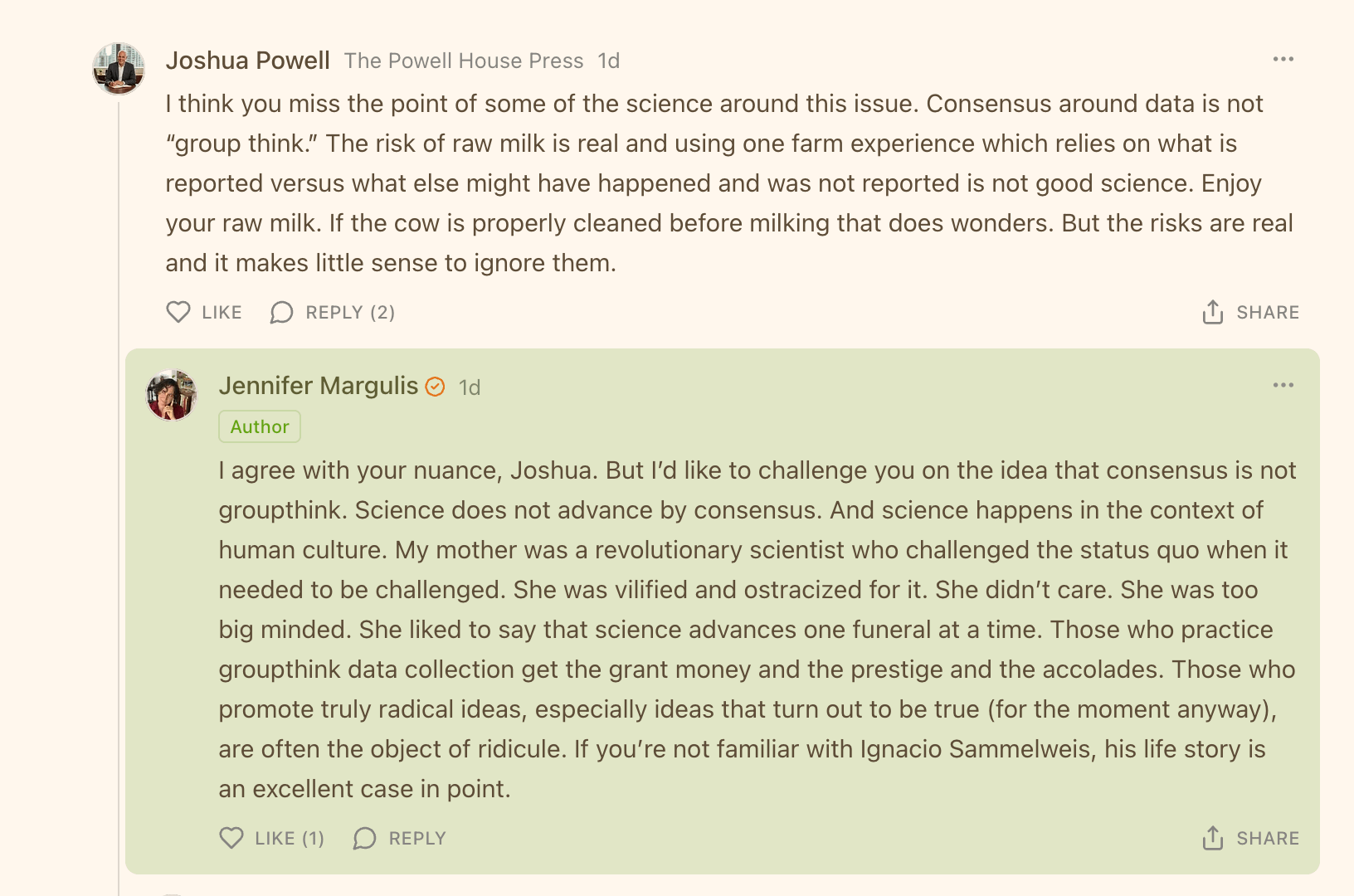
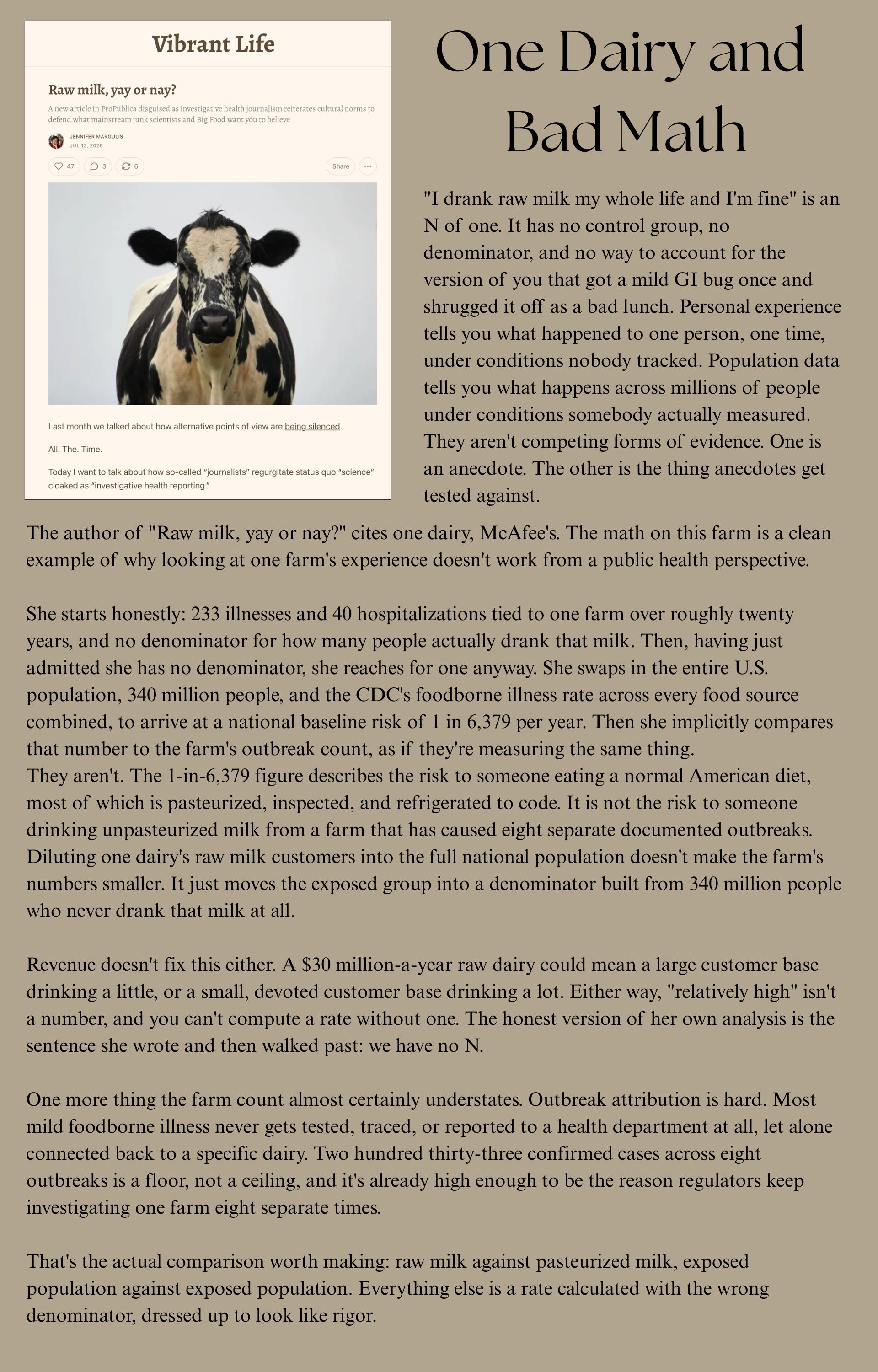
The other day I read an article here on Substack about raw milk. (You can read it by clicking here) I had a very polite exchange with the author, so none of this is meant as a shot at her personally. Two things in her piece did bothered me. One was the wrong information about the risks and benefits of raw milk. The other was the claim that the science community operates on “groupthink.”
Groupthink is a real psychological phenomenon. A group prioritizes agreement and harmony over critical thinking and independent judgment. Members get reluctant to question ideas, voice doubts, or propose alternatives. The group makes worse decisions than the individuals in it would have made alone.
That accusation has gotten a lot of traction in the age of MAHA and RFK Jr. Sadly, plenty of people in both camps (and they overlap more than either side admits) aren’t trained scientists. They’ve mistaken the scientific method for groupthink. I’ll get to that. First, raw milk versus pasteurized, on the actual merits.
Raw milk is having a moment. Wellness influencers swear by it. A few state legislatures have loosened sales restrictions. The sitting HHS Secretary has publicly praised it. None of that changes the microbiology.
Unpasteurized milk carries real, well-documented risks. Pasteurized milk carries almost none. The nutritional case for raw milk is thin. The safety case against it is not.
Milk comes out of an animal that grazes in fields, stands in barns, and lies in its own manure. The udder is not sterile. Neither is the milking equipment, the storage tank, or the truck. Every step between cow and glass is a chance for contamination.
Federal food safety guidance treats unpasteurized milk and cheese as a standard hazard, on par with undercooked meat. The reason is specific. Raw milk can harbor Campylobacter, E. coli, Listeria, Salmonella, Staphylococcus aureus, Yersinia enterocolitica, Mycobacterium bovis, Brucella, and Coxiella burnetii. That’s not a hypothetical list. Those are documented, recurring contaminants tied to raw milk outbreaks going back decades.
Anyone, even a healthy adult, can get sick from drinking raw milk. Children, pregnant women, older adults, and anyone immunocompromised face the highest risk of severe illness. Kidney failure. Miscarriage. Death. These aren’t edge cases dredged up for effect. They’re in the standard clinical literature on raw milk consumption.
As if the bacterial risk weren’t enough, H5N1 avian influenza gave raw milk a new problem starting in 2024.
In March 2024, the USDA, FDA, and CDC announced that highly pathogenic avian influenza had been identified in U.S. dairy cattle for the first time, and the virus turned up in the milk of infected herds. The CDC has confirmed 41 human cases tied to dairy cattle exposure in 2024 and 2025, mostly farmworkers with direct contact.
Researchers didn’t stop at counting cases. A study out of the University of Wisconsin-Madison, published in the New England Journal of Medicine, fed raw H5N1-contaminated milk to mice. All five animals showed signs of illness within a day. Four days later, researchers found the virus throughout the mice’s bodies, including the nasal passages and lungs. The same study found the virus survived in raw milk under refrigeration for at least five weeks. Cold storage doesn’t save you. Time doesn’t save you.
Aging doesn’t save you either, for anyone hoping raw milk cheese was the loophole. Cornell researchers found that the standard 60-day aging process required for raw milk cheese does not, in most instances, inactivate H5N1.
The official public health risk assessment as of mid-2026 is that general population risk remains low, largely because commercial pasteurized milk is unaffected. That’s a statement about the pasteurized supply. It is explicitly not a statement about raw milk, which multiple agencies continue to warn against directly.
Pasteurization is heat treatment. Milk is brought to a specific temperature for a specific time, long enough to kill pathogenic bacteria and viruses, short enough to leave the product recognizable as milk. The process was standardized about a century ago for exactly this reason: raw milk was making people sick and killing children with grim regularity.
Pasteurization kills harmful pathogenic bacteria and other microorganisms, including viruses, and has proven effective against H5N1 just as it has against the pathogens that drove the original adoption of pasteurization 100 years ago. The FDA has tested this claim repeatedly rather than assuming it. A second FDA survey of 167 retail dairy samples, including pasteurized milk, cheese, cream cheese, butter, and ice cream, found no viable H5N1 virus in any of them. Lab studies simulating pasteurization temperatures got similar results: heating infected milk at 63°C for as little as five minutes reduced the virus to undetectable levels.

Viral fragments sometimes still show up on sensitive PCR tests after pasteurization. That is not evidence of danger. It’s evidence the test is sensitive enough to detect dead virus debris. Fragments detected after pasteurization are evidence the virus has been inactivated, and they carry zero impact on human health.
Raw milk advocates argue pasteurization destroys the “good stuff.” Enzymes, vitamins, beneficial bacteria. This is the actual substance of the debate, so it deserves a straight answer instead of a dismissal.
Pasteurization does reduce some heat-sensitive components. Certain enzymes are denatured. Vitamin C and some B vitamins drop slightly, though milk was never a primary dietary source of either. Some naturally occurring bacteria, including the harmless kind, are killed along with the pathogens, because heat doesn’t discriminate between the two.
What pasteurization does not meaningfully touch: protein content, calcium, and the bulk of the vitamin and mineral profile that makes milk nutritionally useful in the first place. The protein isn’t broken down. The calcium isn’t leached out. The fat is untouched. For the average person, the nutritional gap between raw and pasteurized milk is marginal at best, and it is not remotely close to a fair trade against the documented pathogen risk.
The enzyme most often cited, lactase, isn’t naturally present in cow’s milk in a form that helps human lactose digestion anyway. That particular claim doesn’t hold up on its own terms, independent of pasteurization.
This is the honest accounting. Raw milk offers a marginal, contested nutritional edge and a real, well-documented risk of bacterial and viral illness, now including a novel influenza strain that survives refrigeration and aging. Pasteurized milk offers nearly identical nutrition with a risk profile that decades of testing have driven close to zero.
Now to the groupthink theory of why so many of us land in the same place on raw milk. It isn’t because we drank the Kool-Aid. It’s training. And the thing that’s genuinely insulting about the RFK Jr./MAHA version of this argument is that it gets the psychology backward. People who work in science are curious by trade. Some would say too curious. That curiosity is exactly why we don’t just publish findings. We publish methods. We publish so that someone else, a stranger, a rival, a grad student with something to prove, can take our hypothesis, our data, our process, and try to break it. Groupthink survives on silence. Science survives on people trying to prove each other wrong and mostly failing.
So here is the scientific method, plainly, and here is why it is the opposite of the thing it’s being accused of being.
It starts with observation. Someone notices something: cows in Texas are sick, and there’s virus in their milk. Observation alone proves nothing. It just raises a question. From the question comes a hypothesis, a specific, falsifiable claim. Not “pasteurization is probably fine,” but “heating raw milk to 63°C for 5 minutes will reduce H5N1 to an undetectable level.” A hypothesis that can’t fail isn’t a hypothesis. It’s an opinion wearing a lab coat.
From the hypothesis comes a prediction, and from the prediction comes an experiment designed to test it, not confirm it. That distinction is the whole game. A real experiment is built to give the hypothesis a chance to fail. The Wisconsin-Madison team didn’t just heat milk and declare victory. They ran controls: refrigerated milk left untreated for five weeks, to rule out the possibility that time or cold alone would do the job. It didn’t. That’s a negative control doing its job, ruling out an alternative explanation before anyone gets to celebrate the main result.
Then comes measurement, and measurement has to be specific enough that someone else can check it. “The virus went away” is not a result. “PCR-detectable viral load dropped below the assay’s detection threshold after 5 minutes at 63°C, and egg inoculation confirmed no viable virus remained” is a result. The second version can be wrong in a way the first version can’t, because it commits to numbers, methods, and thresholds that another lab can reproduce or contradict.
Then comes analysis: does the data actually support the hypothesis, or does it support something adjacent to it that got smuggled in along the way? Then peer review, where other scientists, who have no stake in your being right, try to find the hole in your design before the public ever sees the paper. Then publication, in full, methods included, specifically so a lab in Georgia or a lab in Japan can run the same experiment without calling you first to ask how you did it.
Then replication. This is the step groupthink cannot survive and science depends on. If the FDA’s finding that pasteurization inactivates H5N1 held up only in one lab, it would be a claim. It held up when the University of Wisconsin-Madison ran a heat-inactivation study, when the FDA ran two separate retail surveys using PCR followed by egg inoculation, when Cornell, the NIH’s Rocky Mountain Laboratories, and the University of Georgia mapped the thermal kinetics beyond the minimum tested conditions, and when a separate Cornell team tested whether aging alone (the shortcut raw milk cheese relies on) could substitute for heat. It couldn’t. Four separate institutions, different methods, same answer. That’s not an echo chamber agreeing to agree. That’s four groups trying to find the crack and not finding one.
And when replication fails, the method doesn’t protect the original claim. It kills it. Science has an entire, unglamorous literature of retracted findings, failed replications, and revised models, because the method is built to let bad ideas die on schedule. Groupthink, by definition, can’t do that. Groupthink protects the consensus from challenge. The scientific method exists for no other reason than to manufacture challenge, constantly, on purpose, against its own conclusions.
That’s the difference. Not lab coats. Not credentials. Not a shared culture that closes ranks. A hypothesis that risks being wrong, an experiment built to let it fail, and a community of people whose careers are made by finding the flaw you missed. Call that groupthink if you want. It’s the opposite of it.
Public health guidance is consistent across every agency that has weighed in: choose pasteurized milk and pasteurized dairy products. Not because raw milk is trendy heresy, and not because scientists all agreed to say so at the same conference. Because the hypothesis got tested, the test was built to fail, and it didn’t. Every time, in every lab that tried. That’s not groupthink. That’s just what happens when an idea is actually true.
©2026 All Right Reserved | The Powell House Press | Josh@thepowellhousepress.com
How the wheel of scientific and human history continues to turn. Louis Pasteur, best known for his work on bacterial pathogens and the development of treating milk by heating to reduce the pathogenic load, was also vilified early in his career by established scientists who did not believe in germ theory. However, through diligent, well designed, and repeatable experimentation, Pasteur and his method of pasteurization overcame the "groupthink" of the mid 1800s. Much of food safety that current society enjoys is the result of this work.
The raw milk advocates ask an interesting question; is there a nutritional and associated health/survival benefit of raw milk as produced in the 2020s? They are neither right nor wrong, but they do have to do the unbiased scientific experimentation to find that answer. Otherwise, the raw milk crowd are but the flat earthers of nutrition and food safety science.
Joshua: For once, we seem to agree on a topic. The whole raw milk scam is just that, and it demonstrates the flaws in Kennedy's approaches to public health. By the way, adults do not need to drink any milk to be healthy. Throughout human history, milk intake was mostly restricted to infants and children.
I am very familiar with the scientific method. I trained under Franz Halberg at the University of Minnesota, and Franz started the field of chronobiology. I have previously mentioned my CARB syndrome theory, and it is just that--an unproven theory that would be challenging to prove using present-day science. I use the theory because it seems to consistently result in better outcomes based on empirical observations. If someone has a theory that consistently gives even better outcomes, I will use their theory. In the real world, we must use the theories that seem to give the best empirical results until we have access to controlled studies. I know it's a bit messy, but that's how the real world works.