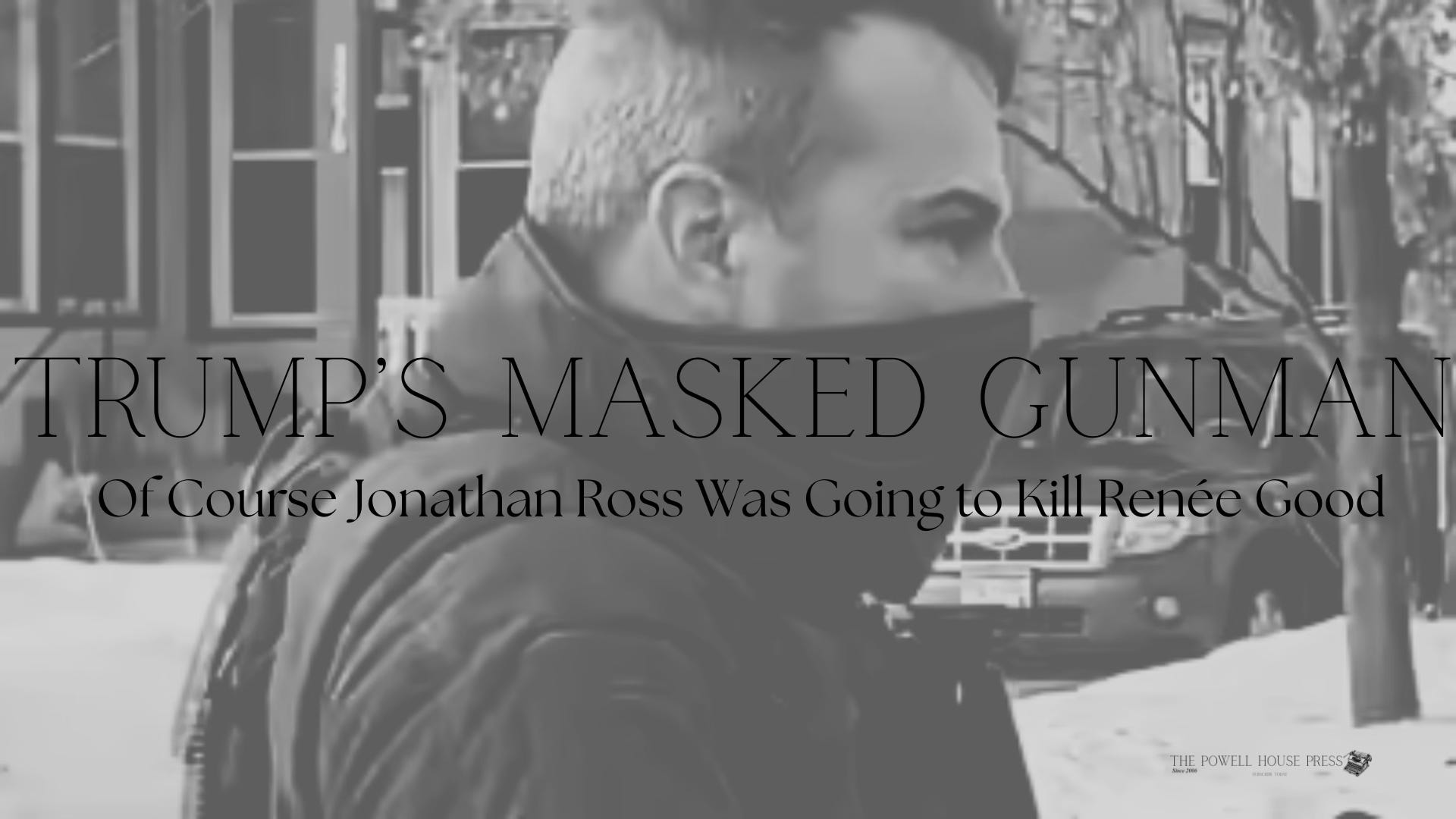
The MAGA Enforcer
Jonathan Ross spent two decades preparing for a moment like this. On a snowy Minneapolis street, it arrived.
By the time Jonathan Ross pulled the trigger on the morning of January 7th, sending three bullets into a burgundy SUV driven by a 37-year-old mother named Renee Nicole Good, the 43-year-old ICE agent had been preparing for such a moment for nearly his entire adult life. Machine gunner in Iraq. Border Patrol intelligence officer in El Paso. Deportation specialist. SWAT team member. Firearms instructor. Active shooter trainer. FBI Joint Terrorism Task Force team leader. His resume reads like a catalog of American force projection, domestic and foreign, the kind of career that begins with a teenage boy from a bankrupt household in Illinois and ends, two decades later, with a man standing in the Minnesota cold, recording himself on his cell phone as he fires into a woman’s windshield. What his phone also captured, in the seconds after Good’s SUV careened down the street and crashed into a parked car, was a voice--his own, or perhaps another agent’s--uttering two words that have since echoed across a nation watching the footage: “Fucking bitch.” It is a phrase that tells you almost everything you need to know about Jonathan Ross, and about the movement that produced him, because Jonathan Ross did not arrive at that moment by accident. He was formed by a politics, decorated his home with its symbols, steeped himself in its rhetoric, and then, on a snowy street in Minneapolis, did exactly what Trumpian politics has always demanded.
In the quiet cul-de-sac outside Minneapolis where Ross lives with his wife and children, neighbors knew him as the reserved one--quiet, watchful, the kind of man who wore fatigue pants around the neighborhood and kept a military license plate on his vehicle. But if Ross himself was reserved, his house spoke loudly enough. Until recently, a “Don’t Tread on Me” Gadsden flag flew from his property, that coiled snake on yellow that has become the unmistakable heraldry of the MAGA movement, the banner under which men have stormed the Capitol and staged armed protests and proclaimed their readiness for civil war. During the 2024 election, Trump/Vance stickers decorated the home. One neighbor recalled it plainly: “He had a don’t tread on me flag, and Trump/Vance stickers up during the election.” By Thursday afternoon, the day after the shooting, the flags were gone and so was Ross, but by then the flags had already done their work. They had announced, for years, exactly who Jonathan Ross was. They had declared his allegiances, advertised his worldview, signaled to anyone paying attention that here lived a man who had chosen a side in the war he believed was coming. The Gadsden flag and the Trump stickers were not incidental to what happened on January 7th. They were prologue.
We have been trained, in this country, to treat political symbols as a kind of protected speech, as expressions of opinion no more consequential than a preference for one sports team over another. But the symbols of Trumpism are not neutral. They are not harmless. They are the iconography of a movement that has made violence its defining feature, that has celebrated the beating of protesters and the running down of demonstrators, that has produced a president who told his followers to “fight like hell” and watched approvingly as they broke windows and hunted lawmakers through the halls of the Capitol. The Gadsden flag, once a symbol of revolutionary resistance to tyranny, has been repurposed in the Trump era as a totem of aggrieved white masculinity, flown by men who see themselves as soldiers in a war against an America that has grown too soft, too brown, too tolerant of people they believe do not belong. When you fly that flag outside your suburban home, when you affix those stickers to your property, you are not merely expressing a preference. You are joining an army. You are declaring that you see the world as a battlefield and that you have chosen your side, and the side you have chosen is the one that has made it abundantly clear what it intends to do to its enemies. Donald Trump has called immigrants “animals” and “vermin” and accused them of “poisoning the blood of our country.” He has promised “retribution” against those who oppose him. He has described his political enemies as “the enemy within” and mused about using the military against them. This is not ambiguous. This is not metaphor. This is a political movement telling you, explicitly, that it intends to inflict violence on the people it despises, and when a man like Jonathan Ross flies that flag and displays those stickers, he is telling you that he is ready to be the one who inflicts it.
The connection between the symbols and the violence is not incidental. It is causal. You cannot marinate in the rhetoric of Trumpism--the dehumanization, the apocalyptic framing, the gleeful cruelty--and remain unchanged by it. The flags and the stickers are not decoration; they are catechism. They teach you who matters and who doesn’t, who deserves protection and who deserves punishment, who is fully human and who is something less. They prepare you, day by day and rally by rally, for the moment when you will be called upon to act on what you have learned. For some Trump supporters, that moment came on January 6th, when they beat police officers with flagpoles and smeared feces on the walls of the Capitol. For Kyle Rittenhouse, it came on the streets of Kenosha, where he shot three people and was subsequently invited to meet the president and feted as a hero by the movement. For Jonathan Ross, it came on the morning of January 7th, when a 37-year-old mother tried to drive away from a group of federal agents and he put three bullets into her car in under a second. The flags told you this was coming. The stickers told you this was coming. The only question was when, and who would be on the receiving end.
What makes Ross’s story particularly revealing is how thoroughly his politics had permeated his life, even to the point of fracturing his own family. In October 2020, his sister Nicole posted a photograph on Facebook of herself wearing a face mask. The caption read: “I denounce and condemn white supremacy.” Jonathan replied. The comment has since been deleted, but whatever he wrote prompted his sister to respond publicly: “We have to respectfully disagree. You are my brother and I love you, but we will not engage in a debate on Facebook.” The subject of their disagreement, according to reports that have emerged since the shooting, was the Proud Boys--the street-fighting nationalist organization whose members have been convicted of seditious conspiracy for their role in the January 6th insurrection, an organization that has marched alongside white supremacist groups and made violence against the left its explicit mission.
That Jonathan Ross felt compelled to argue with his own sister about this, that he could not let her denunciation of white supremacy pass without challenge, tells you everything about how deep the rot had gone. Here was a federal law enforcement officer who apparently could not bring himself to agree, without caveat or qualification, that white supremacy was bad. Here was a man with a badge and a gun who had so thoroughly absorbed the ideology of Trumpism that he would defend an organization of fascist street brawlers to his own family. And his family, in turn, knew exactly what they were dealing with. “We have to respectfully disagree,” his sister wrote, with the exhausted diplomacy of someone who has long since given up on changing her brother’s mind. “You are my brother and I love you.” The flags outside his house were not a surprise to the people who knew him. They were a confirmation.
His father, Ed Ross, is 80 years old and lives in North Pekin, Illinois, where he has served as director of two church-related organizations. When the Daily Mail reached him for comment after the shooting, he offered what he clearly believed was a defense of his son’s character: “You would never find a nicer, kinder person. He’s a committed, conservative Christian, a tremendous father, a tremendous husband. I couldn’t be more proud of him.”
This is how the Ross family understands Jonathan--as a man of faith, a man of family, a man of values. It is a self-conception shared by millions of Trump supporters, this belief that their politics are an expression of their Christianity rather than a perversion of it. But the Trump movement has revealed, with terrible clarity, what American Christianity has always contained: a capacity to hold tenderness and brutality in the same hand, to speak of loving thy neighbor while building a politics designed to crush him. The men who burned crosses were also men who went to church on Sunday. The officers who turned fire hoses on children in Birmingham went home to families who loved them. Cruelty and piety have never been mutually exclusive in America; they have often been conjoined, the one providing cover for the other, the language of salvation deployed to sanctify acts of destruction. And so Jonathan Ross can be, in his father’s telling, a tremendous father and a committed Christian, and he can also be the man who shot a woman in the head as she tried to drive away and then, seconds later, was recorded as a voice on his own phone said “fucking bitch.” These are not contradictions. This is the Trump movement in its purest form: violence wrapped in the language of faith and family, cruelty rebranded as righteousness, murder dressed up as self-defense.
The rhetoric matters. The symbols matter. When a political movement spends years telling its followers that immigrants are “poisoning the blood” of the country, that protesters are “terrorists,” that the enemy is not merely wrong but evil and subhuman, it is building a permission structure for violence. It is telling its adherents that the normal rules do not apply, that the people on the other side have forfeited their right to be treated as human beings, that whatever you do to them is justified because they are not really people at all. This is how atrocities happen. Not because the perpetrators are monsters, but because they have been taught, carefully and systematically, to see their victims as monsters first. Jonathan Ross did not wake up on the morning of January 7th and decide, spontaneously, to shoot a woman in the head. He had been prepared for that moment by years of flags and rallies and Fox News segments and Trump speeches, by a politics that told him every day that people like Renee Good--protesters, liberals, people who would stand in the way of ICE--were the enemy, were terrorists, were a threat to everything he held dear. The flags outside his house were a curriculum. The stickers on his property were a course of study. And on January 7th, he graduated.
There is one more detail that deserves attention, one more thread in a story already dense with irony. Jonathan Ross’s wife is an immigrant. Her parents are doctors who still live in the Philippines. She and Ross married in 2012, when he was still working for the Border Patrol in El Paso; on her Instagram, she once posted a photograph of herself posing next to a U.S. Border Patrol helicopter. When the Daily Mail asked Ed Ross how long his daughter-in-law had been in the United States, he demurred: “I do not want to go any further than that.” The irony writes itself--a man who spent a decade enforcing immigration law with what appears to be considerable enthusiasm, who flew the flag of a movement built on nativist rage, married to a woman whose own family crossed an ocean to reach this country--but perhaps irony is not quite the right word. Perhaps this is simply the way the system has always worked for men like Ross, the unspoken exception that proves the rule. The border is sacred, except when it isn’t. The immigrant is a threat, except when she is your wife. The law must be enforced with maximum violence against them, but the people you love will always be one of us. This is the through-line of Trumpism, the belief that hierarchy is natural and inevitable, that some people are simply worth more than others, that the role of power is to protect those who matter from those who don’t. Jonathan Ross knows, in his bones, who matters and who doesn’t. He knows which immigrants are acceptable and which are “poisoning the blood.” He knows which lives are precious and which can be ended with three quick shots and a muttered obscenity. The flags told him. The stickers told him. The president he supported told him. And on January 7th, he acted on what he had learned.
On the morning of the shooting, Renee Nicole Good drove her burgundy Honda Pilot into a south Minneapolis neighborhood where ICE agents were conducting enforcement operations. She was a poet, a writer, a mother of three, a queer woman who had recently relocated from Canada with her wife and young child. According to witnesses, she and her wife were acting as legal observers, documenting the protest against ICE’s presence in the city. What happened next is captured on multiple videos, including the footage Ross recorded on his own cell phone. Good’s SUV was stopped perpendicular to the street. Agents surrounded her vehicle. Another agent told her to “get out of the fucking car.” In footage from Ross’s phone that has since been released, Good can be heard speaking to him before the shooting, her tone calm, even friendly: “That’s fine, dude. I’m not mad at you.” Then she began to drive forward, turning her wheels to the right, away from Ross, in the correct direction of traffic on the one-way street. Video analysis by the New York Times, ABC News, the Washington Post, and the BBC has shown that at the moment Ross fired his first shot, Good’s wheels were directed away from him and his legs appeared to be clear of the vehicle. He was not, as the Trump administration later claimed, “viciously run over.” He fired three times in under one second--the first shot through the windshield, the second and third through the driver’s side window as the car passed him. Good was struck in the head. Her SUV accelerated down the street and crashed into a parked car. ICE agents refused to allow a bystander who identified himself as a physician to provide medical aid. Six minutes passed before EMS arrived. Eight minutes after being shot, Good began receiving CPR on the street. She was 37 years old, and she had a six-year-old child, and in the last footage of her alive she is smiling at the man who is about to kill her, telling him she’s not mad at him, and then he shoots her in the head and calls her a fucking bitch.
In the days since, Jonathan Ross has become what he perhaps always was: not an aberration but an avatar, the purest expression of a political movement that has been building toward this moment for years. His defenders have rallied to him with the fervor of the faithful. A GoFundMe has raised more than $370,000. For what?
Billionaire Bill Ackman announced that he contributed. Vice President JD Vance declared that Ross “deserves a debt of gratitude” and sneered at the press: “You should be ashamed of yourselves. Every single one of you.” President Trump claimed, in defiance of the video evidence, that Good had “viciously run over” the agent. To his critics, Ross is everything brutal and lawless in the Trump era given a badge and a gun--a man who shot an unarmed mother as she drove away, who displayed the symbols of fascism and then did what fascists do.
But the truth is simpler, and more damning, than either side admits. Jonathan Ross is not a monster. He is a product. He is what the Trump movement makes of men who are willing to be made: true believers, armed enforcers, soldiers in a war against an enemy that exists mostly in their own never-ending adolescent imaginations. The Gadsden flag prepared him. The bumper stickers prepared him. The rallies and the speeches and the endless propaganda about invaders and terrorists and enemies within prepared him. And when the moment came, he was ready. Three shots. A woman dead. A voice on the recording, dripping with contempt for the life he had just taken: “Fucking bitch.” This is the violence of the Trump supporter. Not an accident but an inevitability. The flags promised it. The stickers promised it. Jonathan Ross delivered.
The FBI is investigating the shooting. Ross has not been charged with any crime. Minnesota officials have been barred from participating in the investigation.
©2026 All Rights Reserved Josh Powell, The Powell House Press