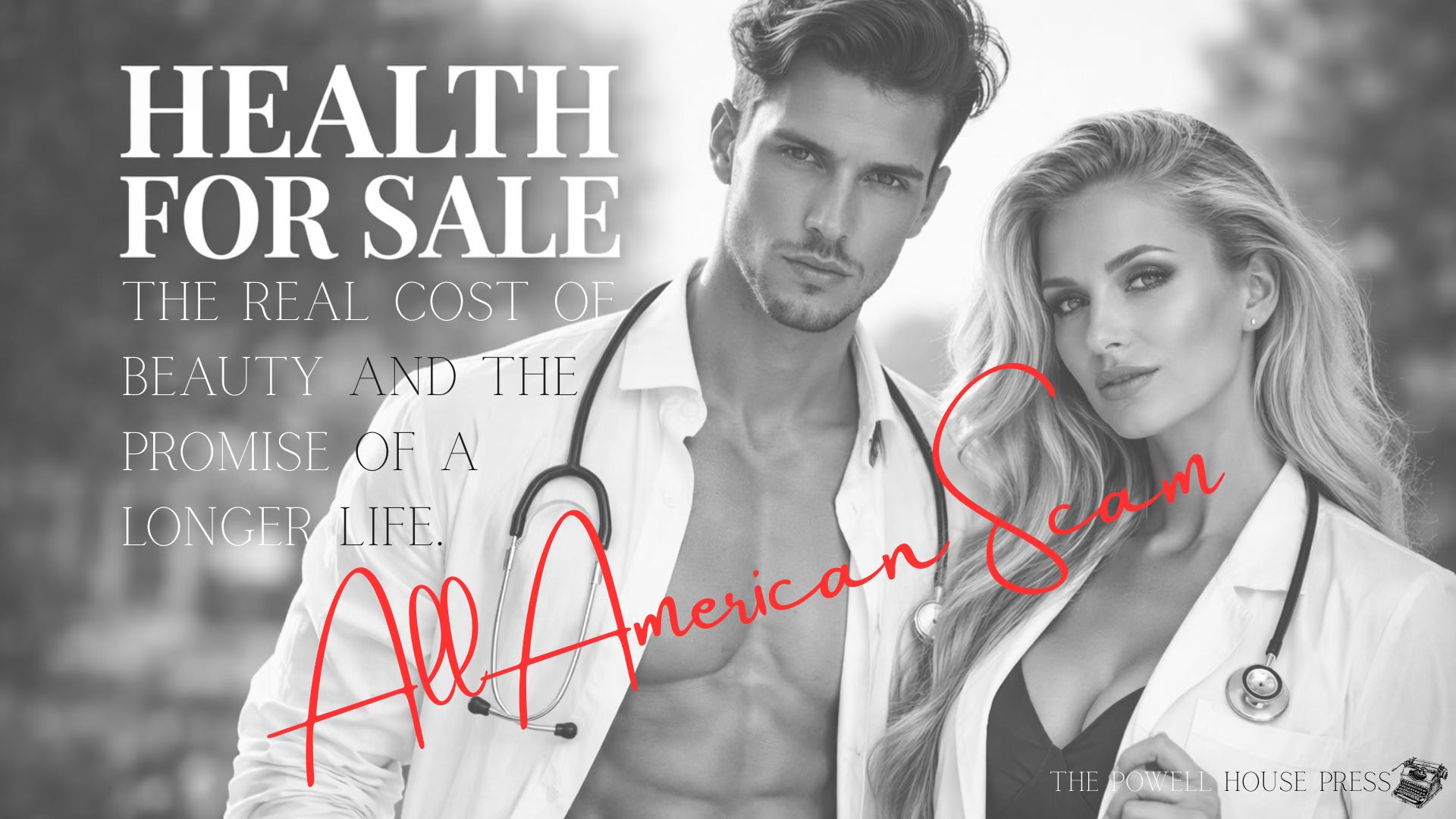
The MAHA Health Hustle: The Doctor Will Sell You Now
We are in the golden age of scam healthcare - and some doctors are game for it
Scroll through social media for five minutes and you’ll find them. The influencers hawking mystery shakes. The telehealth clinics pushing GLP-1s to anyone with a credit card. The THC-infused everything, the IV drip lounges, the biohackers with their continuous glucose monitors and their $400 saunas. All of it wrapped in the language of science, none of it obligated to demonstrate that it works.
That's the legal part. What makes today's wellness landscape truly remarkable isn't just the anonymous hustlers on Instagram. It's the credentialed professionals (doctors, chiropractors, naturopaths) who've figured out that a framed diploma is the most effective marketing tool money can't buy. They don't need to cure you. They need to sell to you. The regulatory system, which has flirted with reining in charlatans and tightening rules around physicians selling products, has made it easy. Now that system is run by a man who not only doesn't know medicine, Robert F. Kennedy Jr., he and his wife Cheryl Hines have sold products in this space. His pick for Surgeon General, Casey Means, has built her career in this unregulated and unproven world of wellness. It is only going to get worse.
The Specialty That Doesn’t Exist
To move the products off the shelves, and there is always a product (be it pills, tests, sessions, meal plans, meal packs) a product has to stand out. One of the tried and true methods is having a good pitchman, and nothing in America is more reliable and trusted than physicians. The word doctor has become ubiquitous while the meaning is becoming more and more opaque. There are doctors of physical therapy, doctors of sports medicine, doctors of nutrition, and of course the doctor of philosophy. None of which are physicians and many are not considered healthcare professionals, even when medicine is in the degree. This only adds to the confusion, and it is in this chaos that some real doctors have found their niche. They are real doctors. What they are selling is, at best, theoretical.

In this gray space between being a real doctor credentialed in a recognized specialty (no disrespect intended to those with advanced degrees) and the garden-variety snake oil salesman, there have emerged the new "specialties."Not the evolution of science. The mother of invention needed to push expensive and often dangerous products.
Longevity medicine. Metabolic medicine. Functional medicine. Wellness medicine. Specialties with no boards to pass, no fellowships to grind through, no peer committees deciding who’s qualified. What they share is a founding premise with just enough truth in it to sting: that conventional healthcare waits until you’re sick before it does anything about it.
That’s not entirely wrong. American medicine is largely reactive. Most people see a doctor when something hurts, not when everything is fine. By the time blood pressure climbs, arteries narrow, and glucose creeps into diabetic range, the damage is done. Longevity medicine positions itself as the antidote, a way to identify problems decades before they become disease. A medical crystal ball.
The entry pitch sounds reasonable. Deeper bloodwork. Imaging to detect early arterial plaque. Genetic analysis to estimate biological age. All of that is real science, used by real researchers. But these clinics don’t stop there. They keep going, deeper into expensive territory, where the evidence gets thin and the invoices get thick.
Success, and it is just that, success is in the eye of the beholder. What was the patient, now better termed the client (one might use “mark”) is often evaluated in the mirror, in waist size, in looking good on the outside no matter the shame of the inside.
It is the equivalent of the lovely home in Greenwich that once you’re inside is decorated exclusively from HomeGoods.
And in the world of looking good, it seems men are doing their level best to catch up with the Kardashian ethos. From Jeff Bezos to RFK Jr. himself, the use of testosterone illustrates this phenomenon perfectly.
Testosterone: The Fountain of Youth That Isn’t
Here’s the thing about testosterone: it does decline with age. Low levels are linked to fatigue, reduced muscle mass, decreased libido, and a general sense that the engine is running on less fuel. For men with genuine hypogonadism — a medical condition where the body fails to produce adequate hormone — testosterone therapy works. The evidence is solid.
And the evidence is solid that testosterone builds muscle and in our anti-aging obsessed culture, this is the goal. Being jacked or having a wrinkle-free face is now “healthy.” Good health is a photo op. And this is where these “brands” of medicine get traction.
What the longevity clinics sell is not treating disease. In the case of testosterone they’re “optimizing” healthy men whose levels are technically normal but ‘on the lower end.’ Push them into a higher, more youthful range, the pitch goes, and you’ll feel like you did at 20. However, the clinical evidence does not support that. Large observational studies following men for nearly a decade have found no meaningful difference in mortality between those on testosterone therapy and those who aren’t. Meta-analyses echo the same conclusion: it does not significantly reduce the risk of death. Meanwhile, the risks are real — elevated hematocrit that thickens the blood and raises clotting risk, potential stimulation of undetected prostate cancers, suppressed natural testosterone production that can crash harder when therapy stops, and substantially reduced fertility.
Symptoms like low energy, weight gain, and reduced drive are not specific to low testosterone. They can come just as easily from poor sleep, excess body fat, stress, or a sedentary life.
The decade-long trials needed to truly assess lifespan effects don’t exist. The short-term trials that do exist focus on men who are clinically deficient — not healthy men paying out of pocket for optimization. The gap between that evidence base and what’s being sold in longevity clinics is not a gray area. It’s a sales strategy.
The $70 Bottle of “Have I Got a Deal for You.”
If only it ended with the slew of tests, scans and hormones. But here’s the real science: if a person is so desperate that they’ll part with money and time and put their bodies through the stress of surgery or hormone therapy, what else are they willing to pay for?
Research shows that people are willing to pay significant premiums for health and wellness interventions when they believe they are supported by credible science, even if the actual evidence is limited. In settings like longevity clinics, perceived expertise and framing by physicians often substitute for proof, leading patients to spend heavily on supplements and treatments that are not well supported by clinical data.
Walk into any longevity clinic, functional medicine office, or upscale naturopath’s waiting room and you will encounter supplements. Dozens of them, often bearing the practitioner’s own name and logo. Professional-grade. Practitioner-formulated. Categorically superior to the generic versions at the drugstore.
Almost none of this is true.

The vast majority of these products are private-labeled (also called white-labeled) from contract manufacturers. The physician browses a catalog of pre-existing formulas, picks the capsule count, uploads their logo, and receives finished product in two to four weeks. They didn’t develop the formula. They didn’t modify it based on clinical experience. In many cases, the identical formula is available online under a dozen other brand names for a fraction of the price. A supplement that costs three dollars to manufacture leaves a longevity clinic shelf at fifty.
The underlying science is largely borrowed from animal studies, early human trials, and theoretical mechanisms. NMN. Resveratrol. CoQ10. Compounds endlessly hyped on podcasts, backed by mouse data, and sold with the confidence of someone who definitely knows what they’re talking about. Long-term clinical outcomes in humans? Thin to nonexistent.
To make it worse, the dietary supplement industry in the United States operates under a regulatory framework that would embarrass most developed nations. The 1994 Dietary Supplement Health and Education Act determined that supplements don’t have to be proven safe or effective before hitting shelves. The FDA must prove harm after the fact. Manufacturers operate, more or less, on the honor system.
In 2015, the New York State Attorney General tested store-brand supplements from GNC, Target, Walgreens, and Walmart. Four out of five products contained none of the herbs listed on the label. Ginkgo biloba was powdered radish. St. John’s Wort was mostly rice. An independent JAMA analysis found nearly a quarter of supplements contained ingredients not on the label at all, including prescription drugs. The FDA has issued hundreds of warnings about supplements spiked with sibutramine, sildenafil, and amphetamine analogues. And that’s the industry’s version of accountability.
But it doesn’t end with how these supplements can augment health. Now popping up all over the internet are tonics that claim to allow users to do unhealthy things and remain healthy. And no it’s not Vitameatavegamin, but it might as well should be.
The Drink-To-You-Drop Supplements
The liver supplement market has quietly grown into a multi-billion dollar industry built on one of the most audacious promises in all of wellness: that you can drink heavily and then pill your way out of the consequences.
Milk thistle has been used medicinally for over two thousand years. Its active compound, silymarin, has genuine anti-inflammatory and antioxidant properties. Animal studies suggest it can minimally reduce alcohol-induced liver damage. When the NIH actually ran a large-scale human trial, the results were underwhelming. NAC (N-Acetyl Cysteine) has real hospital credentials as a treatment for Tylenol overdose. Translating that into a pre-gaming supplement is where the science quietly stops following along.
None of these products have been demonstrated in rigorous human trials to prevent alcohol-related liver disease. The liver processes roughly one standard drink per hour. Nothing on the market changes that. The supplements don’t support the liver. They support the belief that the solution to a behavioral problem is a pill.
Not only does this create a false sense of security for those who need to address alcohol use, it is heavily marketed to college students, who have a higher incidence of binge drinking, and timed to peak during periods of heavier consumption, like the Christmas and New Year’s holidays.
The $200 Cream and the Word That Doesn’t Exist
If you’re between procedures and the milk thistle and hormones haven’t fixed what’s ruining the selfie, there’s a cream for it.
“Cosmeceutical” is not a legal category. The FDA has never recognized it. A product is either a drug (requiring clinical trials, safety data, and regulatory approval) or a cosmetic, which must simply be safe and properly labeled. The skincare industry invented the term “cosmeceutical” to imply pharmaceutical potency while legally remaining a cosmetic, subject to exactly zero efficacy requirements.
It is almost impossible to visit a wellness clinic, plastic surgeon’s office, or longevity expert without being offered a potion.
The marketing is carefully engineered. Labels say “supports skin renewal” rather than “reverses aging.” “Promotes collagen appearance” rather than “rebuilds collagen.” Each phrase is designed to activate the same neural pathway as the drug claim it’s legally prohibited from making.
The physician-branded skincare market runs the same private-label playbook as the supplement world. A dermatologist or plastic surgeon selects a formula from a manufacturer’s catalog, adds their name and a clinical-sounding backstory, and sells a $3 base moisturizer for $80. The term “medical grade” has no regulatory meaning whatsoever. There is no FDA classification called medical grade for cosmetics. Any brand, any physician, any manufacturer can use it freely. If it doesn’t need a prescription and is being sold in an office, you can most likely get it at CVS or Macy’s.

Step back from any individual product the supplement, the hormone protocol, the serum and the underlying business model comes into focus. It isn’t healthcare. It’s the sale of a fantasy, dressed in the language of medicine and legitimized by the presence of a degree.
The regulatory gaps are not accidental. They are the garden where these products grow. Supplements don’t need to work before they’re sold. Cosmetics don’t need to do what they imply. Private-label products can carry a physician’s authority without any of their actual expertise. ‘Medical grade’ can mean anything or nothing. This is the infrastructure that makes the whole enterprise possible.
The longevity clinic, the branded supplement line, the $200 serum: what’s being sold, in nearly every case, is the feeling that someone who cares and is “trained” has solved your complicated problem with precision and care.
What actually happened is that someone picked it from a catalog.
Why Your Subscription Matters
Independent journalism answers to readers—not advertisers, corporations, or access-hungry editors. No story gets killed because it upsets a sponsor. No punch gets pulled because someone important made a phone call.
Your support makes possible sharp commentary, fearless satire, and reporting that follows the story wherever it leads. In an era of manufactured narratives and algorithmic blandness, that independence isn’t a luxury—it’s a necessity.
Subscribe to The Powell House Press. Or settle for content that tells you what someone else wants you to hear.
©2026 | josh@thepowellhousepress.com