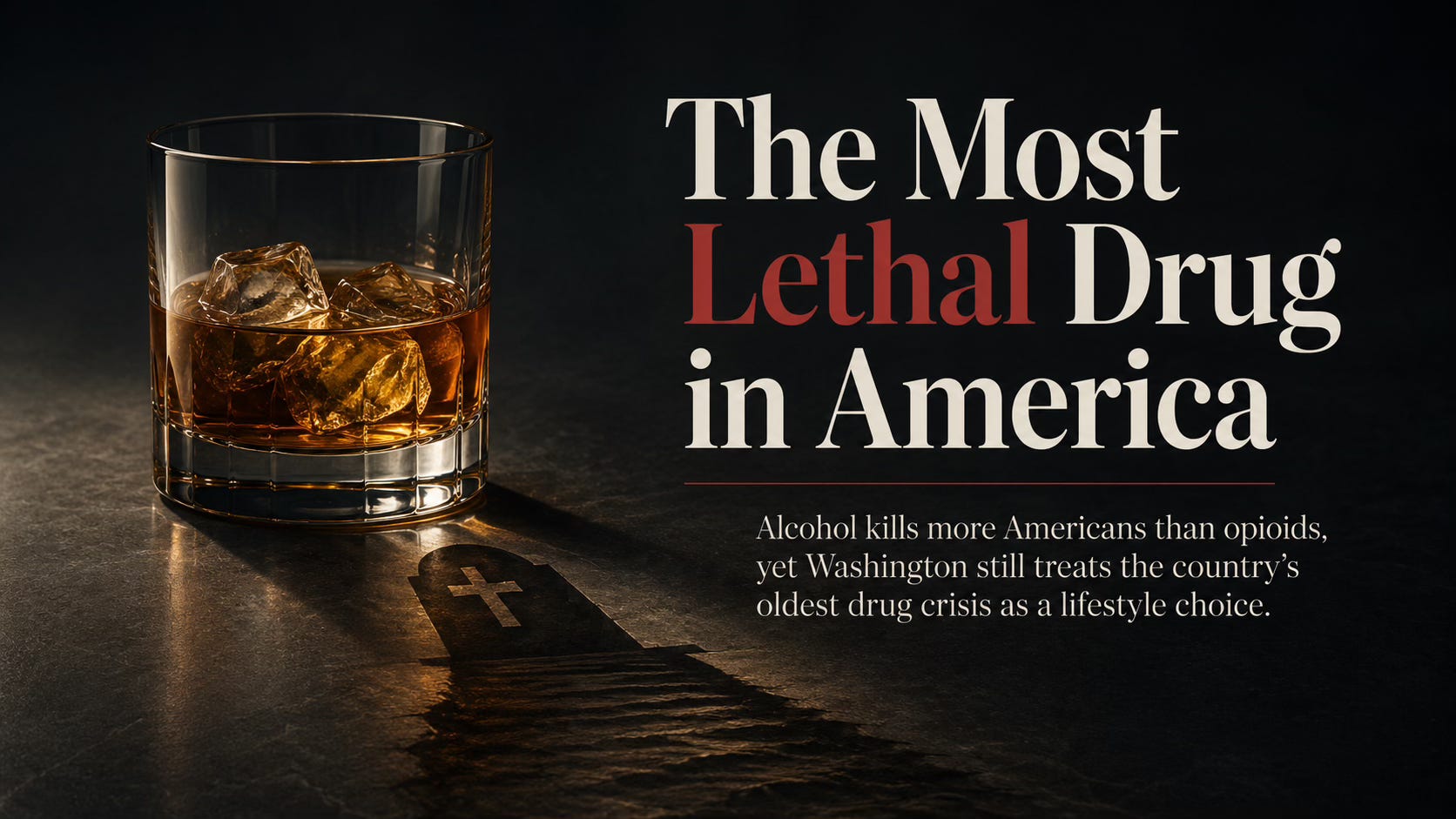
The Most Lethal Drug in America
Alcohol kills more Americans than opioids, yet Washington still treats the country’s oldest drug crisis as a lifestyle choice.
Author’s Note: This article is not part of my serial reporting on the proposed vineyard development in Columbia County, New York. But it is certainly Wine Wars adjacent.
The data on alcohol is strong. The facts are not obscure. We know what alcohol does to people, families, emergency rooms, hospitals, roads, workplaces, and public budgets. This is not an argument for outlawing alcohol. Not even close. I have had my share, and I am not writing from a place of temperance or moral purity.
But alcohol is not only a personal choice. At scale, it is a public-health issue with enormous human and economic costs. That is the point of this article.
I spent years working on the opioid epidemic as a researcher with the HEALing Communities Study, designing public-health interventions meant to keep people alive long enough to recover. I know why opioids command attention. Fentanyl is sudden. It is cinematic in the worst possible way. A person is alive, and then a person is gone. The death is immediate, shocking, and often young. It fits the grammar of American crisis: sirens, body bags, grieving parents, press conferences, emergency funding.
Alcohol does not usually kill that way.
It kills at weddings and football games and brunches. It kills in airport lounges, hotel bars, restaurants, kitchens, college dorms, retirement communities, and living rooms after the children have gone to bed. It kills through car crashes, falls, drownings, alcohol poisoning, suicide, cancer, cirrhosis, heart disease, pancreatitis, fetal exposure, domestic violence, and decades of damage no one calls an emergency until the liver fails or the tumor appears.
That is one reason we have failed to see it clearly. The other is that alcohol is not treated in America as a drug. It is treated as a personality trait, a hospitality ritual, a consumer preference, a social lubricant, a lifestyle brand, a reward, a punchline, and a sacrament of adulthood. We call it wine culture, beer culture, cocktail culture. We do not call it what it is: the most lethal drug in America.
The numbers are not obscure. Alcohol kills roughly 178,000 Americans a year, about 500 people every day. About a third of those deaths are acute: crashes, poisonings, violence, falls. The rest come through the slower channels of disease. Alcohol is linked to cancer, liver disease, cardiovascular disease, and a long inventory of medical conditions that accumulate quietly until they become irreversible. The annual economic cost exceeds $240 billion. Emergency-department visits attributable to alcohol roughly doubled between 2003 and 2022. Jenny Wilson, an emergency physician in Reno, has described alcohol in her emergency department as “an absolute poison.” Multiple cases per shift. Every shift.
Yet the country still behaves as though alcohol is a private matter, while opioids are a public-health emergency.
The contrast is revealing. In one recent year, Massachusetts recorded approximately 10,000 opioid-related hospitalizations and 85,000 alcohol-related ones. One number enters the news cycle. The other is absorbed into the background noise of American medicine. The opioid patient is understood to represent a national emergency. The alcohol patient is understood to have made a series of bad choices.
That distinction is morally convenient and medically false.
For decades, public health has known how to reduce alcohol-related harm. Other wealthy nations have used some combination of accurate warning labels, pricing policy, advertising restrictions, screening, brief intervention, and medication-assisted treatment. None of these measures requires Prohibition. None requires treating moderate drinkers as criminals. They require only that government respond to alcohol in proportion to the damage it causes.
The United States does not.
That failure is especially striking now, because the two men at the top of American health policy carry unusually personal histories with alcohol. President Donald Trump’s older brother, Fred Jr., died at 42 after struggling with alcohol addiction. Trump has often credited his brother’s death with making him a lifelong abstainer. Robert F. Kennedy Jr., the Secretary of Health and Human Services, is the first person to hold that office while publicly discussing his own recovery from alcohol addiction. He has spoken often about addiction, recovery, and the spiritual architecture of sobriety. If biography produced policy, this administration would be uniquely equipped to confront the country’s most destructive legal drug.
It has not.
Instead, federal alcohol policy has narrowed into vagueness and evasion. The new dietary guidance reduced its message on alcohol to the softest possible instruction: consume less. In January, Mehmet Oz, the administrator of the Centers for Medicare and Medicaid Services, explained the guidance by saying the goal was to avoid drinking at breakfast. The next day, he clarified that “brunch is obviously different than breakfast.”
It was treated as a joke because alcohol is always treated as a joke until someone dies from it.
The problem is not one clumsy comment. It is the absence of a serious federal agenda. Proposals to modernize warning labels on alcoholic beverages have stalled. Several national survey instruments that measure American drinking behavior, the very data sets that allow researchers to track the crisis, have reportedly been delayed or cancelled. The administration’s flagship addiction effort, the Great American Recovery Initiative, run jointly by Kennedy and Kathryn Burgum, appears to be focused overwhelmingly on opioids. Asked for specifics on alcohol, HHS pointed to an outreach program for unhoused people with substance use disorders and to overall treatment funding. That is not a strategy. It is a deflection.
The vacuum has consequences. Public-health policy does not remain empty. When government retreats, industry enters.
The alcohol industry is one of the most sophisticated political operations in the country. Beer, wine, and spirits trade associations have spent decades embedding themselves in Washington, in statehouses, in medical organizations, in advocacy networks, and in the research ecosystem. Their influence is not hidden. There are congressional caucuses for beer, wine, and spirits. Industry money underwrites scientific conferences, nonprofits, public campaigns, and studies used to defend the idea that moderate drinking is harmless or even beneficial. When states attempt reform, the industry responds with force. This spring in Colorado, a proposal to fund addiction treatment through alcohol fees was defeated for the second time after lobbying by trade groups and their allies.
Kennedy’s Make America Healthy Again framework rests on a simple premise: that corporate interests have captured American health policy, placing profit over public health. Big Pharma. Big Food. Big Medicine. The theory is not wrong in the abstract. But its selectivity is glaring. By every available measure, Big Alcohol fits the indictment. Its product is highly processed, aggressively marketed, often sugar-loaded, carcinogenic, and responsible for hundreds of preventable deaths every day. It is precisely the kind of corporate public-health problem Kennedy says he came to Washington to confront.
And yet alcohol remains outside the frame.
That contradiction matters because the most consequential failure is not rhetorical. It is clinical.
The United States already has FDA-approved medications for alcohol use disorder. Naltrexone can reduce heavy drinking and lower the risk of relapse. Acamprosate can help people maintain abstinence. These drugs are well-studied, off-patent, inexpensive, and dramatically underused. Fewer than 10 percent of Americans diagnosed with alcohol use disorder receive any FDA-approved pharmacotherapy. This is not because the medications are experimental. It is because the treatment system has never been built around them.
We know what a different model looks like. The federal opioid response, imperfect as it has been, helped mainstream buprenorphine and methadone, eliminated the X-waiver, expanded naloxone access, and made overdose reversal a basic public-health objective. The system began, however slowly and unevenly, to treat opioid addiction as a medical condition requiring medical tools.
That same ambition has not been applied to alcohol.
Part of the reason is cultural. American alcohol treatment remains heavily shaped by the twelve-step model, an abstinence-based, peer-led framework that began in the 1930s. It has saved lives. It works for many people. It is also not the only approach that works, and for some patients it is not enough. The country would never build cancer care around one model of peer support and call it medicine. Yet for alcohol use disorder, we still tolerate a system in which effective medications sit unused while patients are told, implicitly or directly, that failure reflects a lack of surrender, discipline, or spiritual readiness.
That is not treatment. It is neglect dressed up as tradition.
The neglect is especially cruel for the people least able to navigate the system. Pregnant women, more than one in ten of whom report drinking during pregnancy, face a condition with serious consequences and a strong evidence base for intervention, yet many receive little more than shame, warning, or silence. Emergency departments see the same patients again and again. Primary-care doctors often do not screen aggressively enough or prescribe the medications available to them. Insurers pay for the downstream wreckage while underinvesting in prevention. Families absorb the chaos. Then, when the death finally comes, it is treated as personal tragedy rather than policy failure.
The phrase “alcohol-related death” itself softens the violence. It sounds administrative. It does not capture the child killed by a drunk driver, the woman beaten by a drunk partner, the man whose esophageal cancer began as nightly drinking, the college student who never woke up, the patient with end-stage liver disease who entered the hospital yellow, swollen, and terrified. It does not capture the cumulative toll of a drug so normalized that the country has trouble naming the dead as victims of exposure.
Thomas Babor, the addiction scientist at UConn Health, has offered one of the bluntest assessments from inside the field: the harm is distributed across the entire population, and the failure to address it coherently is among the central failures of American health policy. On the country’s oldest and deadliest drug habit, the people in charge do not appear to know what they are doing.
The argument is not that Americans should not drink. That is the reflexive rebuttal, and it is unserious. Nobody is proposing a return to Prohibition. The serious proposals are modest by international standards: better warning labels, smarter taxes, limits on advertising aimed at young people, routine screening in primary care, expanded access to naltrexone and acamprosate, better surveillance data, and a national campaign that tells the truth about alcohol and cancer.
The substance in the bottle is not the only issue. The policy failure around it is.
Alcohol kills roughly 500 Americans a day. It contributes to thousands of cancers, hundreds of thousands of hospitalizations, and billions in public costs. It is implicated in trauma, violence, disease, disability, and death across every class and region of the country. These are not lifestyle concerns. They are public-health facts.
America knows how to declare an emergency when the bodies arrive all at once. Alcohol’s genius, if a drug can be said to have one, is that its bodies arrive everywhere, slowly, under different names. A crash. A fall. A hemorrhage. A tumor. A suicide. A stillbirth. A failing liver. A family destroyed over years rather than minutes.
That is why alcohol remains protected by familiarity. It is not hidden from us. It is everywhere in front of us.
And that may be the most dangerous thing about it.
Why Your Subscription Matters
Independent journalism answers to readers—not advertisers, corporations, or access-hungry editors. No story gets killed because it upsets a sponsor. No punch gets pulled because someone important made a phone call.
Your support makes possible sharp commentary, fearless satire, and reporting that follows the story wherever it leads. In an era of manufactured narratives and algorithmic blandness, that independence isn’t a luxury—it’s a necessity.
Subscribe to The Powell House Press. Or settle for content that tells you what someone else wants you to hear.
©2026 All Rights Reserved | The Powell House Press | josh@thepowellhousepress.com