THE PAYOFF
How a $6 Million Trump Donor Got First Dibs on Venezuela’s Seized Oil
We were told—and it feels like years ago, though it was only days—that the proceeds from Venezuelan oil would go back to the Venezuelan people. Secretary of State Marco Rubio announced it himself: the United States would sell between 30 and 50 million barrels at “market rates,” with revenue used “in a way that benefits the Venezuelan people.” It was the humanitarian gloss on an act of naked plunder, the promise that made the theft sound almost noble. We were liberating their oil so we could give them the money.
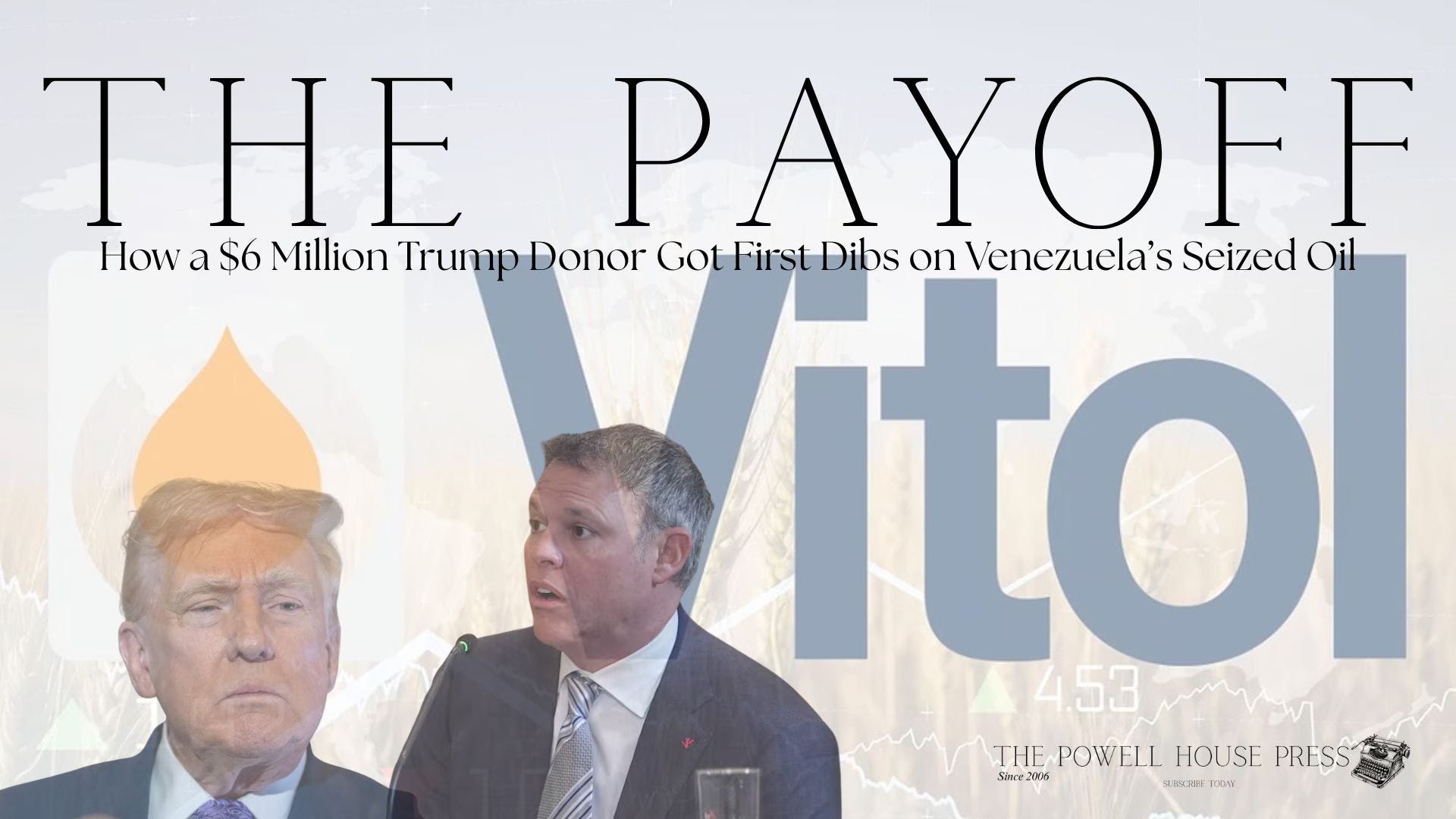
That promise lasted about a week. The first $250 million contract went to Vitol, the world’s largest independent oil trader, whose senior executive had just written $6 million in checks to put Donald Trump back in the White House. The oil is not going to the Venezuelan people. It is going to a Trump mega-donor. The money is not being held in trust for Caracas. It is flowing through Houston. Whatever you believed about this administration’s intentions in Venezuela, you can stop believing it now.
The White House would have you believe that the January 3rd invasion was about narco-terrorism. About fentanyl. About an arrest warrant for a dictator. But two weeks after American bombs fell on Caracas and Delta Force operators dragged Nicolás Maduro from his bedroom, the first contract to sell the oil we seized went to a company whose senior trader had just bankrolled Trump’s return to power. His name is John Addison, and his existence makes a mockery of every justification this administration has offered for its first war.
Addison is a senior energy trader at Vitol, based in their Houston office. Until 2024, he had never given Donald Trump a cent. His political awakening began not with Trump but with J.D. Vance—the Hillbilly Elegy memoirist turned Silicon Valley venture capitalist turned Ohio Senator turned Vice President. Addison was one of Vance’s top donors during his 2022 Senate campaign, backing the Yale Law graduate while Vance was still completing his transformation from a man who once called Trump “America’s Hitler” into one of his most servile defenders. The irony was thick even then: Vance built his brand railing against elites who rigged the economy against working people, while one of his top donors was a commodities trader whose company had been accused of literally manipulating gas prices to gouge American consumers. More Perfect Union noted it at the time. Almost nobody else did.
Vance’s rise was engineered by Peter Thiel, the techno-libertarian billionaire who poured $15 million into the Protect Ohio Values super PAC—the largest amount ever given by a single individual to a Senate race. Thiel had discovered Vance at Yale Law School, hired him at his venture capital firm Mithril Capital, blurbed his memoir, and then bankrolled his political career. But Thiel was not alone. Vance’s donor list, as one investigation put it, “looked like the guest list for a union-busting seminar at Davos.” The job title that donated the most money to Vance wasn’t nurse or construction worker—it was CEO. And among those CEOs and executives was John Addison, the Vitol trader who saw in Vance exactly what Thiel saw: a vessel for their interests wrapped in working-class packaging.
When Trump tapped Vance as his running mate in July 2024, Addison’s investment paid off. His early bet on the senator from Ohio suddenly had a direct line to the presidency. Addison’s checkbook flew open: $5 million to MAGA Inc. in October 2024, another $550,000 to the Trump 47 Committee, $500,000 more to Turnout for America. His wife Shannon added $900,000. The Houston Chronicle identified him as that city’s single largest Trump donor. The through-line is impossible to miss: Addison funded Vance, Vance delivered access to Trump, and now Trump has delivered Venezuela.
Before we go further, consider the company Addison keeps. In December 2020, Vitol admitted to the United States Department of Justice that it had spent fifteen years bribing government officials across Latin America—in Brazil, Ecuador, and Mexico—to win oil contracts. The company paid $164 million in penalties. Their traders used code names like “Batman,” “Popeye,” and “Phil Collins” to disguise payments funneled through shell companies, fake consulting agreements, and offshore accounts. In Ecuador, they paid officials to reveal the “gold number”—the exact price at which Vitol could win supposedly competitive government bids. One of their Houston traders, Javier Aguilar, was convicted last February on three counts of foreign bribery and money laundering. He faces thirty years.
It gets richer. In 2020, California’s Attorney General sued Vitol for manipulating gasoline prices after an Exxon refinery explosion created market disruptions. The lawsuit specifically named John Addison, alleging he supervised traders who coordinated with competitors to artificially spike gas prices and extract windfall profits while California drivers overpaid at the pump. The case settled last year for $50 million. This is what makes the Vance connection so perfect, so obscene: while Vance was on television blaming Joe Biden for high gas prices, one of his top donors was implicated in a lawsuit for actually raising gas prices through market manipulation. Vance’s whole shtick was pointing at problems and blaming the wrong people while allying with those who were really to blame. Addison fit the pattern exactly.
On January 9th, six days after the bombs fell on Caracas, Trump hosted oil executives at the White House to decide, as he put it on camera, “which oil companies are going to go in” to Venezuela. Addison was there. Vitol was the only company to send two senior executives—Addison and Ben Marshall, head of their U.S. operations. ExxonMobil sent one. Chevron sent one. But the company with the bribery convictions and the price-fixing settlement got two seats at the table. During the meeting, Addison addressed Trump directly, promising that Vitol would maximize profits on seized Venezuelan crude “so that the influence you have over the Venezuelans will ensure that you get what you want.” Trump’s response: “Thank you, thank you. Good point.” Days later, the Department of Energy held a closed auction. Vitol won. The first shipment has already arrived at an oil terminal in Curaçao.
The administration’s official story—that this was a law enforcement operation to arrest a narco-terrorist—has convinced almost no one outside the Fox News green room. The United Nations called it a “dangerous precedent.” UN experts labeled it an “international crime of aggression” and “a grave, manifest and deliberate violation of the most fundamental principles of international law.” Brazil’s President Lula said it crossed “an unacceptable line” toward “a world of violence, chaos, and instability, where the law of the strongest prevails.” International law scholars have been equally blunt: Professor Ben Saul, a UN special rapporteur, called for Trump to be investigated; Georgetown’s Steve Vladeck called the legal rationale “quintessential bootstrapping”—the desire to arrest Maduro became permission to invade, and the invasion’s fallout will justify whatever comes next.
The narco-terrorism fig leaf is particularly insulting. The majority of fentanyl entering the United States comes from Mexico, with precursor chemicals sourced from China. Venezuela has never been a significant supplier. If Trump wanted to stop fentanyl deaths, he would not have started by bombing Caracas. But Caracas sits atop the world’s largest proven oil reserves—and Trump has never hidden his intentions. In 2023, he said publicly: “Venezuela was about to collapse. We would have taken over it... and kept all that oil.” In December, he demanded on Truth Social that Venezuela “return to the United States all of the Oil, Land and other Assets that they previously stole from us.” This claim is false—Venezuela’s oil belongs to Venezuela under both international law and its own constitution—but facts have never troubled this administration. On January 3rd, Trump announced the U.S. would “run” Venezuela and needed “total access to the oil.” By January 9th, he was carving up contracts at the White House. By January 15th, his $6 million donor had the first check.
When the Financial Times reported on Addison’s donations and Vitol’s contract, the company issued a statement claiming his political contributions were made “in a private capacity” and were “not connected to the company’s business dealings.” The White House said Trump “always does what is in the best interest of the American people.” These are the official positions. They expect you to believe them.
Let us be precise about what has happened. A man who backed J.D. Vance while Vance was still pretending to be a populist pivoted to Trump the moment Vance joined the ticket. That man works for a company that admitted to bribing Latin American governments to win oil contracts and settled a lawsuit for manipulating American gas prices. That man sat at the White House table where the President divided the spoils of an illegal invasion. That man’s company won the first contract in a closed auction. The oil is already flowing. The administration insists there is no connection between the donations and the deal, just as it insists the invasion was about drugs, not oil. These are lies, and not particularly sophisticated ones.
This is the transactional presidency stripped of all pretense. Trump has transformed American foreign policy into a patronage system: write the checks, get the contracts, collect the spoils. The invasion of Venezuela was not an anti-drug operation. It was not a humanitarian intervention. It was not even, in the traditional sense, an imperial land grab. It was simpler and uglier than any of those things. It was a $6 million investment returning $250 million in the first tranche alone, with tens of millions of barrels still to come.
John Addison bet on J.D. Vance when Vance was still a long shot—a Never Trumper turned MAGA convert running in a crowded Ohio primary. That bet paid off when Vance won. He bet again when Trump picked Vance for the ticket. That bet paid off when Trump won. Now Addison’s company is delivering Venezuelan oil to American refineries while the craters in Caracas are still fresh. Somewhere in the Vitol Houston office, beneath the fluorescent lights and above the trading terminals, there is probably a spreadsheet showing exactly how much profit they will extract from this war. That spreadsheet is the real justification for the invasion—not drugs, not democracy, not freedom. Just money, flowing upward to the men who paid for this presidency.
Remember what they told us, just days ago: the money would go to the Venezuelan people. Remember it, because they are counting on you to forget.
Josh Hawley Spent Exactly Six Days Believing in the Constitution.
Last week, Missouri’s senior senator voted to require congressional approval before Trump could launch more military strikes on Venezuela. He invoked the Founders. He cited Article I. He sounded almost like a man with a spine. Then Trump called him stupid on Truth Social, and Hawley’s vertebrae liquefied on schedule. By Wednesday, he’d flipped his vote to kill the very resolution he’d championed, mumbling something about Marco Rubio promising there weren’t troops in Venezuela. The resolution was meant to prevent future deployments, but apparently Hawley’s constitutional principles have a shelf life shorter than gas station sushi. “That’s good enough for me,” he told Fox News, delivering the official motto of the modern Republican Party.
This is, of course, the same Josh Hawley who pumped his fist at the January 6th mob from behind police barricades—brave warrior of the people!—then was caught on security footage sprinting through the Capitol like he’d heard there was a sale at Brooks Brothers. The January 6th committee played it in slow motion, because some things deserve to be savored. The same Hawley who campaigned against “career politicians climbing the ladder,” then climbed from Attorney General to Senate in two years. The same Hawley whose office “knowingly and purposefully” violated Missouri’s transparency laws to hide his campaign activities—costing the state $240,000 in legal fees—after spending years attacking Hillary Clinton for her emails. The same Hawley who promised he’d “never support Medicaid cuts,” voted for Medicaid cuts, then introduced a bill to fix the cuts he’d just voted for, hoping Missourians have the memory of goldfish.
And who cast the tiebreaking vote to bury that Venezuela resolution after Hawley did his little dance? Vice President JD Vance—Hawley’s fellow Yale Law graduate and shape-shifting soulmate. Vance, you’ll recall, wrote in 2016 that he went “back and forth between thinking Trump is a cynical asshole like Nixon or that he’s America’s Hitler.” He called Trump “reprehensible,” an “idiot,” and “cultural heroin.” Then he needed Trump’s endorsement for his Senate race, and suddenly Hitler was a great president who’d “changed my mind.” Vance deleted his tweets, groveled on Fox News, and now serves as VP for the man he once compared to history’s greatest monster. “I’m not just a flip-flopper, I’m a flip-flop-flipper on Trump,” Vance told Time magazine, laughing. At least he thinks it’s funny.
Hawley and Vance are the same politician wearing different skin suits: Ivy League credentials, populist cosplay, and principles that dissolve on contact with political inconvenience. They’ve correctly diagnosed that American institutions have failed working people, then dedicated their careers to making it worse while pretending to fight it. Rand Paul, Susan Collins, and Lisa Murkowski took the same heat from Trump on that Venezuela vote. They held firm. Hawley crumbled the moment Daddy raised his voice.
The fist pump was always a lie. The running… that was always the truth.
©2026 All Rights Reserved- Josh Powell/The Powell House Press
josh@thepowellhousepress.com