
The Price of Getting Bigger Healthcare
For the billions invested, mergers and technology - American healthcare is worse.
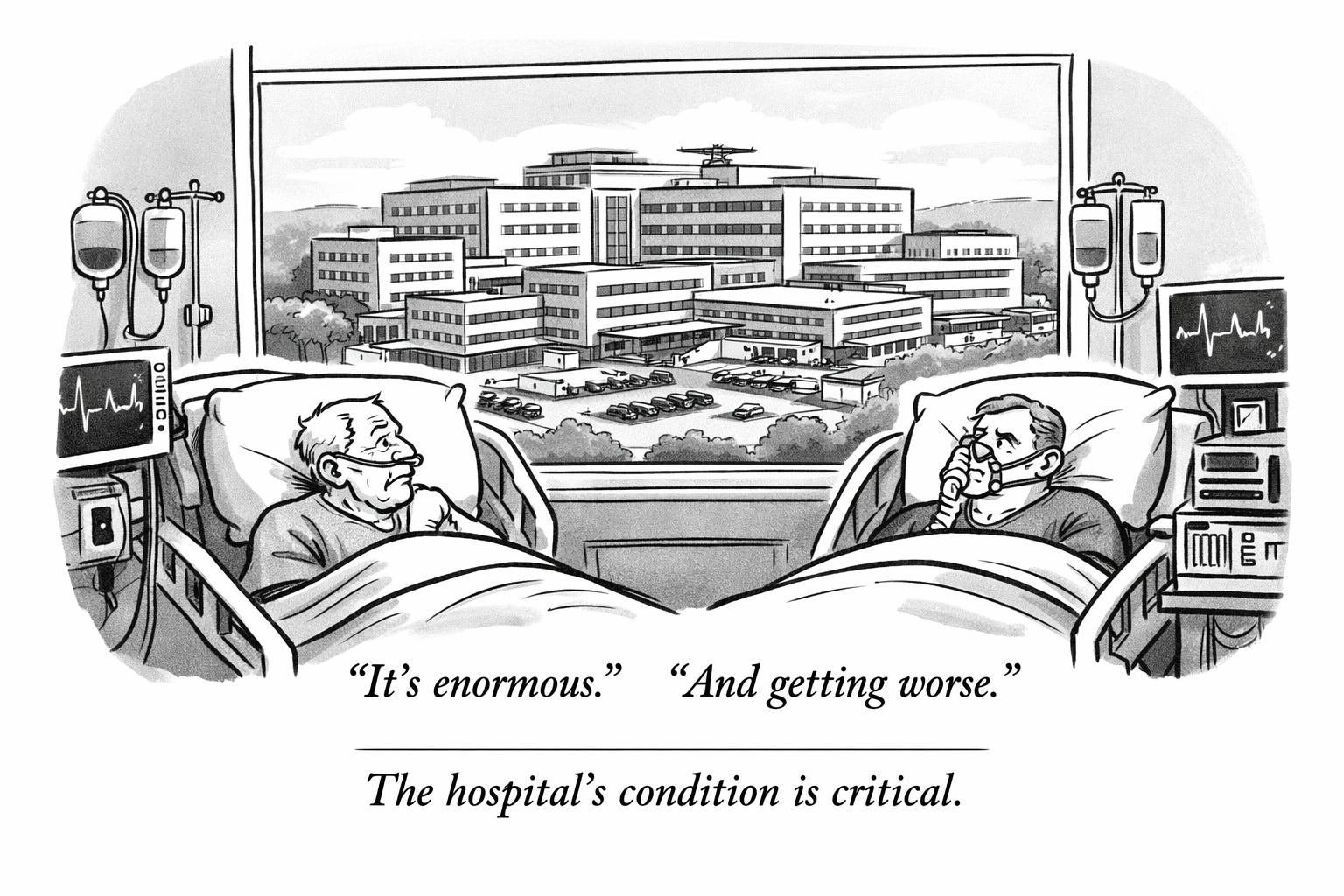
There’s an old saying: a hog that gets fat enough to fill the pen isn’t necessarily a hog that feeds the family. Keep that in mind when someone tells you American hospital systems have never been stronger.
By the numbers most commonly cited, they’re right. The fifteen largest hospital systems in the country, ranked by 2024 revenue, are formidable enterprises. HCA. Ascension. CommonSpirit. Advocate Health. Names that sound less like places of healing and more like the credits roll of a corporate merger film — which, in several cases, is exactly what they are. CommonSpirit, Advocate, Corewell: none of them existed in their current form a decade ago. They were assembled in boardrooms between 2019 and 2022, stacked together like cordwood, and handed a revenue ranking as a birth certificate.
So when we ask whether these systems are better than they were ten years ago, we are, in part, asking whether the thing we’re comparing even existed ten years ago. That’s not a minor footnote. It’s the whole story in miniature.
What the numbers do show, plainly and without much room for argument, is debt. Moody’s put average total debt for rated nonprofit hospital systems at $671 million in fiscal 2024, up from $564 million in 2020. HCA, the country’s largest for-profit chain, carried $31.4 billion in total debt at year-end 2016. At year-end 2025, that figure was $46.5 billion. Ascension alone reported $6.45 billion in hospital revenue bonds as of mid-2024. These are not small numbers dressed up in accounting language. This is a mountain of obligation, and the patients sitting in waiting rooms are not the ones who signed the notes.
To be fair, the debt-to-revenue ratios have improved. Systems are, as the analysts like to say, servicing their debt better than they were during the post-COVID crunch of 2022 and 2023. But “better at managing enormous debt” is a strange thing to lead with when you’re supposed to be in the business of healing people.
On patient satisfaction — which is a clinical way of asking whether sick people feel cared for — the verdict is not a success story. The national benchmark is HCAHPS, a survey that measures whether patients feel heard, whether staff showed up, whether the room was clean. A large study published in JAMA Health Forum found that scores dropped sharply during 2020 and 2021, falling as much as 3.6 percentage points below expected trend by late 2021. The steepest declines were in staff responsiveness and cleanliness. Whatever modest ground hospitals had gained in the years prior was erased. The big systems now sit at flat to mixed on patient experience. That’s the honest description. Not better. Not worse. Flat. After a decade of consolidation, expansion, and record revenue in some quarters, flat.
The access question is where the story gets genuinely complicated, and where the industry’s preferred narrative deserves the closest scrutiny. Yes, telehealth is real and it helps people. Yes, outpatient visits have grown. Yes, ambulatory surgery centers and urgent care clinics have multiplied. The big systems will tell you, with some justification, that they have brought care closer to more people in more forms than ever before. That is true.
It is also true that KFF found hospital closures outpaced openings from 2017 to 2023 in both rural and urban areas, with rural communities absorbing the larger loss. The emergency room in the county seat, the one that has been there since Eisenhower was in the White House, the one where your grandmother had her hip replaced and your cousin was treated after the car accident — that one is at risk, or already gone. The system that closed it may have opened a telehealth portal and an outpatient clinic forty miles away. That is not the same thing. It is not close to the same thing.
The honest summary is this: the largest hospital systems in America are bigger, more consolidated, and more indebted than they were ten years ago. They are better at borrowing and better at building outpatient networks. They are not demonstrably better at the fundamental transaction — a person who is sick, a person who helps them, a room where that happens.
Scale was supposed to bring efficiency, which was supposed to bring savings, which was supposed to improve care. That was the argument. The argument hasn’t held up. What scale has brought is more scale: more mergers, more debt, more brand names on more buildings, and a patient experience that, by the best available measure, hasn’t moved.
The hog just got bigger.


