The Trouble with Trumpers
It’s not the MAGA faithful in their red caps who keep me up at night. It’s the ones with law degrees.
We all know the species of Trump supporter that Jimmy Kimmel and Jon Stewart have made their cottage industry: the cousin at Thanksgiving who gets his news from a Facebook meme, the guy at the bar who thinks January 6th was a walking tour that got a little rowdy. These are not complicated psychological specimens. They are easy marks, low-hanging fruit, fish in a barrel of their own ignorance. God love them, they never had a chance.
But they are not who trouble me.
Who troubles me is the other kind of Trumper—the one with an education, the corner office, the club membership, the summers on the Vineyard. The one who can quote the Constitution when it suits him and memory-hole it when it doesn’t. The one who clerked for a federal judge and now pretends not to understand what “emoluments” means. The one who should know better and has made an elaborate, exhausting choice not to.
I have such friends. Yup, more than one. But today, I want to talk about Ted. Well, I’ll call him Ted. It is not his or her real name.
Ted is an attorney, and we go back years. If I tell too much, people will be able to identify Ted and my point here is not to vilify Ted. Ted is a useful and truthful example of the “intellectual” Trumper.
Ted’s political leanings are not new to me, but after the insurrection—and yes, I use that word with precision, because I am not in the business of offering euphemisms to those who would burn down the republic while complaining about the permit process—I assumed, naively, that Ted would have had his road-to-Damascus moment along with the rest of educated America.
Surely watching a mob smear feces on the walls of the Capitol while hunting for the Vice President would clarify things for a man trained in the law. Surely the gallows erected on the National Mall would focus the legal mind.
My reader (you will understand later), it did not.
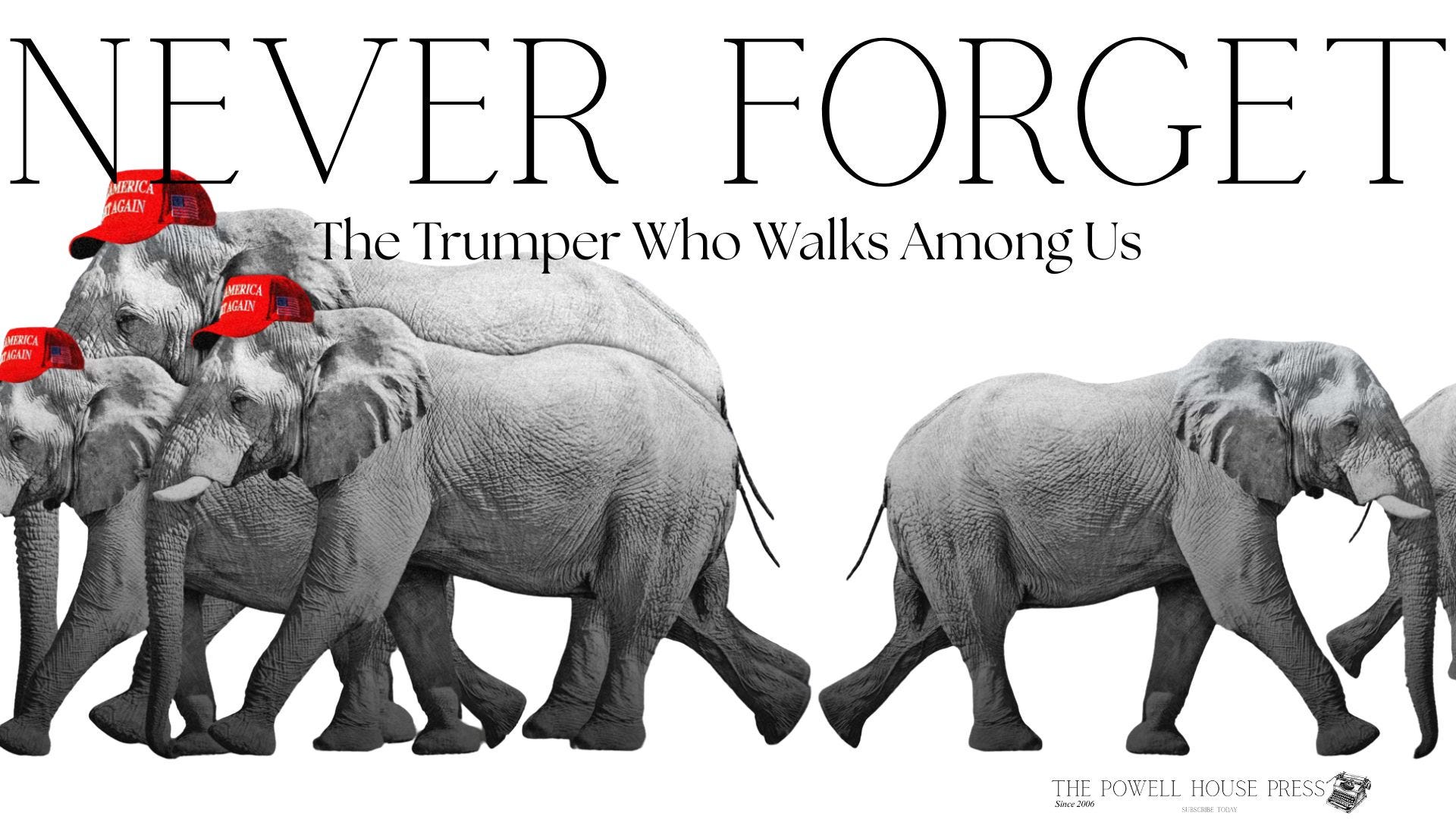
For months we danced around the elephant in the room—or rather, the orange elephant on the room, crushing everything beneath it while tweeting about crowd sizes.
Ted reads my columns.
He offered friendly advice about growing my audience.
He suggested I might consider “tempering” my positions, as though the problem with my writing is that it’s insufficiently accommodating to those with faulty logic. As though what America really needs right now is more balance—that magical word that means treating lies and truth as equally valid contestants in some eternal debate tournament.
Then came the question, delivered with the faux-innocence of a man setting a trap he believes to be clever: Did I think Trump was a racist?
I do not traffic in vibes. I keep spreadsheets (yeah I’m that guy) on some of the people I write about. I ran a statistical analysis of Trump’s statements, policies, and the tropes he deploys with the regularity of a metronome—the “poisoning the blood” rhetoric, the “shithole countries,” the full-page ads calling for the execution of five innocent Black teenagers, the housing discrimination settlements, the birtherism, the “very fine people.” The probability that Donald Trump is not a racist is roughly equivalent to the probability that I will win the Powerball while being struck by lightning on a clear day, while simultaneously being elected Pope.
Ted’s response was magnificent in its absurdity: until someone met his undefined, unspecified, apparently supernatural burden of proof, Trump was not a racist. He was so confident in this position that he floated the idea of offering $100,000 to anyone who could “prove” Trump’s racism—as if bigotry were a geometry theorem requiring QED, as if a man who kept a book of Hitler’s speeches by his bedside were entitled to the benefit of the doubt.
This is what a legal education does when pressed into the service of motivated reasoning: it builds elaborate structures of sophistry, Gothic cathedrals of bad faith, complete with flying buttresses of whataboutism and stained-glass windows depicting Hunter Biden’s laptop.
The real revelation came when Ted decided to offer me a master class in writing for my audience. His thesis: I was too inflammatory, too convinced of my facts, too unwilling to genuflect before “both sides.” He cited, as evidence of my recklessness, my reporting on Trump’s Caribbean military strikes—operations that UN human rights experts have called extrajudicial executions, a phrase that, in simpler times, we might have called “murder.”
Ted informed me, with the confidence of a man who has never been told he’s wrong at a dinner party and wouldn’t hear it if he were, that these strikes were perfectly legal under a law “sponsored by Chuck Schumer back in 2007 or thereabouts.”
“Or thereabouts.” The attorney’s tell. The vague hand-wave that signals: I am making this up, but I trust you won’t check.
I checked.
A few problems: The law is from 1986, not 2007. Schumer was a co-sponsor, not the author. And most critically, the Maritime Drug Law Enforcement Act authorizes prosecution, not execution. It permits boarding and arrest, not blowing human beings out of the water without so much as a warning shot. It is, one might say, a law—the kind of thing attorneys are supposed to understand. Maritime law expert Ian Ralby has been unequivocal: the law “one hundred percent does not make it legal to take out drug boats by blowing them up.” One hundred percent. Not ninety-eight. Not “it’s complicated.” One hundred.
When I pointed this out—gently, with citations, as one does with a friend who has just embarrassed himself—Ted pivoted with the grace of a man who bills by the hour and has learned that confidence is more important than accuracy. No, no, he hadn’t meant that law. He’d meant the AUMF! The Authorization for Use of Military Force! Obama used it! Precedent!
Ah, yes. Obama. The Swiss Army knife of Republican argumentation. Whatever Trump does, Obama did it first, or worse, or more, or something. It is unclear whether Ted believes this exonerates Trump or indicts Obama, and I suspect Ted doesn’t know either. The point is not coherence. The point is deflection.
This is the Trumper two-step: cite a law incorrectly, and when corrected, cite a different law and accuse your interlocutor of missing the point. Repeat until your opponent loses the will to live. The goal is never accuracy; it’s exhaustion. It’s the rhetorical equivalent of a filibuster—if you keep talking long enough, maybe everyone will forget you were wrong.
And then came the coup de grâce: the suggestion that the Colombian president and the Associated Press were simply lying when they identified victims of these strikes as fishermen and laborers. One victim, Alejandro Carranza, was a Colombian fisherman with no ties to drug smuggling—a fact verified by Colombian authorities, reported by the AP, and dismissed by Ted with the airy confidence of a man who has never worked a day on a boat in his life.
But to Ted, this was “ludicrous.” “Laughable.” Because, apparently, impoverished men in Latin America never captain boats that might be mistaken for something else by a military operating with minimal oversight and maximum impunity. Because every fishing vessel in the Caribbean is, in Ted’s imagination, clearly marked with a sign that reads “INNOCENT FISHERMAN—PLEASE DO NOT BOMB.” Because the fog of war is something that happens to other people, in other countries, reported by other journalists who can be safely ignored.
What struck me most, in the end, was not Ted’s errors of fact—those are correctable, at least in theory. It was the tone. When I responded with documentation, he accused me of delivering a “lecture with legal citations,” as though citing evidence were a social faux pas, like wearing white after Labor Day or bringing up money at the dinner table.
Consider the psychology at work here: An attorney—a man whose entire profession rests on the deployment of legal citations—finds the use of legal citations offensive. Not wrong. Not inaccurate. Offensive. The facts themselves had become an insult.
He found my reference to “my readers” pretentious—redolent, he said, of Joan Crawford. (One wonders what nomenclature he’d prefer. “The people who, for reasons unknown, read the things I write”? “The unfortunate souls who subscribe to my newsletter”? “My fellow travelers in this vale of tears”?) My profiles of Trump’s cabinet were “hatchet jobs” because I had the temerity to note their qualifications, or lack thereof—as though pointing out that the Secretary of Defense has no military experience is a matter of opinion rather than a matter of public record.
My concern for democratic institutions was evidence of “TDS”—that tedious acronym Trump coined to pathologize dissent, to suggest that alarm at his behavior is itself a form of mental illness. It is a neat trick, when you think about it: Commit an outrage, then diagnose anyone who objects as deranged. The gaslighter’s playbook, executed at national scale.
But here is what Ted could not do, in several thousand words of correspondence: cite a single source for his own claims. Not one. Not a statute, not a case, not a newspaper article, not even a particularly convincing tweet. The FBI confirmed Trump was an informant against Epstein? Ted’s source was Mike Johnson, who walked the claim back within hours and whose press secretary explicitly denied it. The victims in the Caribbean were all drug runners? Trust him. The AP is lying? Obviously. The Colombian president is fabricating? Naturally.

This is the epistemological rot at the heart of the educated Trumper: a credentialed man who demands impossible standards of proof from his opponents while requiring none from himself. He wants peer-reviewed studies and notarized confessions before he’ll believe Trump is a racist, but he’ll accept Trump’s word that dead fishermen were narco-terrorists. He doesn’t believe the Associated Press, but he believes Donald Trump—a man who lies the way other people breathe. He doesn’t trust the United Nations, but he trusts a press secretary whose job description is, quite literally, to lie.
Ted ended his correspondence by praising Trump as a “hero” for his Caribbean operations and his Venezuela strategy—liberator of the oppressed, leader of the free world. The man who attempted to overturn an election, who incited a mob to storm the Capitol, who traffics in the language of dictators and the aesthetics of fascism, is now, in Ted’s telling, democracy’s greatest champion. War is peace. Freedom is slavery. Ignorance is strength. And Donald Trump is George Washington with better ratings.
The disconnect required to hold this position is not a hiccup in Ted’s thinking. It is virus spreading through the operating system after clicking on Trump. The virus. It is what allows him to function, to go to work, to bill his hours, to attend his parties, to sleep at night. To acknowledge the truth would be to acknowledge that he has spent years defending the indefensible, that his judgment has been catastrophically wrong, that the man he admires is not a hero but something closer to the opposite. And that is a reckoning Ted cannot afford. Even though he can afford 100k gamble in service to proving Trump is not a racist - though a hedged bet really. It would have to be.
So he builds his cathedrals of sophistry. He deploys his whataboutisms. He demands proof while offering none. He calls the Associated Press liars and Donald Trump a liberator. And he does it all with the vocabulary of reason, the syntax of logic, the tone of a man who believes himself to be the adult in the room.
I do not know how to reach Ted. I do not know if he can be reached. What I know is that the threat to this republic is not primarily the man in the red hat who can’t find Venezuela on a map. It is the man in the blue blazer who can—and who has decided, for reasons of tribe or tax bracket or some psychological wound I cannot fathom, to pretend he can’t. It is the man who knows the law and chooses to ignore it. It is the man who can spot a logical fallacy at forty paces and yet commits them by the dozen in defense of the indefensible.
The educated Trumper is more dangerous precisely because he knows better. His ignorance is a choice, renewed daily, defended hourly, dressed up in the language of reason while reason itself burns. He provides the intellectual cover for the mob. He writes the briefs that justify the outrages. He goes on cable news and says, with a straight face, that the emperor’s new clothes are magnificent.
I remain Ted’s friend. But friendship does not require me to pretend that two plus two equals five, no matter how many Latin phrases you deploy to argue otherwise. It does not require me to nod politely while you defend the execution of fishermen. It does not require me to treat your denial of reality as a legitimate “perspective” deserving of equal time.
Some diseases are resistant to treatment. Some patients refuse the cure. This one, I fear, may be terminal—not because the disease is unbeatable, but because the patient has decided he’d rather die than admit he was ever sick.
But, this is not a disease. It is a choice. Ted is ubiquitous, we all know him. And we know that Teds have histories of making bad choices.
This was never reckoning.
Just a reminder.
©2026 The Powell House Press - All Rights Reserved
Josh@thepowellhousepress.com


I have a friend like Ted. He is a brilliant engineer and he listens not to reason. He still thinks the insurrection was Nancy Pelosi’s fault for not calling in the National Guard soon enough. Hard to believe their illusions.
Excellent read! I did, sadly, chuckle at some of Ted’s comments as I have heard the same from many of my own friends, family and educated colleagues. I will say, I’m not convinced that these individuals actually do “know better.” And for the life of me I’ll never understand there supposed logic. There was time, decades ago, when the so called idea of the “educated idiot” I believed was a rare thing. I was profoundly mistaken!