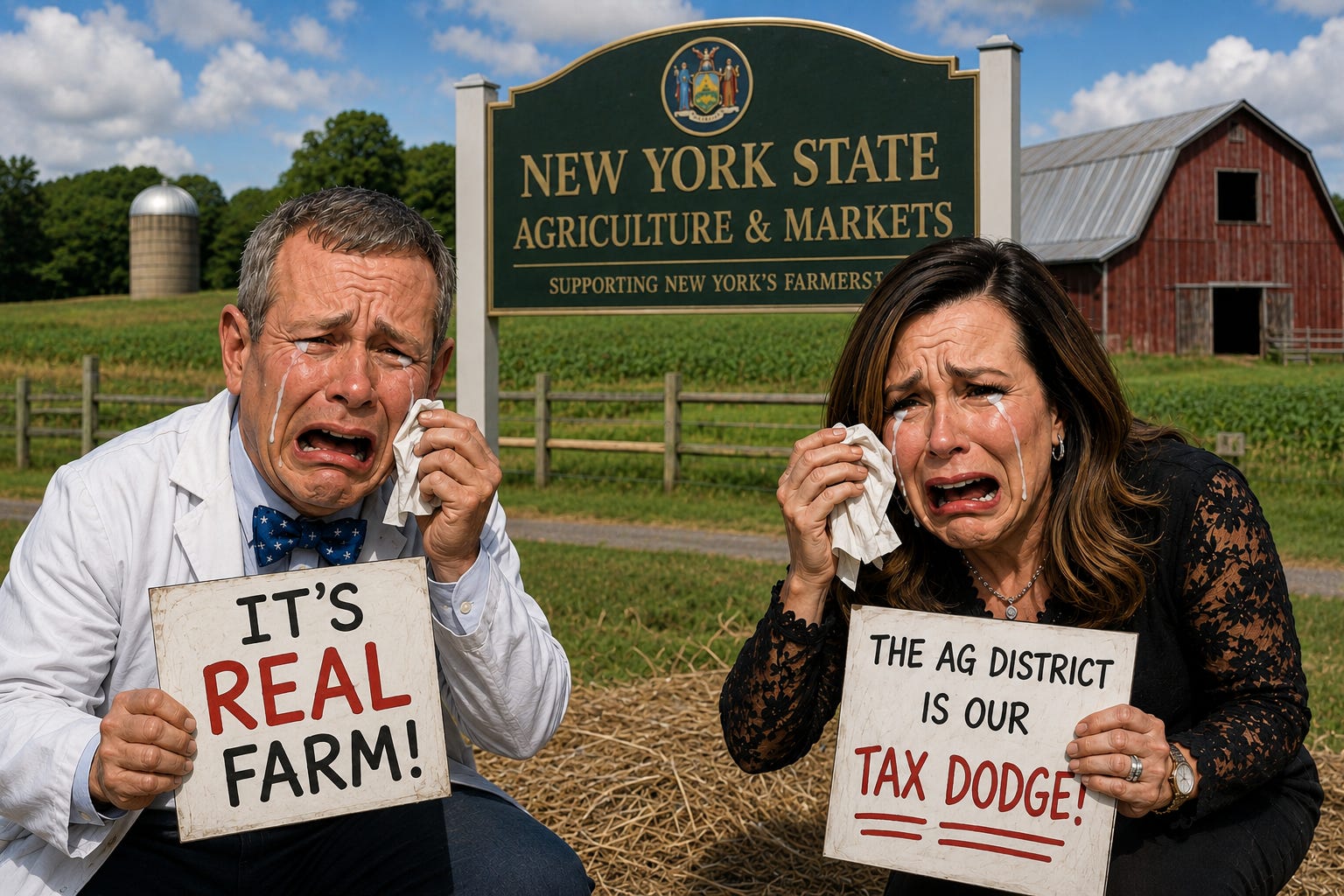
The Wine Wars: All is Quiet for Now
But I got a tip, the Williamses are off to Ag and Markers
On May. 12 the Planning Board closed the Williams application for their tasting room. They never filled out those forms any ways 9. PIn June 14 the is a petition from the community to the NYS Liquor Authority.’
I have it on good authority the William are appealing thru the 305-a process.
Section 305-a is the right-to-farm statute. It exists because every agricultural district in New York eventually fills up with people who moved next to a farm and then resent it for farming. The law says a town cannot unreasonably restrict a working farm operation. Not “shouldn’t.” Cannot. Unless public health or safety is on the line. A vineyard tasting room is not typically a public health threat. It is, at most, an inconvenience to a neighbor who didn’t read the deed.
The Process:
A farm owner files a written complaint with the Department of Agriculture and Markets. There’s a form. Bureaucracy demands its tribute. The complaint lays out the local law in question and why it’s choking the farm operation.
Department staff review it. They look at the zoning restriction, they look at the farm, and they decide whether the town has overstepped. If it has, the Department doesn’t sue first. It calls. It tries to get the town to fix the law voluntarily. This is the diplomatic phase, the part where everyone pretends reasonableness is still possible.
If the town refuses, the Department stops asking. It issues an Order under Section 36, compelling compliance. New York courts give these Orders deference. Translation: when this fight reaches a judge, the judge tends to side with the state’s agricultural expertise over a town board’s zoning preferences.
There is precedent that matters here. The Department has already ruled, in another case, that capping parking at fifteen spaces and demanding a traffic study for a blueberry u-pick operation was unreasonably restrictive. A small farm doing small retail, strangled by paperwork designed for something bigger. That’s the shape of these cases. Towns don’t usually ban farming outright. They suffocate it with conditions.
Here’s the part that should worry the Williamses’ opposition more than it apparently does: 305-a protects the farm operation. The ZBA’s argument is that a tasting room, wine sales, and event activity aren’t farming. They’re commercial retail wearing a flannel shirt. If Ag and Markets agrees with the ZBA’s framing, the whole appeal evaporates. If Ag and Markets decides tasting rooms are simply how a modern small vineyard sells its product, the town loses control of the conversation entirely.
Which means the real fight was never about grapes. It’s about who gets to define what a farm does for a living.
I have FOIL request into Ag & Market.