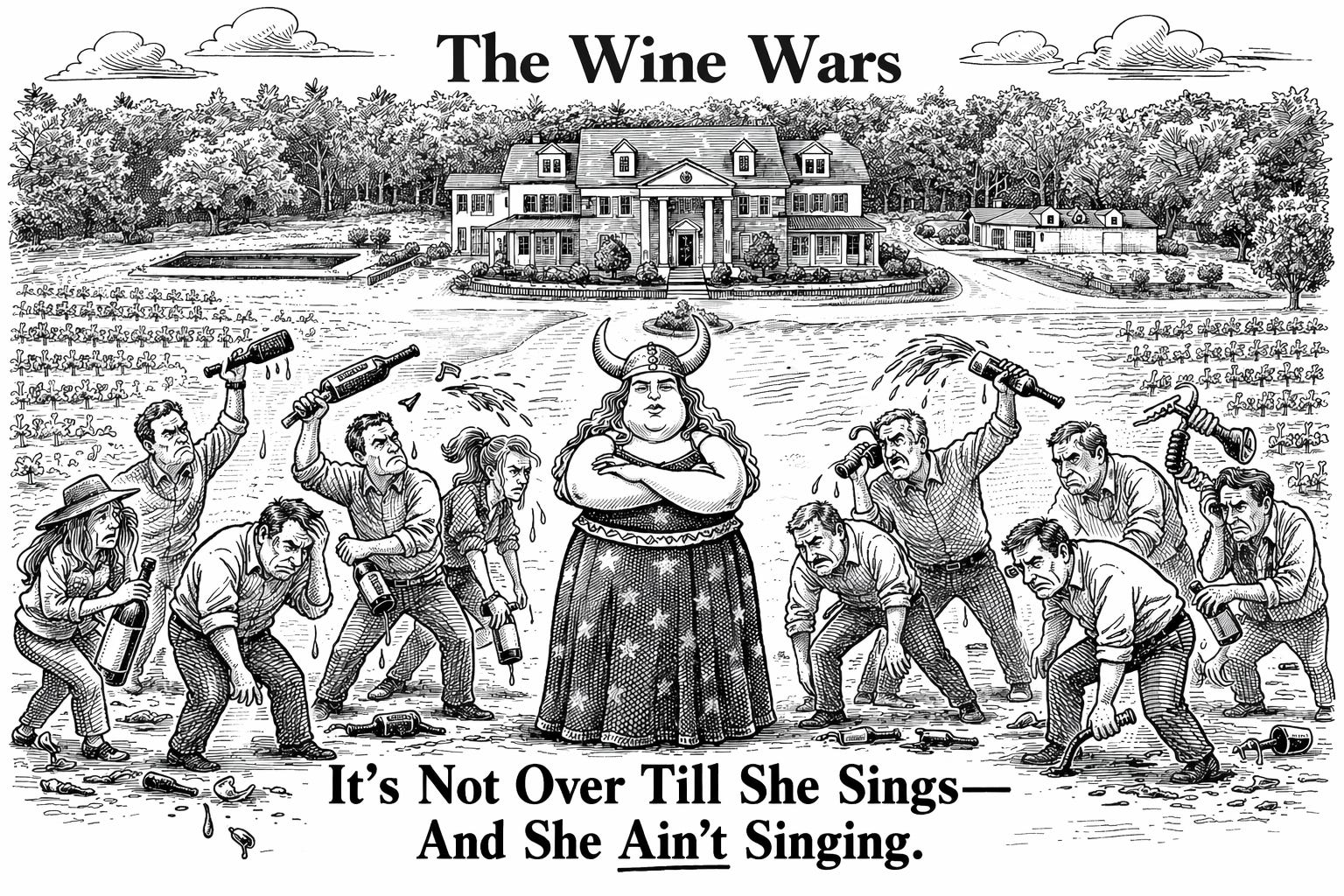
The Wine Wars: Do You Hear the Fat Lady Singing?
While some in the town are saying Fox Hill Vineyard is done, they are wrong. Also, the KKK is coming to town - mark your calendars
Hope springs eternal, and I count myself an optimist, so let the Planning Board and the Town Board have their moment. The white hats won. The bucolic landscape endures. Donal’s fever dream of milk trucks rumbling down Bashford Road — trucks that, for the record, never existed; he knows this — is, for now, parked.
And yet.
Gabriella, dear: the matter is not closed. The ZBA was bullied into doing the right thing, which is not the same as the right thing being settled. Last week the Williamses, those onward Christian soldiers, presented themselves at the Alcohol and Tobacco Tax and Trade Bureau. Box number two, checked. The State Liquor Authority was box number one, last month. I told you about that one already.
Here is what happens next. I know because I spent a long stretch on the phone with Ag and Markets this week, and I am not the only one who has.
The Williamses will return to the Planning Board. Yes, the ZBA has ruled that a tasting room is commercial and therefore incompatible with 509 Bashford Road. Ms. Sperry declared the matter over last week. But kids, it is not over. When the Planning Board holds the line, the Williamses will go to Ag and Markets and complain that the town is being too restrictive — that a tasting room is an extension of the farm. Ag and Markets was unambiguous with me: they will step in. A tasting room, I was told, is a legitimate tool for selling wine from a vineyard.
Weddings are the grey zone. Ag and Markets, alert to the growing cottage industry of people like the Williamses who open “farms” chiefly to host events on them, is no longer supportive of weddings as farm activity. A wedding is a wedding. It is not agriculture.
Food trucks, however, are fine. Events traceable to wine production are fine. If Wine Spectator wants a retreat at 509 Bashford, fine. A New York State wine festival showcasing their crop alongside other New York wines, fine. So Ms. Romeo can sit in Rensselaer and thrill to the prospect of passing boxed hors d’oeuvres, but she should not thaw out those pigs in a blanket just yet.
A note to the board members who are, I gather, a little wounded by this column and by the chorus on Facebook: no insult intended, but Rick, please stop telling people the matter is resolved. It isn’t.
It was useful to learn the board obtained an ethics opinion regarding Donal’s conduct. How they obtained it is another question, and I am not alone in asking it. Some board members are now floating an ethics committee and a rewrite of the rules, as though the problem were the rules.
The problem is not the rules. The rules are already on the books. They have been there since May 21, 2012, when the Town Board adopted Local Law No. 1 of 2012 as Chapter 9 of the Town Code. What is missing is the part where people follow them.
Chapter 9, Article I is the Code of Ethics. It includes § 9-3 on conflicts of interest, § 9-4 on nepotism, and § 9-5 on standards of conduct. Article II is the Financial Disclosure regime: § 9-12 sets out who is required to file, § 9-14 requires the Town to annually determine the list of positions that must file, and § 9-15 prescribes the form itself. The code states in plain language that no Town employee shall have any interest, financial or otherwise, direct or indirect, or engage in any business or transaction or professional activity or incur any obligation of any nature, which is in substantial conflict with the proper discharge of his duties in the public interest. Nothing about that sentence is ambiguous.
Nor is the disclosure requirement. The standards of conduct require that any officer or employee of the Town — paid or unpaid — who participates in the discussion or gives an official opinion on legislation before the board shall publicly disclose on the official record the nature and extent of any direct or indirect financial or other private interest he has in such legislation. That is not a form filed once a year in a binder. That is an on-the-record, in-the-moment obligation. Every time Donal opened his mouth about 509 Bashford Road, about the Williamses, about tasting rooms or wineries or the Planning Board’s jurisdiction, that rule applied.
There is also § 9-5’s prohibition on investments: he shall not invest or hold any investment, directly or indirectly, in any financial, business, commercial or other private transaction, which creates a conflict with his official duties. And the companion clause on private employment, which bars a Town officer from rendering services for private interests where doing so impairs the proper discharge of his duties. These are the exact provisions a board member with a financial relationship to a private vineyard seeking Town approvals is required to navigate. Donal has not navigated them. He has walked past them.
Now to the financial disclosure form itself. Donal has filed one. It is dated March of this year. Before that, none. The annual disclosure is annual. Section 9-12 specifies the persons required to file statements, § 9-14 requires the Town to make an annual determination of which positions must file, and § 9-15 prescribes the form. A disclosure regime in which a board member files a single form, years into his tenure, at the moment public attention happens to fall on him, is not a disclosure regime. It is a formality observed under duress.
The March filing, for all that it exists, does not disclose the nature or the financial terms of Donal’s relationship with the Williamses. That is the disclosure that matters. That is the one his colleagues on the board and the public need in order to evaluate whether he should be voting, speaking, or advocating on anything touching 509 Bashford Road. Its absence is not an oversight. It is the whole point.
And there are teeth in this code. Section 9-9 provides that, in addition to any other penalty in law, any person who knowingly and intentionally violates the code may be fined up to $1,000, suspended, or removed from office or employment in the manner provided by law. Removal. From office. That is what the code says. Whether anyone has the appetite to invoke it is another matter.
These are not the largest violations in the catalogue of municipal sins. They are, however, violations — plural, documented, and ongoing — and the “Ethicist” the board consulted was not the right person to render judgment on them. An independent lawyer was. The board does not need a new ethics committee. It needs to enforce Chapter 9 on the member who isn’t following it.
The inbox tells its own story. A great many people have written to me about the Wine Wars, and two complaints recur. First: agendas go out late, with no explanation, which keeps the public in the dark. Second: no one knows how to get an item onto an agenda in the first place. Reasonable questions both.
The broader problem is communication. Town business has gone essentially uncovered by the press for years, and when anyone — me, or anyone else — asks a direct question, the answers are “under review” or “can’t be discussed.” For a board that ran on transparency, the silence is its own statement.
One last item, and it is not a small one. This Memorial Day, a group calling itself the Sugar Tree Legion plans to hold a ceremony at Chatham Union Cemetery on Shaker Museum Road, in Old Chatham.
The Sugar Tree Legion is a white nationalist organization. It is listed as such by the Southern Poverty Law Center, which tracks it on its current roster of active white nationalist groups in New York State. The SPLC defines white nationalist groups as those that espouse white supremacist or white separatist ideologies, often focused on the alleged inferiority of nonwhite people and the goal of a white ethnostate.

That is the group. That is what it stands for. That is what it is coming to Old Chatham to do. This is year two for them.
It should not need saying, but it does: a cemetery that holds our dead is not a venue for this. Memorial Day is not a white holiday. The uniforms in that ground were worn by men of every color and faith this country has ever produced, and to host a ceremony that sorts them by race at their own graves is an insult to all of them.
More soon. There will be more. There is always more.
Why Your Subscription Matters
Independent journalism answers to readers—not advertisers, corporations, or access-hungry editors. No story gets killed because it upsets a sponsor. No punch gets pulled because someone important made a phone call.
Your support makes possible sharp commentary, fearless satire, and reporting that follows the story wherever it leads. In an era of manufactured narratives and algorithmic blandness, that independence isn’t a luxury—it’s a necessity.
Subscribe to The Powell House Press. Or settle for content that tells you what someone else wants you to hear.
©2026 All Rights Reserved | The Powell House Press | josh@thepowellhousepress.com