


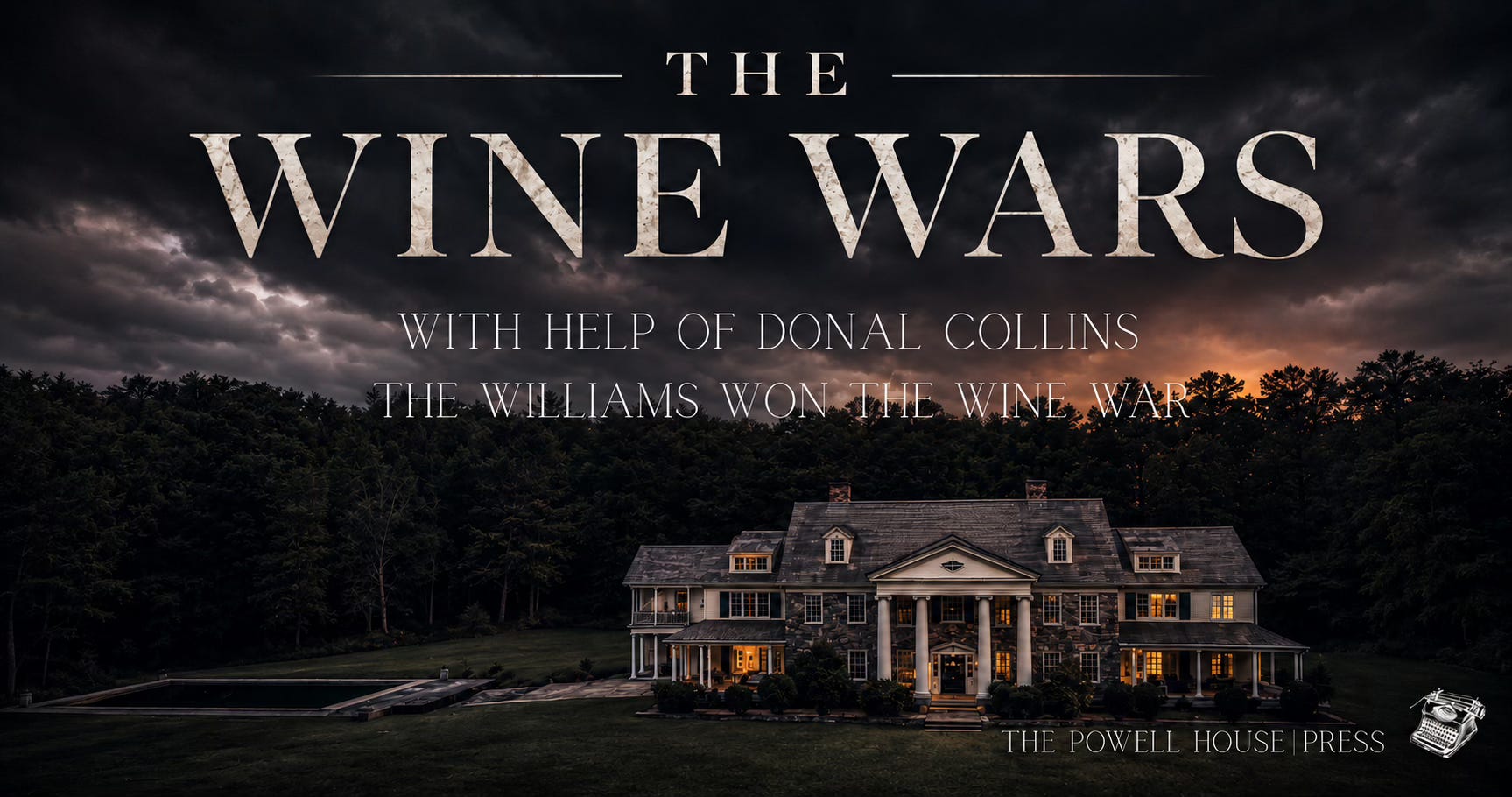
Before the swashbuckling, western-riding Dr. Bilinski opened Waldorf Farm, it was known as Dutch Acres. It was then as it is now, a breeding farm for thoroughbreds. What many don't know is that the previous owners had a side hustle. They raised ring-necked pheasants. This was the 1970s and there were little to no turkeys to hunt, so bird hunters managed with squabs and these beautiful birds. The problem with pheasants is twofold: they are not native and don't have any real skill at keeping away from native predators, and second, they don't really blend in, thus compounding the first issue. Point being, pheasants didn't belong in North Chatham any more than a commercial wine venue on Bashford Road. Well, they learned that pheasants didn't take; it was no harm, no fowl. I know, bad pun. Sadly, the residents surrounding Fox Hill Estate and Vineyard will not get such a break as a pretty bird. Nope. This "farm's" folly will be more permanent.
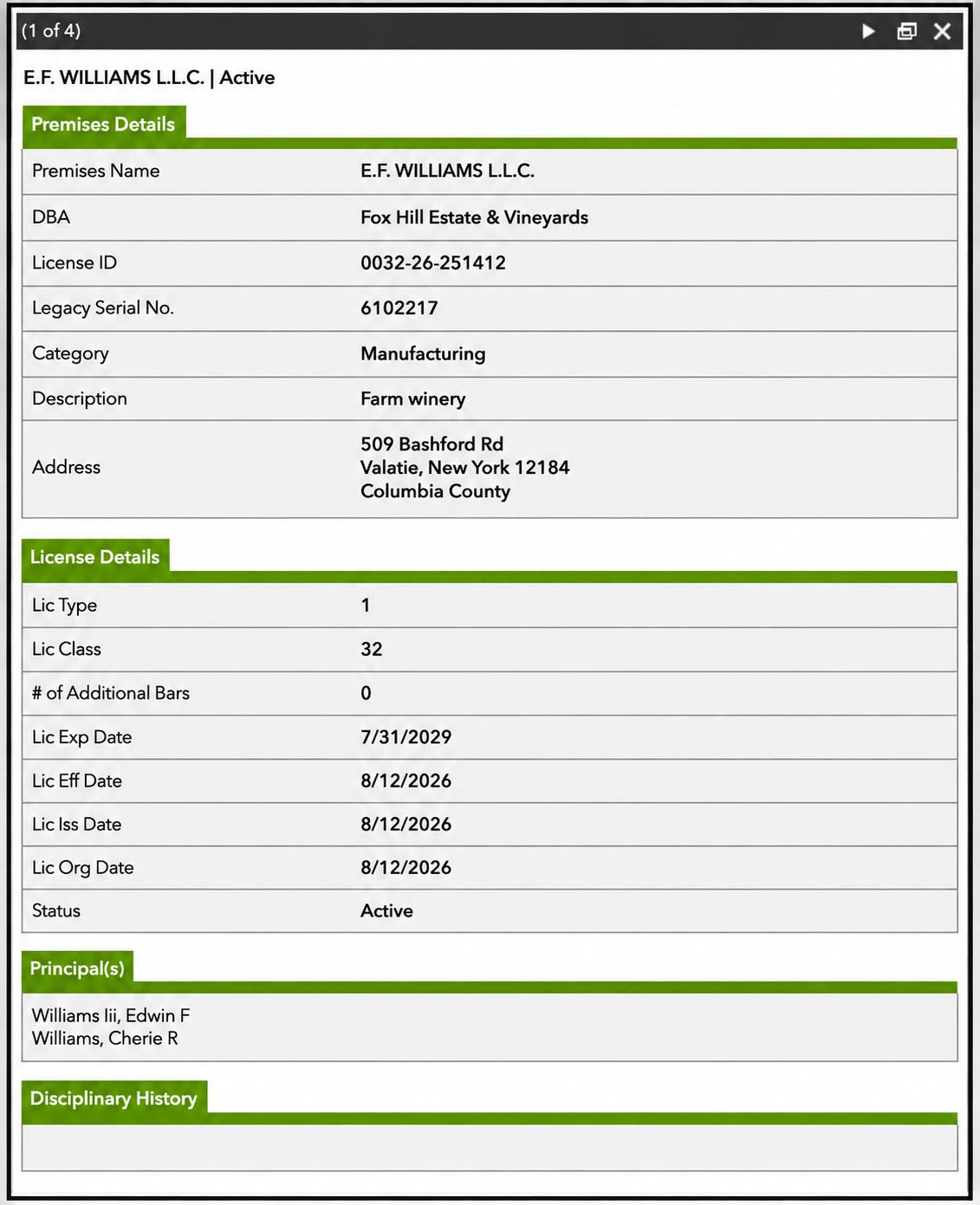
New York State has issued E.F. Williams L.L.C., trading as Fox Hill Estate & Vineyards, a farm winery license, effective that day and good through July 31, 2029. Edwin F. Williams and Cherie R. Williams are named as the principals. And here is the detail the neighbors may not yet have absorbed over their morning coffee: the state did not hand these two a coupon to sell a bottle of wine. It handed them a trousseau.
A farm winery license, under New York’s Alcoholic Beverage Control Law, is not permission. It is a portfolio. Manufacturing, retail, tasting, tourism, all of it bundled and beribboned and delivered at once. Albany rarely does anything by halves once it has decided to do it at all.
Begin with the manufacturing, because it sets the scale of the ambition. The license lets the winery produce wine, New York State-labeled mead, and New York State-labeled cider on the premises, somewhere between a statutory floor of fifty gallons a year (a spirited weekend, really where no doubt daughter Riley will be warbling) and a ceiling of 250,000 finished gallons (a serious industrial concern with a serious industrial payroll). Which is to say that 509 Bashford Road is now, in the eyes of the state, a factory dressed in the gingham of a farm.
Then come the tastings, which is where the parties unfold. The statute expressly authorizes them on the licensed premises, for consumption on or off the property, of whatever the Williamses make and of whatever their fellow qualifying New York farm wineries make. And it does not stop at wine. It waves in qualifying New York beer, cider, mead, liquor, and, in a flourish no lawyer could have invented, braggot, that honeyed medieval ale out of Chaucer’s world, exhumed and rebottled to grace a Columbia County flight. The Liquor Authority’s own guidance confirms the arrangement: the house may sell its own bottles to go, and it may sell the neighbors’ labels too.
The retail reach is wider still. Bottles of the estate’s wine, cider, and mead may go out the door for consumption elsewhere. Cases may go wholesale to the trade, to other wineries and breweries and cideries and meaderies and distillers and wholesalers and retailers, a guest list of the entire licensed alcohol economy. The wine may even be trucked to market without the bother of a separate trucking permit, in the circumstances the statute allows. And because a farm winery may retail the New York-labeled wine, beer, cider, mead, braggot, and liquor of other licensed producers, the vineyard can moonlight, quite legally, as a boutique bottle shop of the whole Empire State.
None of it need be free. The law lets a farm winery charge for its tastings and charge for its tours, monetizing the swirl and the stroll alike. And it may run the gift shop of one’s imagination: food to flatter the wine, local farm products, accessories, souvenirs, artwork, crafts, and clothing. The vineyard as lifestyle brand, tote bags optional but inevitable for the White Coat Entrepener.
Then, for the finale, the clause that turns a winery into a destination. New York’s farm winery statute permits the licensee to operate a restaurant, a hotel, a catering establishment, or another food-and-drinking establishment in or adjacent to the premises, subject to the Alcoholic Beverage Control Law, and to pour its qualifying wine, cider, and mead there. Albany has, in effect, sketched the whole enchanting weekend: arrive, taste, dine, perhaps stay the night.
Now a liquor license is not a zoning permit. The State Liquor Authority governs the bottle. The Town governs the ground beneath it. The two do not merge, however much a licensee might wish they would. So the state’s blessing settles remarkably little of what actually matters on the single acre of Valatie’s premire vineyard. Whether that building may be a tasting room under local zoning. Whether the use wants site-plan approval, or a special-use permit, or a certificate of occupancy that fits the plan. Whether there may be seating on the lawn, concerts in the evening, amplified music drifting over the property line. How many bodies may lawfully be inside. Where their cars will go. Whether the restaurant of the imagination complies with the land-use code of the reality. Albany answered none of it.
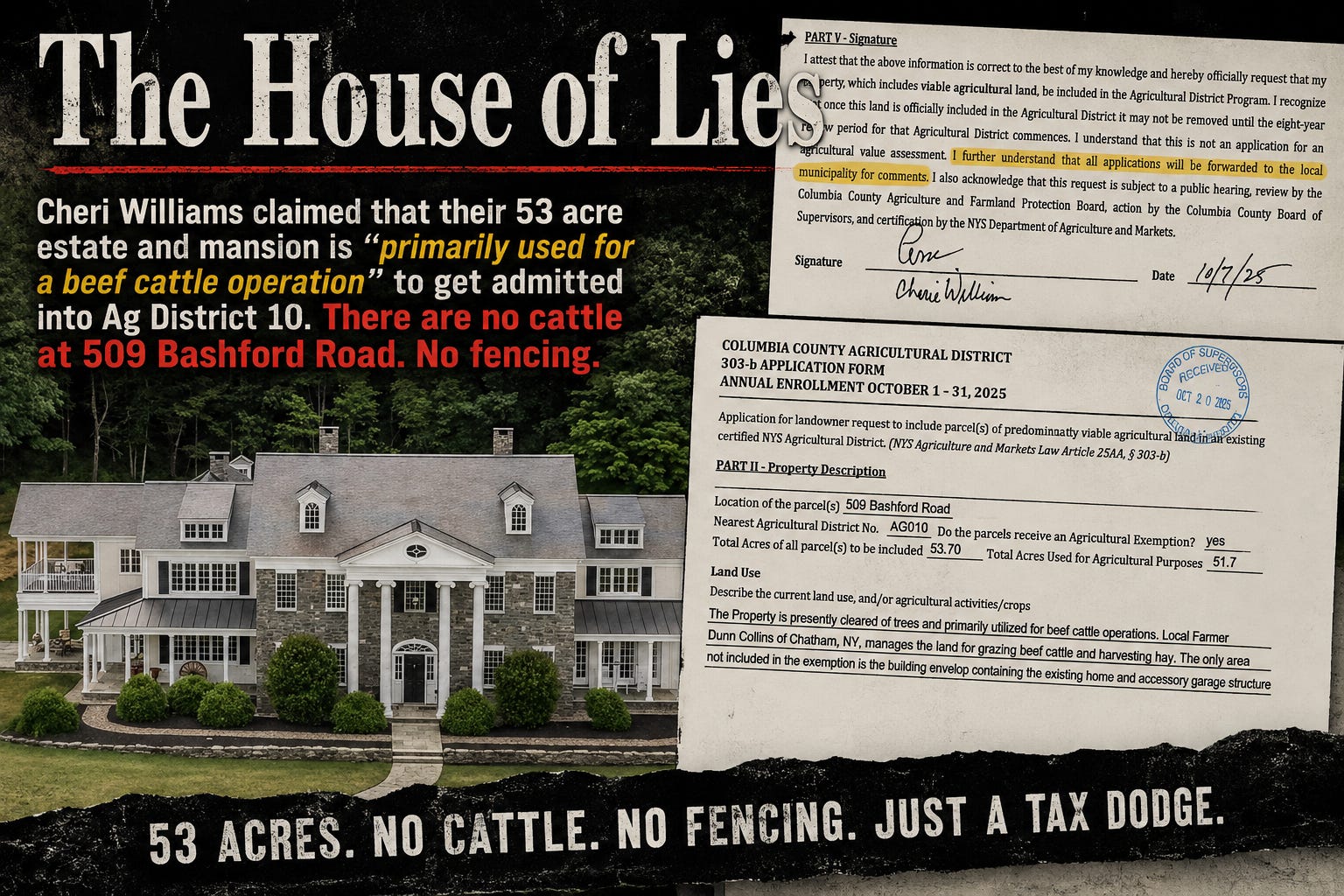
That is precisely the front on which the Fox Hill fight has been waged, in the unglamorous language of tasting-room and accessory-use approvals. A state license does not settle a syllable of it.
And here the plot, which looked for a moment like a tidy comedy of couple versus zoning board, acquires its third act and its most powerful character. Because the ground at Fox Hill sits inside a state-certified agricultural district, and that is not decorative. Under Section 305-a of the Agriculture and Markets Law, a town may not unreasonably restrict or regulate a farm operation, and it is not the town that decides what “unreasonable” means. It is the New York State Department of Agriculture and Markets, an agency in Albany that most Valatie residents have never had cause to think about and are about to.
The Department reviews local zoning as applied to the farm. It renders opinions. Its Commissioner can bring an action to enforce them. And the courts have sided with the Department when it found a town’s restrictions unreasonable, siding with it even against zoning that predated the district, deferring to the state’s reading over the town’s. So the drama is not, in the end, a two-hander. There is a third seat at the table, and it belongs to the party that can tell the Town its no does not count. In quarrels over farm operations, Agriculture and Markets can override the Zoning Board of Appeals and the Planning Board, and it frequently does.
There is also, for the connoisseurs of process, the review that never happened. No environmental study attended the enrollment. The State Environmental Quality Review, SEQR, the state’s look at what a project does to the land around it before an agency signs off, was waived by the county. The paperwork simply glided through.
So the open questions now belong to three parties rather than two: to Fox Hill, to the Town, and to the Albany agency that can outrank them both. What the Town has actually authorized at 509 Bashford Road. Whether that authorization stretches to cover everything the shimmering new license permits. And whether, should the Town summon the nerve to say no, the agricultural district lets that no survive contact with the state.
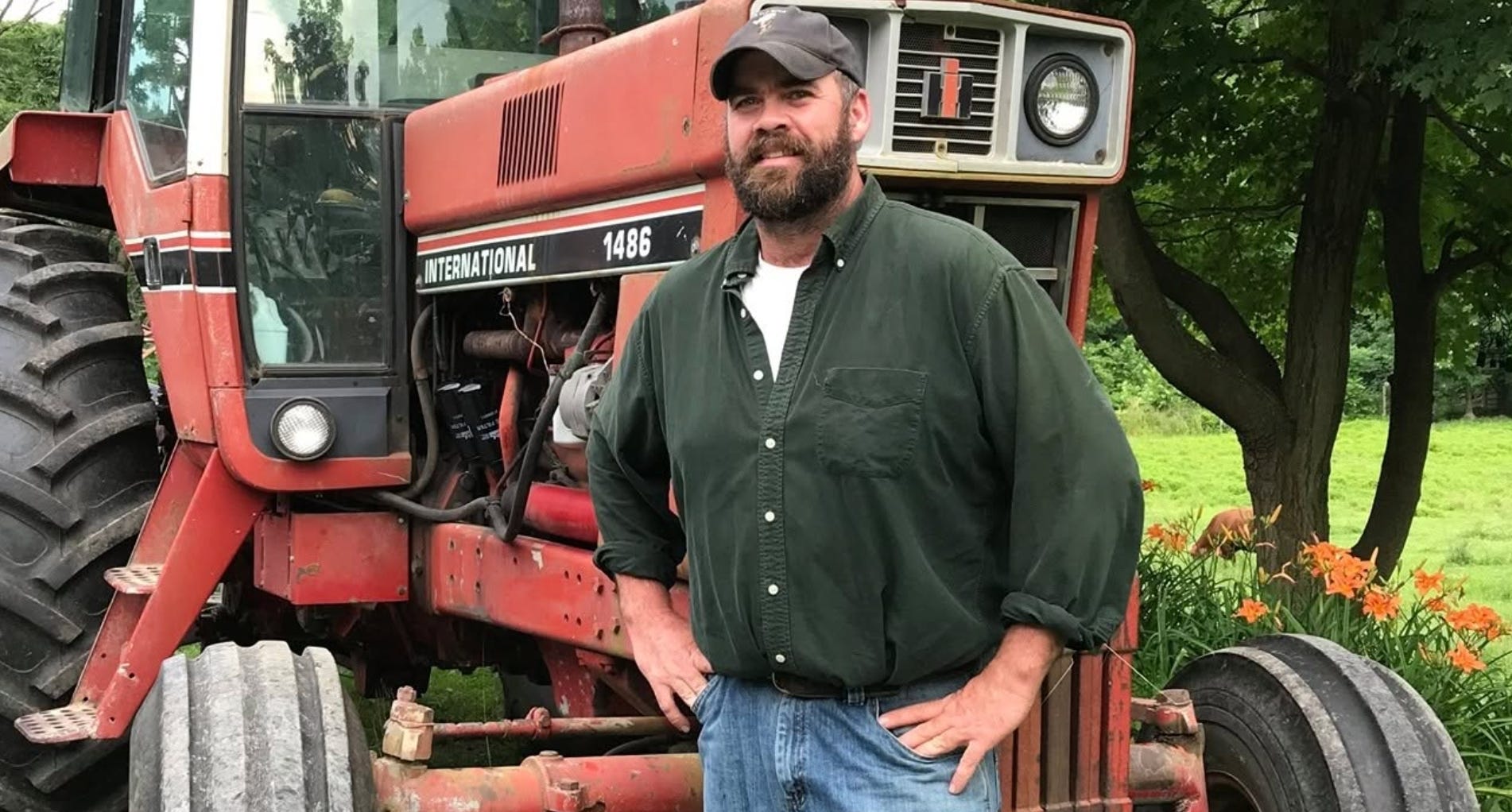
Collins will have his defenders; he always does. Which makes it worth recalling the last time this column took the measure of one of his most devoted: Prew, better known on the public record as Jeanne Veillette Bowerman, the “Democrat” in Trump’s clothing. She recites, at tender length, the legend of her “lifelong Democrat” father, a man whose checkbook somehow found only Republican causes, and of a mother cut from the very same bolt of cloth. It is a seamless performance. It is also, like the vineyard’s paperwork, a costume.
So set down the tasting notes. Strip away the flights and the tote bags and the resurrected medieval braggot. What is left at 509 Bashford Road is a corrupt farce of a “farm,” waved through by a public official who knew everything told no one and chose to feather his nest. Let’s not forget the Williamses will need a farmer. I think we all know who that is going to be. The cork is out, and the guest list was settled in a back room. Donal Collins’s conduct in this affair should not, and will not, be forgotten.
Tomorrow’s town board meeting is going to be interesting.

©2026 The Powell House Press | All Rights Reserved | Josh@thepowellhousepress.com