
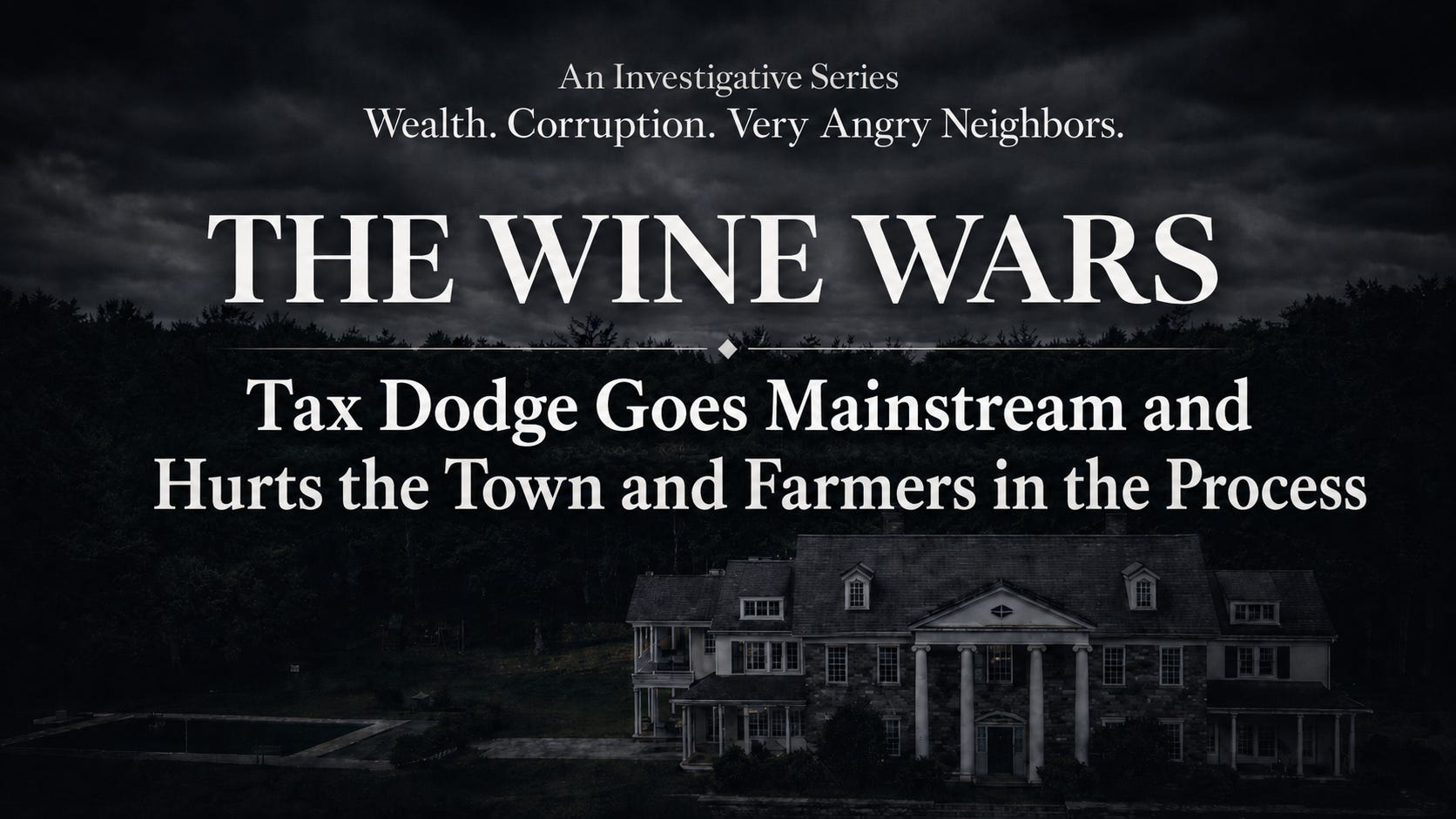
The Wine Wars: How the Welfare Rich Dodge Property Taxes with Fake Farms. It's not just Chatham.
Trump's pick for Surgeon General Nicole Saphier cut her tax bill down to $40 with chickens and lavender. The Williams of Chatham are running the same play. Everyone else picks up the check.
The Town of Chatham is entertaining a new liquor license application. Is it a coincidence that the name and address of the applicant are missing from the 29-page town board meeting agenda? Or is this just more obfuscation at the hands of Donal Collins? Good question. Rumor also has it that there is more legal correspondence missing on the town’s website concerning 509 Bashford Road. Well, let’s not call it a rumor. It’s a fact.
Nicole Saphier keeps chickens. Also rosemary, lavender, hay, apples, and a wedge of forest in New Jersey. The chickens and the lavender are doing important work. They are subsidizing a 16,000-square-foot house with 26 rooms, an in-ground pool, a home theater, a yoga studio, and a dedicated wine room.
That is not a farm. That is a Nancy Meyers film with poultry.
Saphier is a radiologist, an author, a former Fox News contributor, and President Donald Trump’s nominee for surgeon general. According to POLITICO, she is also the proprietor of an estate whose 10.35 farmland-designated acres saw their valuation drop by roughly $624,500. The tax on that land, an estimated $7,200, fell to as little as $40.
Forty dollars. Less than a decent bottle of New Jersey wine. (Saphier has a room for those.)
This is the maneuver. Take a luxury estate. Add a few hens. Plant some lavender. Photograph the apples. Invoke a statute written for people whose lives actually depend on weather. Collect the discount.
The same play is now running in Chatham, New York. Well except for the fact that Saphier has more of a farm if you can call it that.
Edwin and Cherie Williams own 509 Bashford Road. It is a luxury estate on a residential dirt road. Less than one percent of the acreage is vineyard. The property has nonetheless been admitted to an agricultural district, and the Williams now want to convert it into Fox Hill Estate Vineyard, a winery and tasting-room destination, over the objections of neighbors who can read a map.
The vocabulary is identical to New Jersey. Vineyard. Farm winery. Agricultural district. Rural preservation. The vocabulary is doing the work because the agriculture certainly isn’t.
The legal architecture varies by state. New Jersey has farmland assessment. New York has agricultural districts and right-to-farm protections. The strategy is the same in every zip code: locate a statute drafted for working farmers, identify the lowest possible threshold of compliance, and clear it with a gardening hobby. The result is a private financial instrument disguised as a public good.
It is a tax dodge with better scenery.
The genius of the thing is the borrowed moral authority. Americans love a farm. They love the idea of preserving open land, of small producers holding the line against subdivisions and weekend houses. Real farmers are running on thin margins and bad luck. The public extends them special treatment because farming produces food, preserves landscape, and sustains a rural economy that nobody has figured out how to replace.
That bargain does not survive when the beneficiary is a radiologist with a wine room.
The Williams have wrapped their project in the language of agriculture. A property with under one percent vineyard does not become a farm because the paperwork says so. A residential country road does not become a commercial corridor because someone learned the magic word at the right moment in a zoning dispute. Calling something a farm does not produce a farm. It produces a brochure.
The tax cost is real, and it does not stay on the applicant’s side of the property line. School districts still need funding. So do the town, the county, the fire district, the library, emergency services, the highway department. When a luxury estate slips into a favored category, the burden shifts. Quietly. Incrementally. To everyone with less land and worse lawyers.
That is the corrosive part. The benefit goes to the property owner with the consultants, the engineers, the land-use counsel, and the time. The cost is socialized to people who do not have those things. The retiree on a fixed income cannot plant six rows of grapes and reclassify her bungalow. The working family on a quarter-acre cannot hire an agricultural attorney. Only the wealthy can play this game at scale, and only the wealthy do.
In Chatham, the politics are inseparable from the land.
Town Supervisor Donal Collins is himself a farmer. This should have made him useful. Instead it has made him decorative. Collins has backed the Williams while maintaining a business relationship with them, an arrangement most public officials would find awkward and Collins appears to find unremarkable.
He is a more skilled politician than he is given credit for. He understands the emotional voltage of the word “farm.” He understands that no one in a rural town wants to be photographed opposing agriculture. And he understands the sleight of hand at the core of this fight: once a luxury estate borrows the rhetoric of farming, the people who object to it are recast as enemies of rural life. The neighbor who simply does not want tour-bus traffic on a dirt road is repositioned as a villain in a documentary about saving the family farm.
It is a very good trick. It is also a swindle.
A public official genuinely committed to farming would be the first to draw the line. He would argue that farm protections are strongest when they are reserved for actual farms. He would understand that every gentlemen’s vineyard admitted to an agricultural district makes the public marginally less willing to defend the real one down the road. He would understand that the abuse of farm law is not a service to farmers. It is the slow degradation of the brand.
Instead Collins has helped erase the distinction.
The injured parties extend well beyond Bashford Road. Real farmers carry the cost. They are the ones who will face skepticism the next time agricultural districts, tax preferences, or right-to-farm protections come up for renewal. They are the ones whose claim on public sympathy is being thinned out by a wine room in Morris County and a tasting room in Columbia County. They are the ones whose lifeline is being treated as a tax-planning technique.
The Saphier case is useful precisely because it is so naked. A wealthy professional. A luxury estate. A minimal agricultural performance. A spectacular tax advantage. The paperwork is clean. The law allows it. The public can still see exactly what is happening.
Chatham should be able to see it too.
The Williams are not strengthening farming. They are weakening it. They are weakening the tax base, weakening the meaning of the agricultural district, and asking a residential neighborhood to absorb the consequences of a commercial ambition dressed up in flannel.
The question worth asking is not whether the Williams found a route through the statute. They did. So did Saphier. The question is what the statute was for in the first place.
If the answer is a working farmer, defend the law and protect the land.
If the answer is a luxury estate, a vanity vineyard, a tasting-room business plan, and a town supervisor doing business with the applicants, then the public is not preserving anything.
It is picking up the check for the Williams and Collins.
Nice gig if you can get I suppose.
Independent journalism answers to readers—not advertisers, corporations, or access-hungry editors. No story gets killed because it upsets a sponsor. No punch gets pulled because someone important made a phone call.
Your support makes possible sharp commentary, fearless satire, and reporting that follows the story wherever it leads. In an era of manufactured narratives and algorithmic blandness, that independence isn’t a luxury—it’s a necessity.
Subscribe to The Powell House Press. Or settle for content that tells you what someone else wants you to hear.
©2026 All Rights Reserved | The Powell House Press | josh@thepowellhousepress.com


