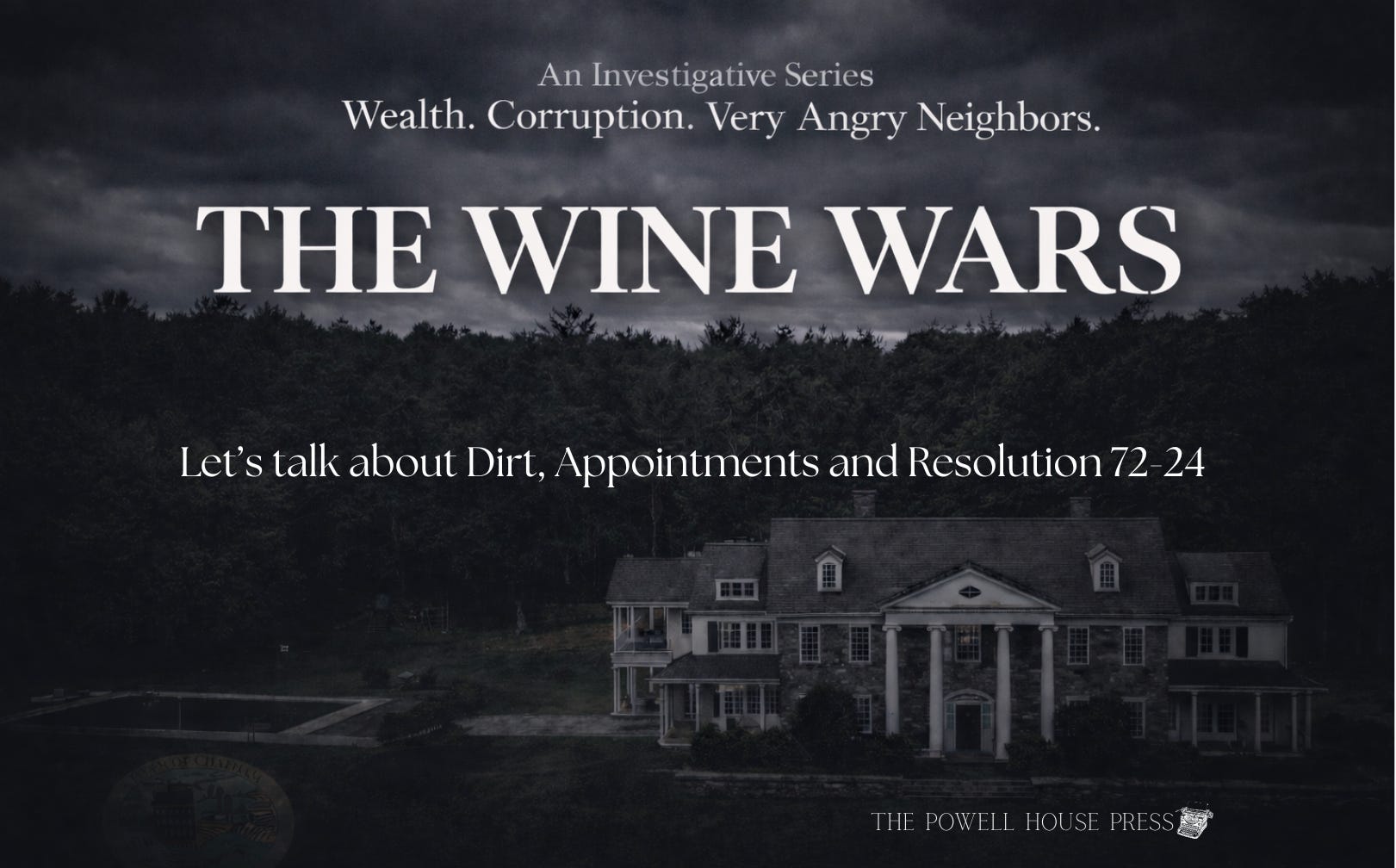
The Wine Wars: Is All Fair in Love and Cons?
For more than 7 years, the Williamses have tried to turn their home into a commercial destination — it's been a game of chess with the neighbors used as pawns and the town supervisor as their rook
Editorial Note: The original version of this post contained the wrong link to Resolution 72-24. The corrected link is now live in the article. You can also view it here.
Is it fair? Sit with that for a second. Is it fair that the residents of Bashford Road might have their lives, property, and peace of mind upended because Edwin Williams III and his wife Cherie want to throw weddings and sell wine?
Take your time. Everyone else has.
Here’s the second question, and it’s the bigger one: why have these neighbors had to wait years just to get an answer? The Town of Chatham’s Planning Board should have resolved this drama long ago. It didn’t because it couldn’t. The matter is now far more complicated than it ever needed to be, not by accident. By design. Each new disclosure sharpens the picture, and what’s coming into focus is not a vineyard story. It’s a plan. A methodical one. It has drawn in Chatham’s Planning Board, Building Department, Town Board, Zoning Board of Appeals, the Town Supervisor, the Town of Kinderhook’s Supervisor, the County Board of Supervisors, the Columbia County Agriculture and Farmland Protection Board, and Columbia County’s Soil and Water Conservation District Committee. For a quiet road in a small town, that is a remarkable list.
But first, let’s kill a myth. Dr. Williams and his wife Cherie are not victims. Not by my pen, not by their neighbors’. And while we’re killing myths, let’s dispense with another one: the Williams are not farmers. He’s a surgeon. She works at his 52,000 square foot private surgery center. They don’t farm. They don’t support themselves off the land. The closest either of them gets to agriculture is the ornamental greenhouse next to the pool house.
If someone insists on funding the victim fiction, let’s at least name it correctly: self-created hardship. In a legal sense, and this part matters, the Williams don’t have a leg to stand on. When they bought their home in 2008 they knew the zoning. They knew the terms of living on Bashford Road. They are victimizing themselves. You don’t get a variance because you bought property with a plan the zoning doesn’t allow.
If that sounds like a shot across the Zoning Board of Appeals’ bow, it isn’t. As the kids say: them’s the facts.
I’ll come back to that, and to the on-the-record myths of Fox Hill Estate. But first, let’s talk about the three-dimensional chess that the Williams, their surrogates, and Town Supervisor Donal Collins have been playing. The pieces have been moving for a long time. It’s worth laying out the whole board. And don’t mistake this for a recap. There are new revelations, new rules being broken.
Rules. Laws.
Tomato, tomahto.
The Website That Said Everything
The goal was never farming. The record makes this clear.
The first move, the first community test, was the Fox Hill Estate website. No mention of a vineyard, because there wasn’t one. The site stayed live just long enough to do two things: alert the neighbors and leave a digital record of exactly what was intended. Want to know what that intention was? The website address was foxhillweddings.com. Mrs. Williams could be reached at foxhillweddings@gmail.com. How’s that for on the nose?
The site came down. The pivot began.
On September 8, 2020, the Williams approached the Planning Board with a new ask: a tasting room in their detached garage. They had a pending application with the NYS Liquor Authority, they said. They had planted vines, they said, though the number stayed vague. No new structures, no new buildings. Simple. The board asked about neighbors, parking, compliance with Ag & Markets rules. They asked for detailed plans and a site visit. The Williams said they’d be in touch.
They were not in touch. For nearly two years.
When Williams finally reappeared at the Planning Board in February 2022, he brought a story. The problem was that the story kept changing, and the parts that didn’t change couldn’t be verified.
Start with the two-year gap. Williams’ lawyer, William Better, blamed it on deliberations over which grapes to plant. Plausible, except that two years earlier the same board had been told vines were already in the ground. You cannot be deciding what to plant while simultaneously reporting that planting is done. Better then introduced Williams to the board. Dr. Williams wanted the board to meet him.
Williams laid out a farming history. Most of it couldn’t be verified. Mostly because, by all available evidence, there isn’t one.
Then came the vine count. Two hundred vines, Williams said. Then, in the same meeting, two hundred more. The number shifted mid-conversation without explanation or apparent embarrassment. This is worth pausing on: a vineyard’s vine count is not a detail a farmer misplaces. It is also, under New York State farm winery law, a figure with direct legal consequence, as production minimums depend on it. The casualness of the revision was its own kind of tell.
Then there was the question of what, exactly, was being proposed. Williams described a modest winery, a small tasting room, a quiet agricultural operation compatible with the neighborhood. Nothing to worry about. The letter he had already submitted described something else: six large events per year, twenty to forty smaller ones, tents accommodating up to 150 people. Board member Haimbach did the math out loud and concluded it looked far more like an events business than a winery. Board member Everett said the proposal was “essentially an events banquet hall, kind of masquerading as a very, very small winery.”
Williams also wanted the board to understand that Bashford Road was already a busy thoroughfare. FedEx trucks, he said, made seventy trips a day up and down it, offered as evidence that tasting room traffic would be unremarkable. What he did not offer was documentation. FedEx does not share its travel logs with the public, for safety and privacy reasons. What FedEx did share: the average driver covers between 75 and 125 deliveries across an entire territory in a single day. For one rural road in Columbia County to account for 70 of those stops, it would have to consume nearly a driver’s entire route.
Then there were the neighbors. Chairperson Sperry asked if Williams had spoken to them. Williams said he had — naming the Mitchisons, who run heavy equipment on the road, as the neighbors across the road he had consulted.
The Mitchisons don’t live across the road. Jay and May Levine do. They are on the record stating they were so troubled by the proposal that if it goes through, they were considering selling their home. A man who claims to care about his neighborhood might lead with that detail. The Mitchisons are not on the record supporting the project. No one is.
Finally, Everett asked if this was their primary residence. Yes, Williams said. For 25 years. Public records show they purchased the property in 2008. That’s fourteen years, not twenty-five. This is not a rounding error. It is an error with a purpose: the longer you’ve lived somewhere, the more sympathetic you appear when trying to fix your zoning hardship. The actual number is considerably less sympathetic than the one Williams gave. Like almost everything else in this saga, the record is riddled with half-truths and conflicting information.
How to Make a Problem Disappear
Tedious doesn’t begin to cover it. And here’s the thing: the Williams must have felt the same way. What about the liquor license application from 2020? What about a proper site plan? An environmental study, the kind the Silver Brothers on Shaker Museum Road actually submitted when they went through this process? Those 70 FedEx trucks?
Good questions. No good answers. So the Williams did what people do when a process isn’t going their way: they stopped engaging with it. No environmental studies were completed. A traffic study was conducted in winter, months before any planned weddings or wine tastings. The application eventually expired. The town returned their escrow deposit. Publicly it was over.
Privately it was not.
The Second Act
In the fall of 2025, the project came back, publicly. Cleaner this time. Much cleaner. And it had the support of Donal Collins, the Town Supervisor of Chatham, privately. Useful, but a politician in your corner doesn’t neutralize a Planning Board. The Zoning Board of Appeals, however, is another matter.
Here’s what happened. While the Williams’ vineyard plan, in all its morphing glory, reappeared before the Planning Board, Williams quietly approached the building department and received a permit for his tasting room. He just had engineers file for it. Approved. When that approval was challenged, the Planning Board had no option but to refer it to the ZBA. And once the ZBA takes jurisdiction, the Planning Board is out. A ZBA decision, if approved, could only be challenged in New York State Supreme Court through an Article 78 proceeding. Not only would opponents have to sue, they’d have to hire an attorney, upwards of $15,000. The town would have to defend it at $175 an hour. The Williams’ cost? Zero.
Brilliant. Spending other people’s money is a powerful deterrent. It was also a deliberate distraction.
While residents organized, wrote letters, and focused on what was in front of them, the Williams in October quietly went to Columbia County and filed an application to fold their property into a New York State Agriculture District. The property is one where a sliver of vineyard occupies less than one percent of the acreage, with a mansion taking up the rest. Inclusion in Ag District 10 would bring substantial cover under Agriculture and Markets law. That coverage includes, among other things, protections for event hosting. Like, say, weddings.
The notice appeared in the agate section of the Columbia County Register-Star, which is no longer a daily. Most people missed it. They thought this was a town fight, not a county one.
The Lone Wolf
One person who did not miss it: Town Supervisor Donal Collins. The same Collins who has a business relationship with Williams, using 509 Bashford Road (a.k.a Fox Hill Estate and Vineyard, a.k.a. FoxHillWeddings.com) for hay production and cattle grazing. The same Collins who did not disclose that relationship to the town or the county in writing as required by law.
The same Collins who only recused himself on February 19, 2026, after he had already weighed in officially at both the town and county levels. When asked point-blank why he hadn’t disclosed his recusal or conflict earlier, his response was: “I didn’t have to.”
After a cursory look at the town’s laws, Collins seemed to be correct, at least about reporting his county interactions (the conflict remains…a conflict), but he did toss the board and the public a bone: he said he’d disclose all county business issues in the future. The response seemed rehearsed. It should have — the conflict had already been reported in this column. So had his county-level activity. Combined, that coverage had been read, shared, and seen more than 100,000 times: twenty-five times the population of the entire Town of Chatham. His disclosures disclosed nothing. It seemed he knew the question was coming. And as reported earlier, Collins’ recusal was irregular and not in accordance with the law.
What was not discussed at the Town Board meeting was that this was not Collins’ first transparency rodeo. The board had seen this behavior before: a supervisor who kept his county-level activity to himself, who treated what he did at the county as nobody else’s business.
Ergo Resolution 72-24
In 2024, the board decided to make it their business. They proposed Resolution 72-24, requiring that Collins’ monthly report include “an update containing pertinent information from the County Board of Supervisors and any County Committees the Town Supervisor sits on.” The purpose was not complicated: keep the board informed about what their supervisor was doing on their behalf at the county level.
Collins tried to kill it. He argued passage would trigger a referendum, upend twenty years of established practice, and generally cause chaos. He was the only one who seemed to feel that way. The resolution passed. Collins cast the lone nay vote.
He then proceeded to violate it.
He did not tell the Town Board that the Williams property was moving through the Agriculture and Farmland Protection Board. He did not tell them that County Resolution 70-2026 was naming 509 Bashford Road for inclusion in Ag District 10. And he did not tell them, and this is where it gets sharp, that he remained an active participant in the Columbia County Agriculture and Farmland Protection Board’s (AFPB) deliberations on that very application in November 2025.
Two people with direct knowledge of the proceedings, speaking independently and off the record, confirm that Collins did not recuse himself from the AFPB. He participated. The board heard nothing of his relationship with Williams. He did not recuse himself as required by state and local ethics laws.
What the AFPB signed off on is significant. They determined that the Fox Hill project would have no meaningful environmental impact. That determination was the green light for 509 Bashford's inclusion in Ag District 10. Consider what they were being asked to waive through: a property with a DEC wetland at its base, a vineyard perched on a hill above it, bringing with it documented pesticide loads and soil erosion risk that such operations are known to carry.
There's more. Consider it the cherry on this particular irony sundae — and it does not appear anywhere in the Chatham Town record: in January 2025, Collins was appointed to Columbia County's Soil and Water Conservation District committee.
The SWCD is not a ceremonial post. It is a state-created local government body that exists specifically to address land stewardship: erosion control, wetland protection, agricultural runoff, stormwater management, conservation planning. Every county in New York has one. Collins’ appointment gave him standing on precisely the environmental questions that should have triggered the most scrutiny of the Williams property. It also gave him, within the AFPB proceedings, a credibility on soil and environmental risk that other members would have had every reason to defer to.
So the question just sits there. It is not subtle.
How does a man who profits from an undisclosed relationship with 509 Bashford Road — who is supposed to represent the residents of his town, who sits on the AFPB, who sits on the county’s Soil and Water Conservation District, who knows the property at the center of all this conflict sits on a DEC wetland, and who is obligated to know that vineyards carry documented erosion and pesticide risk — how does that man sign off on a review concluding there is no meaningful environmental impact, in writing, without raising a single flag?
And then not mention any of it to the board he is legally required to keep informed?
It is a great question. It deserves a straight answer. Collins has been asked. He has not provided one.
The Resolution That Wasn’t Posted as Promised
County Resolution 70-2026 is now on the books. It names Edwin and Cherie Williams and their property at 509 Bashford Road. It folds the property into Agriculture District 10, lending agricultural standing to an estate where a vineyard occupies roughly one percent of the land and the rest is mansion. The business operating there goes by Fox Hill Winery. It does not appear in the New York State business registry.
The resolution is required to include a SEQRA Environmental Assessment Form. That form is required to be posted publicly on the county website — the county’s own resolution says so. The resolution is there. The environmental assessment is not. And how is the public supposed to know what’s in it? The county has an answer for that: file a FOIL request and wait. That’s not transparency.
The ZBA’s ruling on the Williams tasting room application was scheduled for release on February 26th. An hour before the meeting, the item was pulled from the agenda. Chairman Persing gave a specific reason: the board hadn’t had time to write it up. He noted, with some deliberateness, that the board had 62 days from the close of the public hearing to issue its decision under New York State Town Law §267-a(8). Accurate. Interesting timing to flag it.
More interesting is what a source familiar with the board’s internal deliberations shared afterward off the record. The board had initially been prepared to approve the tasting room. Then came the scrutiny, the letters, the public attention, and the mounting recognition of a fundamental problem. Under New York ABC Law §76-a, a farm winery must be located on a farm where wine is actually manufactured. A tasting room, the one the Williams want, is an accessory use to a winery. Fox Hill has no farm winery license. Without the license, there is no winery. Without the winery, there is nothing to be accessory to. There is a house. There is a garage. The write-up, when it comes, is now rumored to end in denial.
Supervisor Collins was required, under Resolution 72-24 passed by his own board in February 2024 and under the plain obligations of his office, to disclose his recusal in writing and to keep the Town Board informed of everything he was doing at the county level on a matter directly affecting a constituent property in his town. His claim at the February 19, 2026 Town Board meeting that no such obligation existed is not accurate.
Whether the town addresses Collins’ conduct remains to be seen. Whether the county pulls back its resolution rather than defend it is an open question.
The battlefield is expanding. Residents are more willing than ever to fight, and the terrain is shifting toward State Supreme Court and the New York State Comptroller’s Office.
Ed and Cheri Williams soldier on. Behind them: damaged careers, bad blood, and a reputation in freefall in a very small town where everyone is watching and no one is forgetting.
A Williams win, at this point, seems like a very long shot. Which raises the question: is the grape juice worth the squeeze? This is, after all, New York State wine. Better can be found in a box.
Link to Collins’ Appointment to Columbia County’s Soil and Water Conservation District committee
Link to Columbia County Resolution 70-2026 sans SEQRA Environmental Assessment Form
Columbia County Code of Ethics
Town of Chatham — Town Board
Donal Collins, Town Supervisor supervisor@chathamnewyork.gov
Angus Eaton, Deputy Town Supervisor aeaton@chathamnewyork.gov
Lisa Simonetti, Councilmember lsimonetti@chathamnewyork.gov
John Wapner, Councilmember jwapner@chathamnewyork.gov
Rick Werwaiss, Councilmember rwerwaiss@chathamnewyork.gov
Zoning Board of Appeals
Trish Fallon, ZBA Clerk zoning@chathamnewyork.us
Planning Board
Erin Reis, Planning Board Clerk planning@chathamnewyork.us
Why Your Subscription Matters
Independent journalism answers to readers—not advertisers, corporations, or access-hungry editors. No story gets killed because it upsets a sponsor. No punch gets pulled because someone important made a phone call.
Your support makes possible sharp commentary, fearless satire, and reporting that follows the story wherever it leads. In an era of manufactured narratives and algorithmic blandness, that independence isn’t a luxury—it’s a necessity.
Subscribe to The Powell House Press. Or settle for content that tells you what someone else wants you to hear.
©2026 All Rights Reserved | Tips or comments? Josh@thepowellhousepress.com
A member of the National Press Club and the National Writers Union