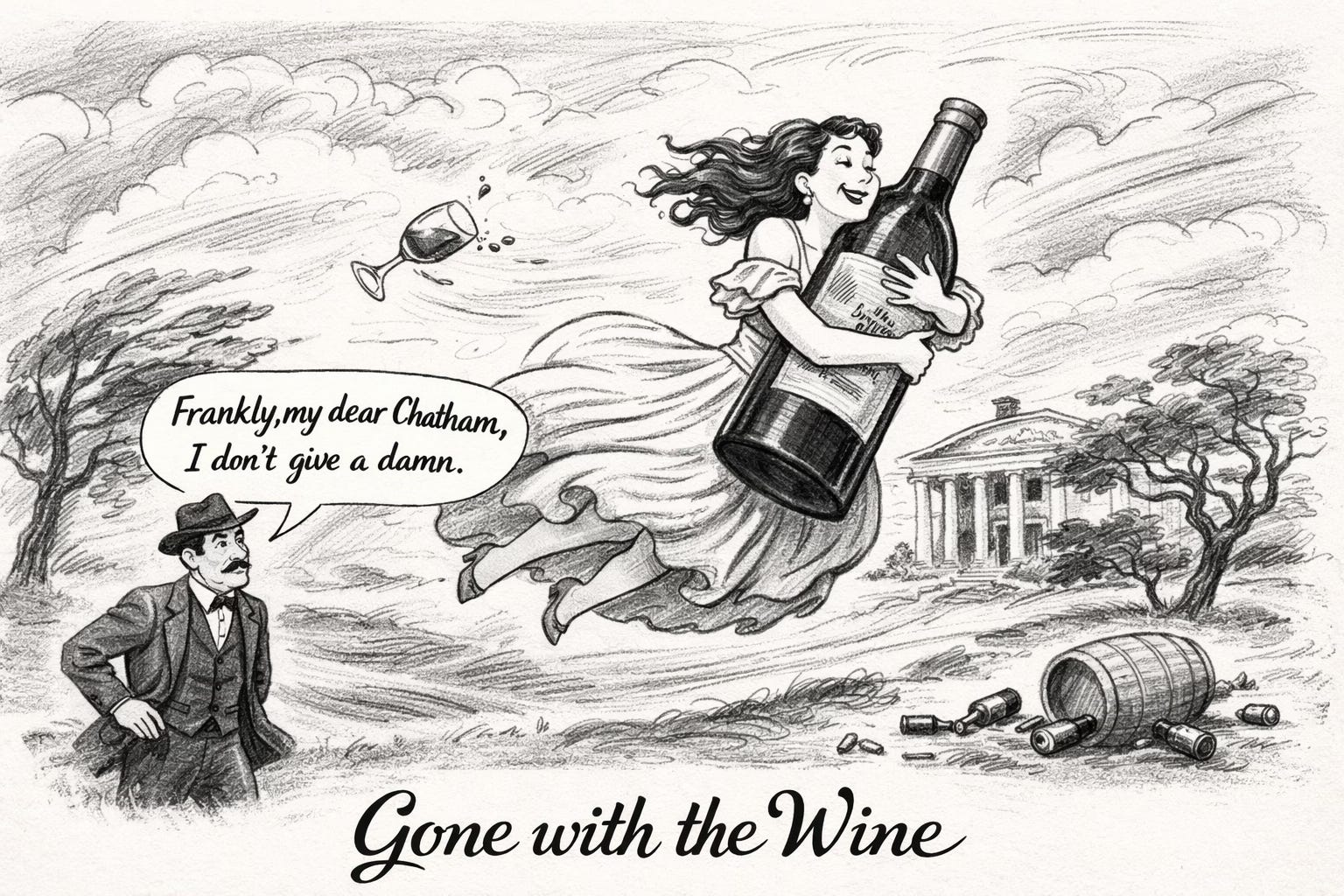
The Wine Wars: The Befuddled and Bemused
How the town of Chatham and its Board was played inside and out by Team Williams and let down an entire community.
Tonight, the Town of Chatham receives the Zoning Board of Appeals decision on whether Ed and Cherie Williams can use their garage for something. Just what that use is? Good question, and now a largely meaningless one.
While this shifting matter has been simmering on the ZBA’s stove, the real meal is already on the table.
How the Williams pulled this off is fascinating and made clearer by the recent posting of public information on the Town’s website. Was it a poorly conceived transparency policy or a survival strategy? It is hard not to think that dumping documents online and hoping no one notices the mess beneath them was part of the survival calculus. Whatever the objective, what is clear is that the more they reveal, the more they expose.
The new video section is more obscene than what used to sit behind the curtain at the old Video Cave across from the Val-Kin.
What, exactly, was that engineer, the one cosplaying as a Proud Boy, doing before the Planning Board on October 14, 2025? One thing becomes obvious: he is either on the take or genuinely incompetent. Plans without documentation. Maps missing landmarks. Straight-faced claims that a commercial operation anticipates zero deliveries.
The Planning Board asked the right questions. The answers were preposterous or nonexistent. It is nauseating to watch. Seriously, as God is my witness, I will never be hungry again.
At the same time, Team Williams discussed the anticipated visitors, vague sewage plans, and all the bottled water and supplies that Ed and Cherie would pick up themselves on their way home from the office. They could not, however, speak to the scope of the actual farm. When questioned about headlights disturbing neighbors, they offered a casual “we can change that.” A plan built on shifting sands. A plan, reportedly in development for over half a decade, still unable to answer a basic question: Where will people park?
At first, after reviewing more Fox Hill Vineyard documents, incomplete applications, revised plans, and continued waffling, I leaned toward incompetence. Then I wondered if the Williams were simply impossible clients, constantly moving the target. The Meg and Harry of Columbia County. Maybe the engineers are just chasing a paycheck. It is hard to tell.
What is hard to avoid is the conclusion that there is an element of bad faith, along with a confidence on the Williams’ part that the process will succeed, powered by a single fuel: the assumption that no one is paying close enough attention, or that those who are will not have all they need to make an informed decision.
The 303-b application brings all of this into focus. Though it was legally required to be posted on the Columbia County website, it was not. When finally produced, it stood out for its inaccuracies. Sources report the Williams were furious, even considering legal action over a supposedly slanderous article suggesting Cherie had lied.
But the truth is simpler. The application, and the signature, spoke for themselves.
Readers saw for themselves Cherie Williams’ application to join Agricultural District 10 claiming most of the land was used for hay and cattle. This was not a typo. People do not accidentally claim cattle they do not have. Was it a lie? Fair question. A better one is whether this is part of a pattern.
Recent released documents included an “Addendum to Simplified Site Plan Application.” Its contents were less a revelation than another tile in a mosaic of misrepresentation; specifically, it outlines Ed Williams’ agricultural credentials. A dairy farm background and a degree in Agriculture and Life Sciences from Cornell, class of 1982.
Impressive. Except his own professional website (the face-fixing one) lists his degree as Animal Physiology.
And that is not the only confounding claim.
Margaret Mitchell, take notes. This is how fiction is written.
In the Williams’ telling, alongside the cattle, there were horses. Like the cattle, these horses are about as real as Tara, the plantation, not the one perched atop 509 Bashford Road.
Where were these horses stabled? In the garage? Not one with the cars. The other one. The one described variously as a short-term rental, a bunkhouse for farm help (Big Sam?), and according to a recent Planning Board visit, a storage space for lawn equipment. This same building is now, apparently, the future tasting room. Where the wine is, or will be, made.
Confused? You should be.
The story expands to include a barn complex. Where I assume the farmhands work and the livestock live. At this point, the 303-b application feels less like a mistake and more like a pattern.
What is notably absent, both in filings and hearings, is any clear description of the vineyard itself. What is abundant, however, are details about weddings, tents, and events. That tracks. It should. That is the plan.
The agricultural narrative softens the reality. Weddings, port-a-potties, and corporate events fade into a bucolic backdrop of barns, cattle, and horses, at least on paper.
“Ag District” appears throughout the applications like a legal talisman. It is not decorative. It is structural.
It’s no longer news that the Williams pursued inclusion in a New York State Agricultural District at the county level while local proceedings played out. This happened with the full knowledge of Donal Collins, Town Supervisor, County Board member, and tenant farmer of 509 Bashford Road.
What is new, buried in the document release, is the legal pivot by their attorney, Joel Howard.
Back in January, the argument was that the bunkhouse (whatever it is) was subordinate to the main residence and therefore qualified as a tasting room. Why not? Fiddle-dee-dee. Does it really matter?
Apparently not, because by the final day of the extended hearing, in a written submission, the argument changed completely.
Now Howard claims, it is a “renovation of an existing garage.”
He questions why the Williams are being treated differently than anyone else, reframing the project as a simple renovation of an existing structure. But that is not what was presented to the Planning Board, nor what the ZBA was originally asked to consider was it?
And still, no detailed renovation plans exist.
Previously, Howard argued the operation was no more commercial than an honor-system egg stand on the side of the road, comparing the Williams’ winery to a 4-H side hustle. That argument has now gone with the wind. Farming, it turns out, is commercial. You are reading this right. Farming is commerical and faming is allowed in Chatham.
And remember when the wine was not being made in the garage? Now it is. Supposedly. How? No one knows. Seems a lot has changed since the planning board went on their field trip.
Whether it is happening or not, the claim serves a purpose. It strengthens the legal argument that this is a legitimate farm operation.
Under Town law, farm operations include on-site production, preparation, and marketing of agricultural products. Howard goes on to claim, correctly, that tasting events are protected agricultural practices, dismissing impacts as minor compared to traditional farming.
Dust gets a mention. Pesticide fog does not.
And of course, this new development regarding where the wine is made has another purpose. Not just convenience. Necessity, actually, because on March 18, 2026, the Williams applied for a New York State winery license. And you can bet their application includes the approved tasting room signed by Ken Pratt last fall. That, along with their inclusion in an Ag District, represents crossed t’s and dotted i’s.
All of this also supports their federal permit application through the Alcohol and Tobacco Tax and Trade Bureau (TTB).
The TTB is not the Town of Chatham. A secretive supervisor, a hapless engineer, and a creative lawyer do not get to perform. It is all paperwork. The TTB wants documents. A town-verified production facility in a New York State Ag District is exactly what that application needs. Better than an invented agriculture degree and phantom livestock.
The Town will receive, or has already received, notice of the winery license application, and the Planning Board can object. Then the Williams will say the Town is being unreasonable. Ag and Markets will step in as they have done before. They will tell the Town to pound salt. Because thanks to Donal, 509 Bashford is now in an Ag District. Parking, signage, tasting rooms, weddings, all of it now arrives wrapped in the word “farm.” The Planning Board’s questions, legitimate as they were, will ultimately be decided in Albany.
Does any of this sound familiar? It should. This is what many of the neighbors, and this column, have been reporting as the goal. Sure, it has been a bit uncomfortable, but for the Williams, the juice, as they say, has been worth the squeeze.
While Rick and Angus blather on about their personal views of FOIL law, the real issues, brought to light via Substack and clarified only after costly legal bills, delays, and non-disclosures, have evolved from hidden plans and good ol’ boy politics into a property now in a protected New York State Ag District, with liquor and farm licenses on the way.
It is not Monday morning quarterbacking to ask what if people had known. It is fair to ask what would have happened to that 303-b application if Donal Collins had recused himself as required by law. It is also fair to ask the entire board about this fragmented process that has been unfolding for years, and to expect a response.
If this process had been transparent at any stage of development, would it have gotten this far? What about the board’s knowledge of Donal’s conflicts? Those are not hypothetical. He eventually recused himself, but not before signing off on inaccurate claims of farming and land use on legal forms. What about the public health issues that were ignored when the county voted to waive environmental review, based on a recommendation from the Columbia County Agriculture and Farmland Protection Board, of which Donal Collins is a member?
What about the engineer’s clear request, made public in posted recordings, to consider only parts of the project rather than the whole, and the legal concept of segmentation? And adding insult to injury, a former Town Board member, the significant other of the Town Supervisor, Donal Collins, openly bragged that they have had this arrangement with the Williams for years and that the property has value to them.
Now the Town Board has a choice. Accept that it was played. Accept a supervisor who decided his recusal was optional. Accept misleading documents. Keep dragging out FOIL obligations and pretending the board is in control, when the law and the courts have already made clear that Ag and Markets regulations take priority. Defend this process when it is challenged under an Article 78 proceeding and the spend legal fees. Or, they can start discussing the issue publicly with their constituents.
Imagine that.
And in the end, it may not matter.
Tonight’s ZBA decision carries the power of a dead 9-volt battery. A denial of the garage renovation can be brought to Ag and Markets as too restrictive to a farm operation. A favorable decision becomes a brick in the application structure before the SLA and the TTB.
Tomorrow is another day, but it is not looking like a good one on Bashford Road. Well, unless you are Ed and Cherie Williams.
Cheers!
Why Your Subscription Matters
Independent journalism answers to readers—not advertisers, corporations, or access-hungry editors. No story gets killed because it upsets a sponsor. No punch gets pulled because someone important made a phone call.
Your support makes possible sharp commentary, fearless satire, and reporting that follows the story wherever it leads. In an era of manufactured narratives and algorithmic blandness, that independence isn’t a luxury—it’s a necessity.
Subscribe to The Powell House Press. Or settle for content that tells you what someone else wants you to hear.