
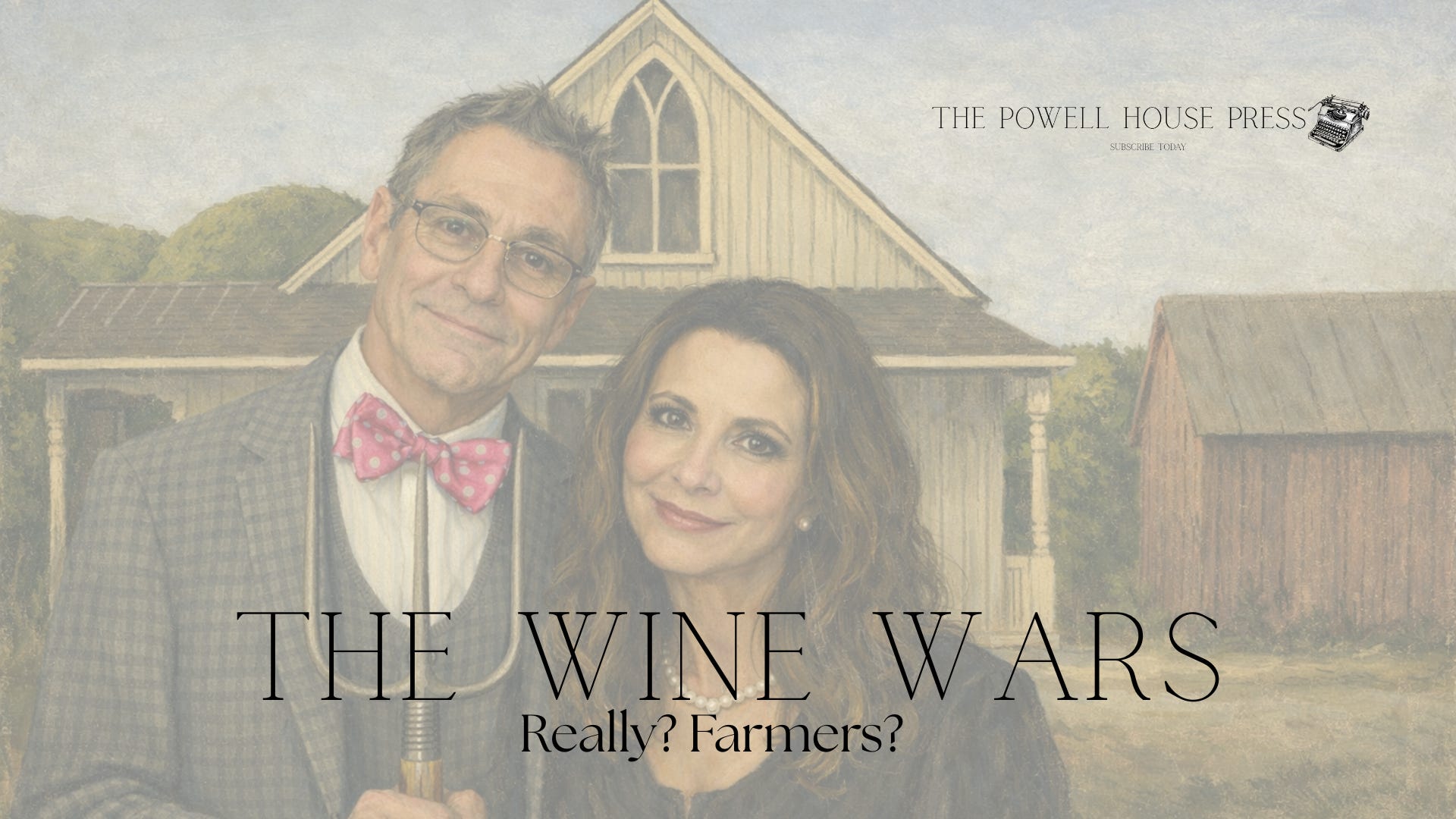
The Wine Wars: the White Coat Entrepreneur and the Vineyard that Isn’t
A Surgeon, a Carcinogen, and the Audacity of Agricultural Cosplay
While the issues around what I have called “The Wine Wars” seem local, they are anything but. This is not NIMBYism. This is a story about whether one couple with enough money and gobs of persistence can fundamentally alter the character of a historic community, and whether the regulatory system will let them dress up a commercial entertainment venture in the borrowed clothes of agriculture to do it. It is happening in New York’s scenic Hudson Valley, and if it can happen here, it can happen anywhere. And it is.
There are many issues, but today I want to talk about four of them: the legitimacy of Ed and Cheri Williams' claim to be farmers and what that means for the tax base and property values; public safety; the pattern of behavior that reveals what this project has always been about; and the product they propose to market.
Dr. Edwin Williams is a facial plastic surgeon. Not a part-time surgeon. A full-time, board-certified, dual-specialty surgeon who operates the Williams Center, a 22,000-square-foot facility in Latham, New York, with multiple surgeons, 75 staff, a surgical center, a hair center, and a med spa. He holds offices in Manhattan, Saratoga, and the Virgin Islands. He served as President of the American Academy of Facial Plastic and Reconstructive Surgery. He has been an active member of the Entrepreneurs’ Organization for over a decade. He has co-written chapters in textbooks and in industry journals. He presents at national and international conferences.
And he is, by his own trademarked designation, The White Coat Entrepreneur™.
His website, DrEdwinWilliams.com, makes no mention of farming. It offers “valuable business education and guidance for Physicians & Med Spas to learn how to scale up their practices.” His book, also called The White Coat Entrepreneur, is subtitled “Master Business So You Can Work Less, Earn More, and Exit Successfully While Maintaining a Balanced Life.” Its Amazon description reads: “FROM SURGEON TO CEO: Earning a degree in medicine doesn’t prepare you to take on the world of entrepreneurship.” His podcast, also branded The White Coat Entrepreneur, features interviews with other surgeons about growing aesthetic practices, opening profit centers, and acquisition strategies. And the book (self-published*), like the vineyard, is a vanity project. And not for nothing, White Coat should be hyphenated because it is a compound modifier, two words that work together to modify a noun: White-Coat Entrepreneur. I say this not to be catty, but to point out that expertise in one area is not necessarily transferable. A good surgeon does not necessarily make a good editor, or a good farmer.
Let me be clear about what is not on this résumé: a single day of agricultural training. Not one season of commercial crop management. Not one year of livestock husbandry as a principal operator. Not one agricultural certification, not one USDA interaction, not one crop yield report filed with any agency.
Yes, Dr. Williams attended Cornell’s College of Agriculture and Life Sciences as an undergraduate. He has cited this in communications with me as evidence of agricultural credentials. But as his own podcast reveals, he studied physiology and chemistry, not farming, not viticulture, not agronomy. He went on to medical school, did a residency in otolaryngology and a fellowship in facial plastics. The Cornell agricultural college was a waypoint on the road to the operating room, not the vineyard.
Yes, he has said he “worked on a dairy farm for over ten years through college and medical school.” Working on a farm is not the same as being a farmer. Millions of Americans held farm jobs in their youth. It does not make them qualified to operate commercial agricultural enterprises any more than working at a law firm filing paperwork makes one a lawyer.
The cattle on the property adjacent to Fox Hill Estate? They belong to Donal Collins, a farmer who leases the land and just happens to be Chatham’s Town Supervisor. I asked the town if Mr. Collins has recused himself from any decision making on the issues before the town or disclosed the nature of the business relationship he shares with Williams. While I got a response to the email (and for that matter every email I have sent), what I did not get was an answer to that question. This led me to FOIL the town. (You can read the FOIL request here as well as the one sent to Columbia County.) Why does this matter? Simple. The process with the town has been strange. You can read about that here (The Wine Wars: Is Fox Hill the Hill To Die On).
The Fox Hill Vineyard property itself, 509 Bashford Road, is classified as residential or RL-2. Its full market value is $4,573,171. It is not, and has never been, classified as a farm. Never. Why? Because it is not a farming operation, not by any interpretation of the law. Four hundred grapevines producing approximately 150 bottles of wine per year. That is roughly twelve cases. A dedicated wine enthusiast could consume that quantity in a year without particular effort.
So when the application arrived at the county level this past January requesting that this property be included in Agricultural District #10, granting it state-level protections designed for working farms whose operators depend on the land for their livelihood, one has to ask: for whom was this statute written? Was it written for The White Coat Entrepreneur™, the serial entrepreneur who built a multi-million dollar medical practice and trademarked his own brand name? Or was it written for the actual farmers of Columbia County, the people who get up before dawn, who don’t have surgical centers and med spas and Manhattan offices, who depend on the land not as a side hustle but as a life?
If this property receives agricultural district designation, the Williams would be eligible for agricultural tax assessment under Section 305, taxing the land at its agricultural value rather than its fair market value. Consider what that means: a $4.5 million estate, currently paying taxes commensurate with that valuation, could see its assessment reduced to a fraction of that amount. The revenue lost to the Town of Chatham, to the school district, to the county, that revenue would need to be made up somewhere. By whom, you ask? Everybody but the Williamses.
And then there is the burden on first responders. On March 18, 2013, a fire broke out at 509 Bashford Road, the Williams’ previous home on the property. It was a horrible fire that claimed the lives of pets and property. An absolute tragedy. How did it start? A housekeeper cleaning out the fireplace from the night before left embers on the porch. Luckily no person was physically harmed. The children were at school and the Williamses were working at their full-time jobs at the surgery center and medical spa.
The volunteer fire department responded and tried to extinguish the blaze to no avail. Even with a large pond on the property, built by Bill Spencer over fifty years ago and part of the New York State designated wetlands, the volunteer firefighters were unable to marshal enough water to save the original Williams home. The uphill grade made it impossible to get enough water to the fire.
Now consider what a commercial operation would mean for those same volunteer responders. More traffic on narrow dirt roads. More visitors unfamiliar with the area. More vehicles, more people, more risk, on a road where the fire department already could not save a house. If the existing public-safety infrastructure was insufficient to protect a single residential structure, what happens when dozens of patrons are added to the equation on a regular basis?

And it is not just taxes. It is property values, everyone else’s property values. The weight of evidence from communities across the country is clear: commercial event activities adjacent to residential properties in rural settings, including weddings, concerts, and tasting rooms with significant foot traffic, create noise, traffic, parking, light pollution, and safety concerns that suppress neighboring property values. While there’s no exact percentage on the cost of living next to a winery/wedding venue, research on noise and traffic externalities consistently shows impacts ranging from five to eighteen percent, depending on intensity and proximity.
The anecdotal evidence from zoning battles nationwide is remarkably consistent. In Franklin County, Missouri, when a wedding venue was proposed, an appraiser for the venue owner claimed no impact on neighboring property values. Three members of the neighboring Kerr family presented appraisals showing they could lose more than $100,000 in property value if the venue was built. In Dripping Springs, Texas, homeowners fought a legal battle with a wedding venue that hosted weddings with loud music approximately 250 feet from a neighbor’s back porch. One neighbor stated: “I can’t use my property… I’m hostage on my own land.” A neighborhood coalition explicitly listed reduced property values among the documented impacts and urged neighbors to get baseline appraisals before the construction of the proposed venue.
One resident near an existing venue testified: “We live in a residential area where several years after we moved here a wedding venue was quietly built right next to our property… Once they were established, it became obvious there was very little concern for the residents. Their focus was to grow the business. Now, delivery and trash trucks are frequent, buses park near our property… Noise levels are no longer monitored… Most importantly, residential property values fell. No one wants to live next to or near a wedding/event venue!”
The residents of Bashford Road should not have to wait until the damage is done to learn what their homes are worth. If this project goes forward, the question is not whether property values will be affected. It is by how much.
This is not a farming venture. This is tax strategy dressed in Gucci overalls.
The Product: A Known Carcinogen
Let us talk about what Dr. Williams proposes to sell.
Wine has no meaningful nutritional value. None. Real crops do. A five-ounce glass contains 120 to 140 calories, virtually all of them from alcohol and trace sugar. Zero fiber. Negligible protein. No significant vitamins or minerals. The antioxidants that wine enthusiasts love to cite, resveratrol chief among them, are present in quantities so small that a person would need to consume dangerous volumes of wine to achieve any therapeutic effect. The U.S. government does not classify alcoholic beverages as nutritious. Wine bottles are not required to carry Nutrition Facts labels. The product is regulated not by the FDA but by the Alcohol and Tobacco Tax and Trade Bureau.
What wine does contain, in meaningful quantity, is ethanol. And ethanol is a Group 1 carcinogen.
This is not my opinion. This is the determination of the International Agency for Research on Cancer, a body of the World Health Organization, which first classified alcohol as a Group 1 carcinogen in 1988. Group 1 is the highest classification, the same category as tobacco, asbestos, and ionizing radiation. The U.S. National Toxicology Program has listed alcoholic beverages as a “known human carcinogen” since 2000. The World Health Organization states there is “no safe level of alcohol consumption” when it comes to cancer risk.
In January 2025, U.S. Surgeon General Dr. Vivek Murthy issued a formal advisory calling for cancer warning labels on all alcoholic beverages, calling alcohol the third leading preventable cause of cancer in the United States. Approximately 100,000 cancer cases and 20,000 cancer deaths per year in this country are attributable to alcohol. Alcohol causes more deaths annually than drunk driving crashes.
And here is where the story acquires its particular irony.
Alcohol is directly linked to cancers of the oral cavity, the pharynx, and the larynx. These are head and neck cancers. The cancers of the mouth, throat, and voice box. The precise anatomical territory that otolaryngologists, ear, nose, and throat specialists, are trained to diagnose and treat.
Dr. Edwin Williams is board-certified in Otolaryngology. He is trained to treat the cancers that the product he proposes to sell is known to cause.
A meta-analysis of 20 case-control studies found that alcohol consumption has a strong direct relationship with laryngeal cancer risk. How strong? Eighty percent of oral and pharyngeal cancer cases in men are attributable to alcohol and tobacco use. The National Cancer Institute confirms that even light drinking, one drink per day, increases cancer risk.
I have no quarrel with people who choose to drink. Adults make their own decisions. But there is something that should give pause about a physician, specifically a physician trained in the specialty that treats the cancers alcohol causes, seeking to build a commercial enterprise around selling that carcinogen from a garage in a residential neighborhood, on a road with no sidewalks, to patrons who will then drive home on dirt roads through horse country.
Less than 45 percent of Americans are aware that alcohol causes cancer. Eighty-nine percent know tobacco causes cancer. This awareness gap is not accidental; it is the product of decades of industry marketing that has successfully positioned wine as a wholesome, even healthful, product. The Surgeon General’s advisory was issued precisely to close that gap.
Dr. Williams knows the science. He has to. It is his field. And yet here we are.
What This Has Always Been About
Let’s review the record. Not the aspirational language of the applications. Not the attorney’s letters. The actual pattern of behavior.
Around 2019, the Williamses advertised their property as a wedding venue. Events for 100 to 150 guests. Parties continuing to the early morning hours. The neighbors vigorously objected. They backed off and then reapproached, this time as farmers.
Then they plant 400 grapevines and rebrand the same project as a vineyard with a tasting room. Same garage. Same neighbors. Same zoning code that does not permit commercial retail in residential districts. They represent to the town that the wine is made off-site. Then, at a January 2026 hearing, when licensing law makes on-site production more legally advantageous, the story suddenly changes: the wine has apparently been made in the garage all along. Odd to say the least.
Their filing with the town suggests a vineyard at 800 vines. Williams’ letter to me says 5,000 (you can read it here). Their initial applications propose selling Fox Hill wine. Their attorney’s latest salvo acknowledges the tasting room would sell other commercial brands with no connection to Bashford Road, just as long as it’s made in New York.
When the neighbors asked Dr. Williams what he thought of their concerns, according to three separate sources who asked not to be identified, his response has been consistent: “I don’t give a f*ck what my neighbors think.”
Meanwhile, in October 2025, quietly and without public announcement, an application was filed to include 509 Bashford Road in Columbia County Agricultural District #10. A public hearing was held on January 5, 2026. The residents of Bashford Road and the surrounding area, who have been attending meeting after meeting, writing letter after letter, one of whom hired a lawyer, another of whom conducted a theoretical risk analysis, mostly didn’t even know it was happening. It’s hard to know. Columbia County puts notices in the Register-Star and its paywalled online e-edition, not the Times Union, the only true daily newspaper in the area, with delivery and a more robust circulation in the northern part of Columbia County, where the Town of Chatham is located.
This is what the entire saga has always been about. Not farming. Not viticulture. Not preserving agricultural land. It is about hosting events on a hilltop property in horse country and finding the legal vehicle to make it happen: wedding venue, vineyard, tasting room, agricultural district designation and tax dodge. The vehicle changes. The destination does not.
The Burning Question
Dr. Edwin Williams is a dual board-certified surgeon. He is The White Coat Entrepreneur™. He runs a multimillion dollar medical practice with 75 staff across multiple locations. He is an author, a podcaster, a business mentor, a conference speaker, a member of the Entrepreneurs’ Organization. He owns a surgical center. He owns the trademark on his personal brand.
He is not a farmer. The property is not a farm.
He produces (or claims to) twelve cases of wine per year from a property assessed at $4.5 million, and he wants the State of New York to classify this as agriculture deserving of the same protections granted to the dairy farmers, the crop growers, and the livestock operators who depend on the land for their survival.
He wants to sell a product classified as a Group 1 carcinogen, a product directly linked to the cancers his own medical specialty is trained to treat, from a garage on a dirt road in a residential neighborhood where not a single person has gone on the public record in support of his proposal.
And he wants a tax break for it.
Can anyone really take at face value that Ed and Cheri Williams are farmers? Do they really deserve the exemption? Or is Fox Hill Estate & Vineyard just another gig for The White Coat Entrepreneur™?
He trademarked the name, after all. You have to give him credit for that. He has always been transparent about what he is. Just not, it seems, about what he wants to do to Bashford Road.
There is now a petition circulating online to stop the project. Interested parties can access that here.
*Advantage Media Group is a hybrid book publisher founded in 2005 by Adam Witty in Charleston, South Carolina. It specializes in helping CEOs, entrepreneurs, and business leaders publish books through a “done-for-you” model, where authors don’t have to write a single word themselves. The company uses a “Talk Your Book” process to turn interviews into manuscripts. Authors retain creative control and 100% of their book rights.
In short, it’s a vanity press for professionals who want to become “published authors” to build their personal brand and authority.
Why Your Subscription Matters
Independent journalism answers to readers—not advertisers, corporations, or access-hungry editors. No story gets killed because it upsets a sponsor. No punch gets pulled because someone important made a phone call.
Your support makes possible sharp commentary, fearless satire, and reporting that follows the story wherever it leads. In an era of manufactured narratives and algorithmic blandness, that independence isn’t a luxury—it’s a necessity.
Subscribe to The Powell House Press. Or settle for content that tells you what someone else wants you to hear.
Previous installments in The Wine Wars series:
Part One: The Grapes of Wrath
Part Two: The War of the Rosé
Part Three: Let’s Get Local
Part Four: Fox Hill Vineyard Tasting Room Proposal Faces Legal Hurdles in Chatham
Part Five: Is Fox Hill the Hill to Die On?
Other: Dewey Loeffel & Nassau Lake: When Private Property Becomes A Public Problem
References and Source
U.S. Surgeon General’s Advisory on Alcohol and Cancer Risk (January 3, 2025)
International Agency for Research on Cancer (IARC/WHO)
National Cancer Institute, “Alcohol and Cancer Risk Fact Sheet”
National Toxicology Program, 15th Report on Carcinogens
MD Anderson Cancer Center
IARC Handbooks of Cancer Prevention, Volume 20A
Columbia County tax records (Image Mate Online)
dredwinwilliams.com
Amazon/Barnes & Noble (The White Coat Entrepreneur)
Apple Podcasts (The White Coat Entrepreneur)
Town of Chatham Zoning Law, Chapter 180
Columbia County Planning Department correspondence (February 6, 2026)
N.Y. Agriculture and Markets Law §§ 303-b, 305-a
Rehold property records, 509 Bashford Rd fire incident (March 18, 2013)
Washington Missourian (March 2017) — Franklin County, Missouri wedding venue/property value case
KVUE/KXAN News, Austin, TX — Dripping Springs, Texas wedding venue dispute
Friendship Alliance (friendshipalliance.org) — neighbor testimony compilation, Dripping Springs, TX
©2026 All Rights Reserved The Powell House Press | josh@thepowellhousepress.com


