To Be Seen
Saratoga draws roughly a million people a summer. Most of them come for the scene. The horses pay for it.
The crowd comes for the hats.
That is not a slight. It is the business model. Saratoga Race Course pulls something on the order of a million people across its summer meet, and the New York Racing Association knows precisely what it is selling. (Its own copy for Travers Day sells “extravagant fashion, raucous crowds, and superstars,” a day no one is permitted to miss.) There is a Best in Pink fashion contest. There are fascinators built by hand. There is breakfast on the Clubhouse Porch at dawn, served to spectators while the horses train in front of them.
This is old. In 1863, a month after Gettysburg, a casino owner named John Morrissey ran the first thoroughbred meet on the grounds. The New York Times described the grandstand that summer as a “superb array of beauty and fashion,” the equal of Ascot or Goodwood. The town has sold the same product ever since: the spring waters, the social whirl, the prettiest track in the country. Health, history, and horses, in that order, which also happens to be the order of priority.
Here is the other ledger.
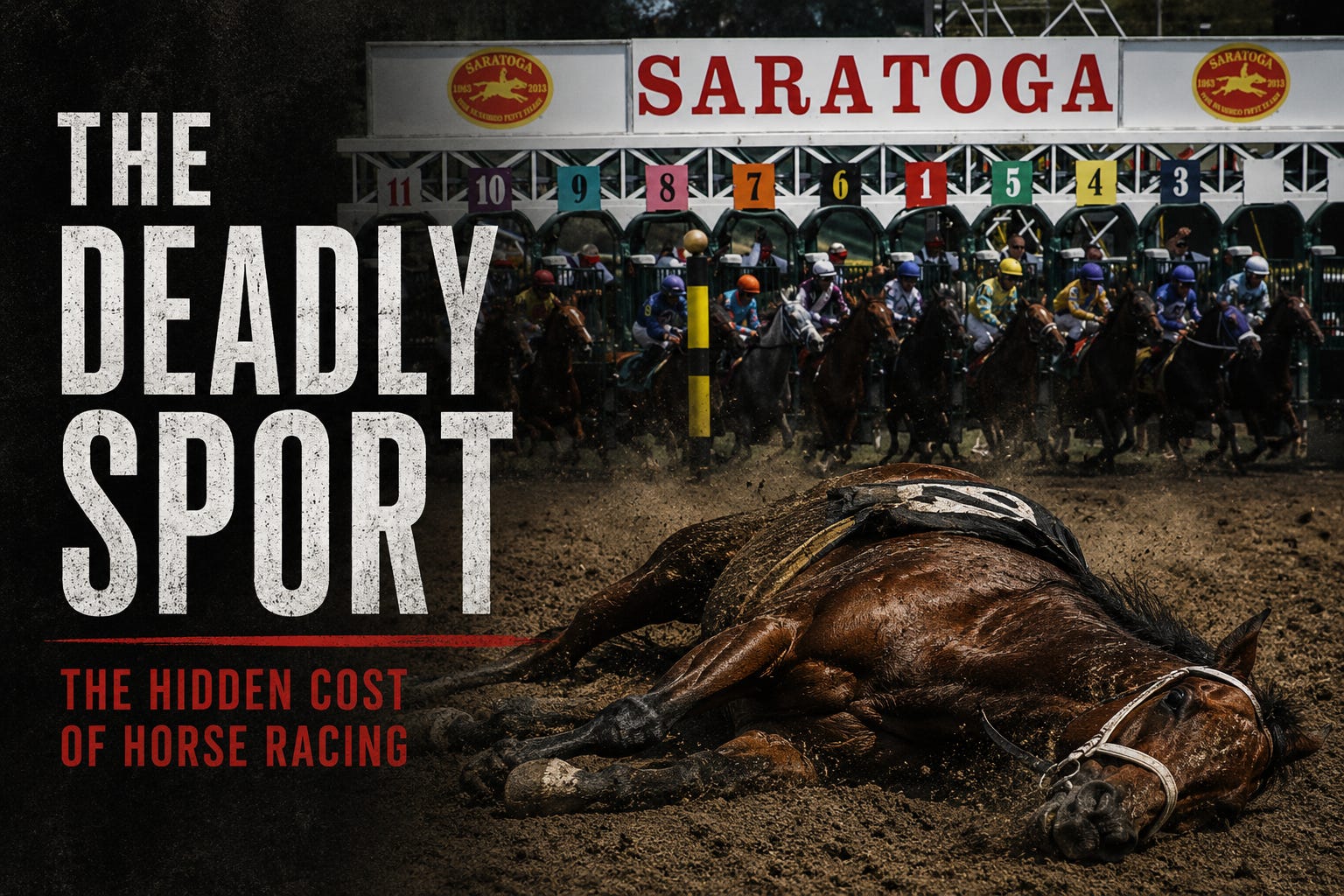
In 2023, 14 thoroughbreds died at Saratoga over the course of the meet. A federal review afterward could not name a definitive cause. It said only that the summer’s heavy rain “could not be overlooked.” In 2025, the New York State Gaming Commission counted 18 dead from the June racing festival through the close of the season, 11 of them tied directly to racing and training. Neither meet stopped. The Travers ran on its appointed Saturday both years. The hats stayed on.
A Thoroughbred at full gallop runs near forty miles an hour. Its lower legs carry almost no muscle. Bone and tendon take the load, stride after stride, and the leading killer at any track is the catastrophic musculoskeletal injury: a fracture or breakdown severe enough that the leg cannot be saved and the animal cannot stand. The needle follows. Some of these breaks happen in races, in front of the crowd. Many happen at dawn in training, in front of no one. They count the same.
Many of the animals doing this are two and three years old, and the Saratoga calendar is built around them. A Thoroughbred’s skeleton does not finish maturing until years after the horse’s first races. Growth plates are still closing. The spine and pelvis are among the last bones to set, generally not until around five or six. High-speed work loads an unfinished frame, and when bone remodeling cannot keep pace with the workload, the margin thins. Stress fractures accumulate. Tendons and ligaments take damage that compounds. None of it announces itself before it fails. The meet runs maiden races for juveniles, classics for the sophomores, the Travers itself a midsummer Derby restricted to three-year-olds, exactly as the Kentucky Derby is. The marquee event of the season is a contest among adolescents, dressed up as heritage.