
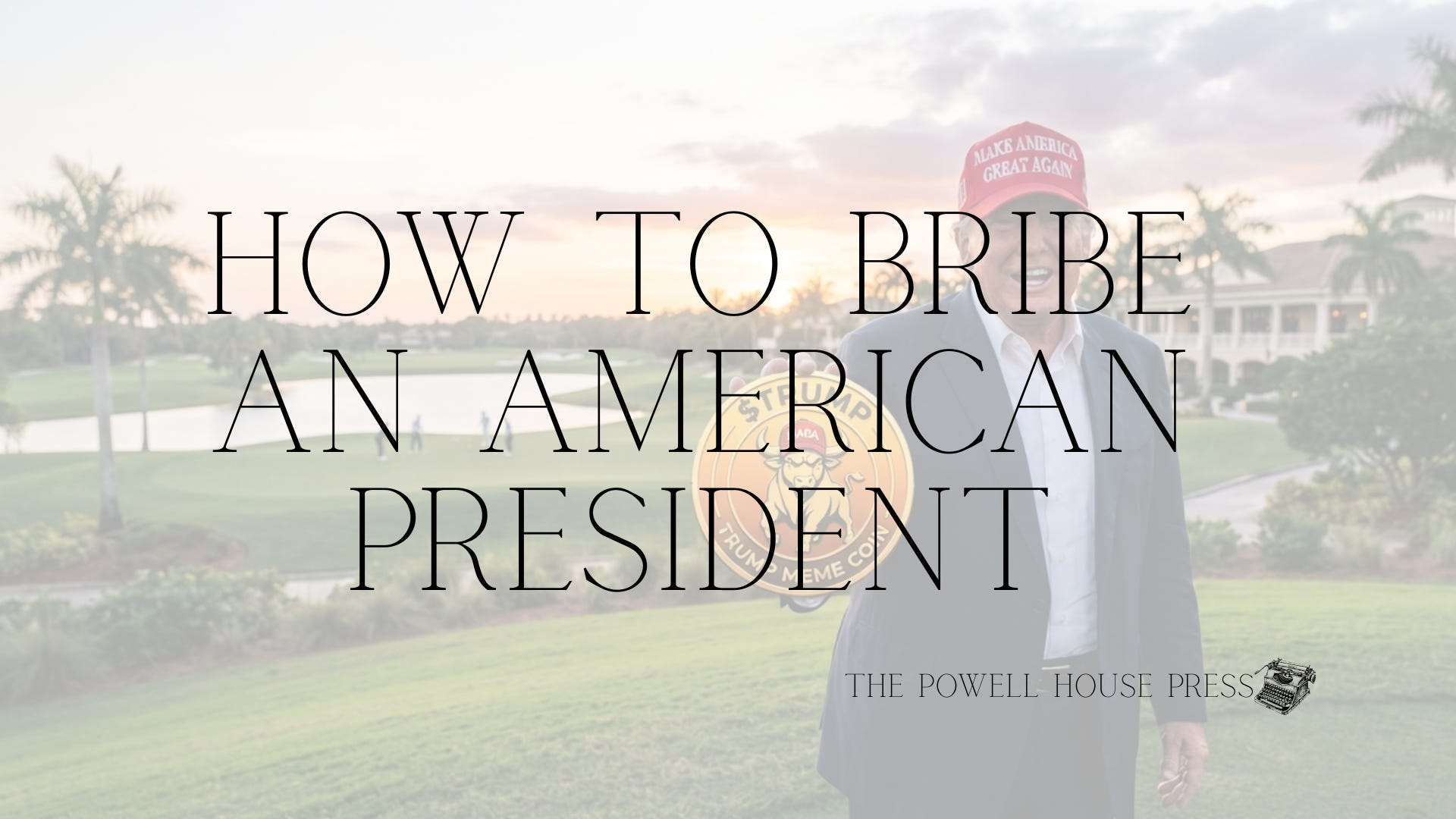
$TRUMP Coin Con: How to Bribe a President
Most of us don’t understand Bitcoin, Meme Coins or Crypto. When you do you see that what President Trump is doing is a national security risk of historic and epic proportions.
A couple of days ago, when I was writing about Trump and his grifting family, it was staggering how much money they made off of “crypto.” And to be honest, when a reader asked me what Bitcoin was and how it differs from meme coins, I had no idea. To be more honest: I didn’t really understand Bitcoin. I asked a few friends, and they, like me, knew the terms. They knew people made money (many more lose). None of us actually knew what crypto was, how it was valued, how it worked, or just how the Trumps made billions.
So I spent a good portion of the past three days boning up on these “terms” and just how the Trumps made billions. It’s worth knowing about because, when you actually know, you see that the Trumps did not “make” money; they were paid off. Let’s start with what crypto is.
Cryptocurrency is digital money with no bank behind it. No government either. Bitcoin, the first and biggest, appeared in 2009, invented by someone using the name Satoshi Nakamoto. Nobody knows who that is. Seventeen years later, nobody still knows.
The system runs on a blockchain, a public ledger copied across thousands of computers worldwide. Every transaction gets recorded there permanently. No central authority can alter it, freeze it, or reverse it. That is the pitch. Money without middlemen.
The catch is that nothing backs it. Crypto’s defenders point out that nothing physical backs the dollar either, and they are right. The dollar was tied to gold for most of its history. Roosevelt ended domestic convertibility in 1933, and Nixon cut the last link in 1971, when foreign governments lost the ability to redeem dollars for gold. Since then, the dollar has been fiat money, backed by no vault anywhere. Makes you wonder what all that gold in the U.S. Mints is there for.
But the dollar is not backed by nothing. It is backed by the state. The government demands taxes in dollars, which guarantees permanent demand. Legal tender laws require their acceptance. The Federal Reserve manages the supply to keep the value roughly stable. Behind all of it sits a $28 trillion economy, a court system, and an army. Belief, yes, but belief with enforcement.
A bitcoin is backed by the belief that someone else will pay more for it tomorrow. That is the whole structure. No compulsory demand, no manager, no state. When the belief holds, the price climbs. When it wavers, the price falls off a cliff. The dollar loses two or three percent of its value in a bad year. Bitcoin has lost more than half its value four separate times and come back each time, which believers cite as proof of resilience and skeptics cite as proof of insanity.
So, in practice, how does Bitcoin work? Say Mary Jones, a schoolteacher in Hudson, decides she wants some bitcoin. Here is the whole process, start to finish.
Step one: she opens an account. Mary downloads an app from a crypto exchange. Coinbase is the biggest American one. An exchange is a company that stands between regular money and crypto, the way a currency booth at an airport stands between dollars and euros. She signs up, photographs her driver’s license, and takes a selfie. Federal law requires this. Despite its reputation, buying crypto the normal way is not anonymous. The exchange knows exactly who Mary is, and so does the IRS.
Step two: she connects her bank. Mary links her checking account or debit card, the same way she would with Venmo.
Step three: she buys. Mary spends $500. The app now shows she owns a small fraction of one bitcoin. Nothing arrives in the mail. There is no coin. What Mary actually owns is an entry in a ledger.
Which brings us to the blockchain. Picture a shared notebook that records who owns what. Every bitcoin transaction ever made is written in it: this person paid that person this amount, going back to 2009. Now picture thousands of identical copies of that notebook, kept on computers all over the world, all updated at the same time. That is the blockchain. Nobody owns the notebook. Nobody can secretly change a page, because their copy would no longer match the thousands of others. That is the entire trick. A bank keeps one ledger, and you trust the bank. Bitcoin keeps thousands of matching ledgers, and you trust the math. When Mary bought her $500 worth, a new line was written into every copy: this much bitcoin now belongs to Mary’s account.
My next question was: Where do new bitcoins come from? This is where it gets kind of Dungeons and Dragons. Somebody has to write the new pages of the notebook (blockchain). Computers around the world compete for the job, roughly every ten minutes, by racing to solve a math puzzle through sheer guessing; trillions of guesses per second. The winner writes the next page and gets paid in brand-new bitcoin. That is “mining.” It is how every bitcoin in existence was created, and it is why the ledger stays honest: cheating would require more computing power than the rest of the world combined. Mining started as a hobby for people with laptops. It is now done in warehouses full of specialized machines, located wherever electricity is cheap.
Step four: the price moves. Mary’s $500 is now worth whatever the market says. It might be $700 by Christmas. It might be $250. There is no dividend, no interest, no rent. The only way Mary makes money is by selling to someone who pays more than she did.
Step five: spending it. Here is the part that surprises people. Mary mostly cannot spend her bitcoin. The diner in Hudson does not take it. Neither does the grocery store, the landlord, or the IRS. A handful of retailers accept it, and there are debit cards that convert crypto to dollars at the register, but for practical purposes bitcoin is not money you spend. It is a thing you hold and eventually sell. So when Mary wants her money, she goes back to the app, sells her bitcoin at the going price, and transfers the dollars to her checking account. It takes a day or two. If she sold for more than she paid, that profit is taxed like a stock gain, and the exchange reports it.
One warning. As long as Mary keeps her bitcoin on the exchange, the exchange holds it for her, like a bank. Some people prefer to move their coins to a private digital wallet that only they control. The wallet is protected by a string of secret characters called a key. Lose the key, and the bitcoin is gone forever. No customer service line, no password reset, no one to sue. Remember that for later.
As for who regulates all this: less than you would hope. There is no crypto equivalent of the FDIC insuring Mary’s account or the full rulebook that governs the stock market. Several agencies each police a piece: the SEC handles crypto that resembles an investment contract, the CFTC treats bitcoin as a commodity like gold or wheat, and the IRS taxes the gains. The exchanges themselves must follow the same anti-money-laundering rules as banks, which is why Mary had to send in her license. But the coins themselves carry no guarantees. And meme coins, per an SEC ruling issued three weeks after $TRUMP launched, are generally not securities at all, which means no disclosure rules and none of the investor protections that come with them. If a meme coin goes to zero, and most do, Mary’s remedy is nothing.
The Meme Coin
A meme coin is cryptocurrency with the pretense removed. The pretense is purpose. Bitcoin at least claims to be something: an alternative financial system, money beyond the reach of banks and governments. You can doubt the claim, but the claim exists. A meme coin makes no claim at all. It is a joke, a mascot, a celebrity’s face turned into a tradable token. The first was Dogecoin, created in 2013 by two software engineers as a parody of crypto speculation. It featured a Shiba Inu dog. It was designed to be worthless. At its 2021 peak, it was worth $88 billion.
There is no product. No revenue. No underlying anything. The price of a meme coin is a pure measurement of hype, and hype has a schedule: early buyers get in cheap, promotion drives the price up, latecomers buy the top, insiders sell, the price collapses. Crypto people call this a pump and dump. It happens over and over, and it keeps working because every buyer believes he is early.
The Trump Con
Three days before his second inauguration, in January 2025, Donald Trump launched $TRUMP, a meme coin bearing his image. One billion tokens were created. Only about 200 million went to the public. The other 80 percent stayed with two Trump-affiliated companies, CIC Digital LLC and Fight Fight Fight LLC. Nobody “mined” $TRUMP. All one billion tokens were simply created at the push of a button, and the Trump companies kept 800 million of them.
This means the Trump side never needed the coin’s price to rise. The family companies collect fees on every trade and sell tokens from their enormous reserve on a staggered schedule. The buyers speculate. The house collects.
The numbers have only grown. A Reuters analysis published in June found that, by the end of April 2026, the Trump family had added at least $2.3 billion to its fortune from its major crypto ventures, while outside investors in those same ventures had absorbed roughly $2.3 billion in losses, much of it on paper as token prices fell. The analysis found that the structure of the ventures consistently favored the Trump side. Trump-affiliated companies received large founder allocations, licensing fees, royalties, and revenue-sharing agreements while risking comparatively little of their own capital. Outside buyers assumed nearly all of the market risk. The house collected.
The meme coin is one arm of a larger machine. There is World Liberty Financial, the crypto venture founded by Trump’s sons, which sold tokens and a stablecoin. There is the $MELANIA coin. There was a black-tie dinner in May 2025 for the top 220 holders of $TRUMP, an event that functioned as a pay-for-access auction. Reuters estimated that qualifying participants collectively held roughly $148 million worth of the coin. One crypto billionaire, Justin Sun, invested hundreds of millions of dollars across Trump crypto ventures while facing an SEC fraud case that the administration’s regulators later paused. (Reuters)
The scale became official through Trump’s financial disclosure, filed July 1, which reported more than $1.4 billion in crypto-related income for 2025. His companies received nearly $800 million from World Liberty Financial, including more than $520 million from crypto token sales and more than $250 million from the sale of interests in the venture. The disclosure also reported about $635 million from the $TRUMP meme coin business, largely through a licensing arrangement. Crypto now out-earns the golf courses, the hotels, and the licensing deals combined. The real estate empire took fifty years to build. The crypto empire took eighteen months. (Reuters)
None of this required the coins to be good investments. That is the Trump elegance of it for lack of a better term. Trump profits from fees, royalties, and token sales regardless of price. The buyers carry all the risk. Campaign donations are capped and disclosed. Lobbying is registered. Buying the president’s coin is neither. We know how much money came in. With a few exceptions, we have no idea from whom. A chilling reality.
Winners and Losers: Regular Crypto
The winner. Erik Finman was twelve years old in 2011 when his grandmother gave him $1,000. He put it into bitcoin at around $12 a coin. By eighteen, he was a millionaire. He had also made a bet with his parents that if he hit a million by then, he would not have to go to college. He won the bet. Timing was the entire strategy. He bought when almost nobody was paying attention.
The loser. James Howells, an IT worker in Newport, Wales, mined 8,000 bitcoin in 2009 when it was essentially free. In 2013, he threw out the hard drive containing his only copy of the keys. It went to the municipal landfill. At bitcoin’s peaks, that drive was worth several hundred million dollars. Howells spent a decade begging the Newport council to let him excavate the dump. He offered to fund it himself. He proposed AI-assisted sorting robots. The council said no. A judge threw out his lawsuit in 2025. The bitcoin is still there, under roughly 110,000 tons of garbage, technically his and permanently gone. Crypto has no bank, which sounds like freedom until you need a bank. It brings to mind the Kristofferson lyric: “Freedom’s just another word for nothing left to lose,” doesn’t it?
Winners and Losers: Meme Coins
The winner. During the run-up to the $TRUMP holders’ dinner in the spring of 2025, a trader known publicly only as “Noah” put $2.2 million into $TRUMP before the contest was announced, rode the surge, and sold at the end for a profit of more than $950,000. He was not a fan. He was not a believer. He understood the only thing that matters in a meme coin: get in before the crowd, get out before the crowd. The crowd is the product.
The loser. Glauber Contessoto, a thirty-three-year-old in Los Angeles, put his entire savings, about $250,000, into Dogecoin in February 2021, some of it borrowed. Two months later, his stake was worth over $2 million, and the press crowned him the Dogecoin Millionaire. He announced he would not sell until it hit $10 million. “Diamond hands,” in the parlance. Dogecoin then lost more than 90 percent of its value. His paper fortune evaporated. He held the whole way down. The same trade that made Noah rich ruined Contessoto, and the only difference between them was the willingness to leave the party.
Rebecca Davis of Little Rock belongs here too. A conservative radio host who knew nothing about crypto, she bought $TRUMP from her bed one January morning in 2025 because Trump, she figured, knows how to make money. He does. The Washington Post found nearly 67,000 first-time crypto buyers just like her who pulled out debit cards for the coin. As a group, their bet was a bust. Her assessment of Trump was correct. Her mistake was assuming she was on his side of the table.
The Lesson
Cryptocurrency is a technology. Meme coins are a casino built on that technology. And the Trump ventures are the casino perfected: the operator holds 80 percent of the chips, collects a cut of every hand, sells access to the owner’s box upstairs, and answers to regulators he appointed. The winners in this system are the people who create the coins and the traders cold-blooded enough to treat them as timing exercises. The losers are the believers. There were 813,294 of them, give or take, and most of them thought they were early.
Ironically, unlike Atlantic City, Trump has finally found a casino that works - for him. Just like Atlantic City, he has found a way to screw people over. However, the terrifying part is that the President of the United States is taking in billions of dollars from unreported sources for a worthless digital coin. In any other world, this would be a bribe. The $TRUMP meme coin is just the bag man.
©2026 All Rights Reserved | The Powell House Press | Josh@thepowellhousepress.com


