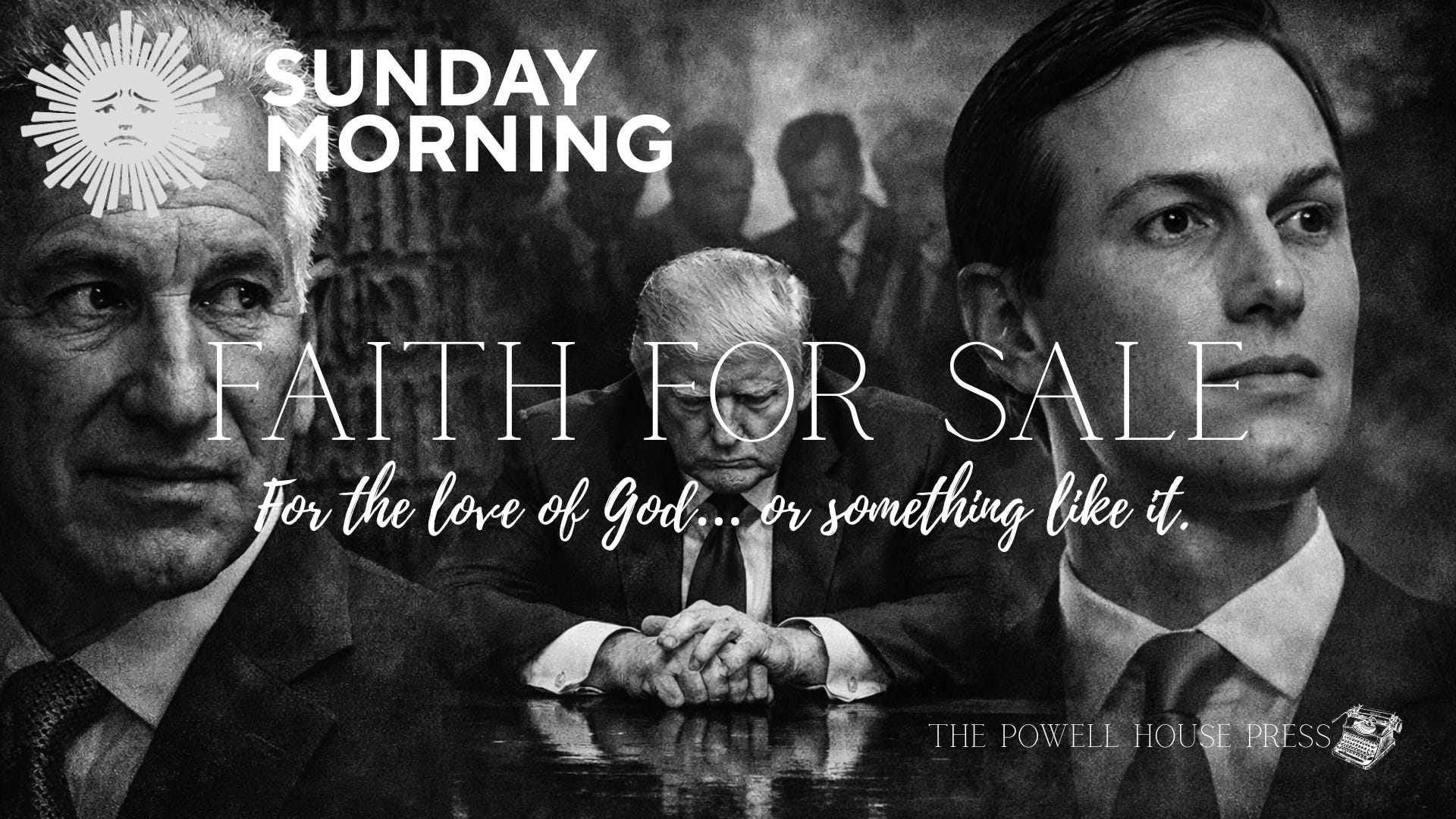
Trump, Kushner, and the Religious Crusades of Greed
Never have men in government made such a cash-grab in the name of God
There is a sermon that American audiences have heard so many times, delivered in so many registers, from so many pulpits and podiums and cable news green rooms, that it has acquired the smooth, worn quality of a river stone. The sermon goes like this: God rewards the righteous with prosperity. Wealth is evidence of virtue. And when the government comes for a man of faith, it is not justice arriving at his door. It is persecution. It is Caesar reaching into the temple. It is, in the most operatically self-serving formulation available to the English language, an attack on religious freedom itself.
Jim Bakker preached this sermon from a theme park in South Carolina before he went to prison for fraud. Jimmy Swaggart preached it between scandals. Joel Osteen preaches it still, from a former NBA arena in Houston that seats sixteen thousand worshippers, each of whom has been assured by a man with dental work that costs more than most of their cars that God’s favor manifests in the material world, that the Almighty is, in the final accounting, a prosperity investor with a preferential allocation for the already comfortable. The Christian right did not invent the prosperity gospel, but it has been its most visible, most theatrical, most American evangelist.
What is less often acknowledged, because it disrupts a convenient cultural shorthand, is that the prosperity gospel has never been the exclusive property of the Christian right. It does not require a cross. It does not require a choir, or a broadcast tower, or a televised telethon where viewers are invited to sow a seed of faith with a credit card. It requires only three things: a sincere or performative relationship with religious identity, a community that conflates material success with divine favor, and the audacity to reach for the nearest scripture when the law closes in. Philip Esformes had all three. Jared Kushner has all three. And the story of their intersection, conducted inside the machinery of the most powerful government on earth, is the prosperity gospel in its most concentrated, most consequential, and most expensive form.
Philip Esformes was, on paper, a deeply religious man. His father Morris was a rabbi. The family name adorned schools associated with the Chabad-Lubavitch movement. They gave to charities. They were seen at synagogue. They occupied, within their Orthodox Jewish community, the kind of position that the Bakkers occupied in theirs — the position of people whose wealth was taken as confirmation of their righteousness rather than a reason to scrutinize either. Between 1998 and 2013, the father and son paid over $20 million in settlements to the U.S. government to resolve allegations of kickbacks and substandard care at their facilities, though they never admitted guilt. In the prosperity gospel, one does not admit guilt, because guilt implies that the mechanism of divine favor has somehow misfired, and the mechanism does not misfire. The mechanism simply awaits a more creative explanation.
The explanation, when it became necessary, was furnished in full. Esformes ran a network of nursing homes that he used to perpetrate a massive Medicaid fraud scheme involving about $1.3 billion in fraudulent claims. He bribed doctors. He bribed regulators. He bribed a college official to get his son into a university. He directed his facilities to give powerful opioids like OxyContin and fentanyl to patients to get them addicted so they remained at his facilities, allowing him to continue billing Medicare and Medicaid for their care. These were not the actions of a religious man who had momentarily strayed. They were the actions of a man who had built, over two decades, a system specifically designed to extract money from the bodies of the vulnerable, and who had wrapped that system in the insulating material of community standing, charitable giving, and Orthodox Jewish identity so thoroughly that for years, no insulation was even necessary. The FBI agent who finally named what she was looking at called him “a man driven by almost unbounded greed.”
Jim Bakker would have recognized the blueprint immediately. What Bakker built at Heritage USA in the 1980s was not, at its core, a ministry. It was a real estate and entertainment enterprise wrapped in the language of salvation, funded by followers who were told that their investment was a covenant with God rather than a transaction with a man who was billing them for timeshares they would never use. When Bakker was convicted of fraud in 1989, his supporters did not conclude that they had been deceived. They concluded that a righteous man was being persecuted. The prosecutors were agents of a secular state hostile to Christian values. The prison sentence was a test of faith. The criminal justice system, in this reading, was not arriving to protect the defrauded. It was attacking the faithful.
Esformes’s defenders deployed the same playbook with only minor theological adjustments. When the Justice Department moved to retry him on the six counts his original jury had deadlocked on, after Trump had commuted his sentence, his legal team characterized the prosecution as an act of institutional vendetta — a politically motivated assault on a man who had already been shown mercy by the president. Defense attorney Joseph Tacopina said prosecutors were engaged in an “obvious vendetta” against the former president for letting Esformes out of prison, adding that his client was “clearly a political casualty of partisan games.” The framing was precise and familiar. The criminal was the victim. The prosecution was the persecution. The $1.3 billion in fraudulent Medicare claims, and the nursing home patients chemically addicted to OxyContin to serve as billing fodder, had been edited out of the story entirely, replaced by the figure of a devout man of faith being hounded by a hostile state.
It is here that Jared Kushner enters the picture, and it is here that the parallels with the Christian prosperity gospel become not merely rhetorical but skeletal — visible in the bones of how the whole operation was built. Kushner is not a televangelist. He does not hold rallies or solicit seed offerings. He operates in a register that is quieter, smoother, and orders of magnitude more expensive than anything Jim Bakker could have conceived. But the underlying grammar is identical. Religious community as social capital. Social capital as access. Access as the mechanism through which the normal processes of accountability are rerouted or dissolved entirely. And when scrutiny arrives, the immediate reframing of that scrutiny as something other than what it is.
To understand Jared Kushner, you must first understand his father, Charles — and to understand Charles, you need only to consult the federal docket in the District of New Jersey, case number 2:04-cr-00580. In 2005, Charles Kushner pleaded guilty to 18 counts of illegal campaign contributions, tax evasion, and witness tampering, and was sentenced to two years’ imprisonment. The witness tampering charge was not a technicality. It stemmed from an elaborate revenge scheme in which Charles Kushner hired a prostitute to seduce his brother-in-law, who was cooperating with federal investigators, recorded the encounter, and sent the tape to his sister. Former U.S. Attorney Chris Christie, who prosecuted the case, called it “one of the most loathsome, disgusting crimes” he ever handled. As a convicted felon, Charles Kushner was also disbarred and prohibited from practicing law in New Jersey, New York, and Pennsylvania. He served 14 months at a federal prison camp in Alabama before being transferred to a halfway house to complete his sentence. Then, in December 2020, his son’s father-in-law granted him a full pardon. The circle of mutual benefit was geometrically perfect.
Jared Kushner was raised in a Modern Orthodox Jewish family and at Harvard supported the campus Chabad house. His father Charles — fresh from his legal ordeal and the check-writing apparatus that had preceded it — had deep and financially generative ties to the Chabad-Lubavitch movement. The movement itself is not a grift. It is a centuries-old tradition of Hasidic Judaism with genuine spiritual roots and a record of genuine charitable work. But like every religious institution with sufficient wealth, prestige, and proximity to power, it had become, by the time of the Trump administration, something that certain people could use. The Aleph Institute, a Chabad-affiliated criminal justice nonprofit, cultivated a direct line into the White House through Jared Kushner and outside advocates such as the lawyer Alan Dershowitz. That line was not incidental. It was the product of years of careful relationship-building, strategic positioning, and the kind of institutional trust that religious organizations accumulate precisely because we have collectively agreed to extend them a level of presumptive goodwill that we do not extend to, say, lobbying firms, even when they are performing functions that are functionally indistinguishable from lobbying.
Of the 238 total pardons and commutations granted by Trump during his first term, 27 went to people supported by the Aleph Institute, its peer organization the Tzedek Association, and the lobbyists who worked with them. Twenty-seven. In any other context, a single organization channeling that volume of successful clemency petitions directly to a sitting president while bypassing the Justice Department’s formal review process would be called what it is: an influence operation. Wrapped in the language of faith and prisoner rehabilitation, it was called something else, or it was not called anything at all, because most people were not watching closely enough to call it anything.
Trump had largely overridden the highly bureaucratic process overseen by pardon lawyers for the Justice Department and handed considerable control to his closest White House aides, including Kushner, who in turn outsourced much of the vetting to political and personal allies, allowing private parties to play an outsize role in influencing the application of one of the most unchecked powers of the presidency. This is the Joel Osteen move, transposed to constitutional law. Osteen does not personally ask his congregants for money. He creates an environment, a theology, a community, in which the money flows toward him through channels that feel sacred rather than transactional. Kushner did not personally ask Philip Esformes for $65,000. He created an environment, a network, a community, in which the money flowed toward the Aleph Institute and then toward freedom, through channels that felt like charity rather than procurement.
The Esformes family, for their part, understood the mechanism perfectly. Esformes’s own lawyers acknowledged in a court filing that his family’s donations to Aleph were given partly “in appreciation for all that Aleph has done for Mr. Esformes,” generously, if not exclusively selflessly. There is something almost refreshing about that formulation. Not exclusively selflessly. In four words, one of the most expensive legal teams in Miami had accidentally written the epitaph for the entire enterprise.
What happened after Esformes walked out of federal prison is, in the long view, less important than what it revealed about what was already in place. Because the Esformes commutation was not an anomaly. It was a proof of concept. It demonstrated, in granular and fully documented detail, that the right religious affiliation, the right charitable donations to the right religiously affiliated nonprofit with the right access to the right son-in-law, could neutralize a twenty-year federal prison sentence for the largest healthcare fraud in American history. The price of that demonstration, in Esformes’s case, was sixty-five thousand dollars and some real estate in Miami Beach. It was, by any measure, the greatest return on philanthropic investment since the invention of the papal indulgence.
And then Jared Kushner left the White House, and the scale of the enterprise expanded in ways that make the Esformes commutation look almost quaint. After leaving the White House in 2021, Kushner — a man with no experience in private equity, the son of a convicted felon who had been pardoned by his own father-in-law — launched Affinity Partners out of Miami. The firm had no institutional track record, no major exits, no portfolio. What it had was a Rolodex of Middle Eastern relationships built on four years of American diplomatic access, and the audacity to charge for them. Advisers for the Saudi government’s Public Investment Fund expressed several concerns about the transaction — including the inexperience of Affinity management, the degree of risk to be assumed by the Saudi kingdom, an “excessive” management fee, and a finding that Affinity’s operations were “unsatisfactory in all aspects.” The committee’s recommendation was overruled by Crown Prince Mohammed bin Salman, who heads PIF’s Board of Directors and who had been exchanging WhatsApp messages with Kushner throughout the Trump years. The professionals said no. The prince said yes, to the tune of $2 billion. It was, structurally speaking, less an investment than an installment.
The numbers that followed are worth sitting with, because they do not behave like the numbers of a functioning private equity firm. Affinity pocketed as much as $157 million in fees from foreign clients, including $87 million from the Saudi government alone. Affinity disclosed that its funds have not generated any return on investment and have not distributed a penny of earnings back to clients. According to financial statements and other documents sent to clients, Affinity marked “N/A” for “not applicable” in line items related to the fund’s annual rate of return. “N/A.” On the line where earnings are supposed to appear, Jared Kushner’s firm wrote: not applicable. And yet, by the end of 2024, Affinity Partners had nearly $5 billion in assets under management, after Abu Dhabi-based Lunate and the Qatar Investment Authority added $1.5 billion to the pile. Forbes reported that Affinity helped boost Kushner’s net worth to at least up 180% from early 2017, when he became senior advisor to Trump. By September 2025, Forbes had crossed him over the threshold into billionaire territory — a $100 million increase in his fortune in the preceding twelve months alone.
The deals that followed grew to match the ambition. Affinity Partners — funded primarily by autocratic Gulf regimes — is behind the largest leveraged buyout in recorded financial history: a $55 billion effort to take video game giant Electronic Arts private, involving the sovereign wealth funds of Saudi Arabia, Abu Dhabi, and Qatar. At the same time, Affinity is part of a consortium backing Paramount’s hostile takeover bid for Warner Bros. Discovery, in which sovereign wealth funds from Saudi Arabia, Qatar, and the UAE are collectively offering around $24 billion. The man who entered government in 2017 worth an estimated $300 million, the son of a man who went to federal prison for tax fraud and witness tampering and was pardoned by that same administration, is now a billionaire orchestrating the largest media consolidation in American history using money from foreign governments whose policies he is simultaneously helping to shape as a diplomatic envoy.
This is the prosperity gospel at its most rarefied altitude. Joel Osteen asks his congregation to believe that God wants them to be rich, and that their donations are seeds that will bloom into abundance. Jared Kushner asked the sovereign wealth fund of Saudi Arabia to believe that his private equity firm — staffed by former government officials with no investment track record and charging fees that the fund’s own analysts called excessive — was a sound commercial investment. The Saudis, like Osteen’s congregation, appear to have concluded that the transaction was not primarily commercial. Senator Ron Wyden wrote that “the Saudi government’s decision to place $2 billion with Affinity is the result of an effort by Crown Prince Bin Salman to curry favor with Kushner and Ivanka Trump or reward them for favorable U.S. policy towards Saudi Arabia during the first Donald Trump administration.” Senator Wyden further warned that Affinity “is likely part of a compensation scheme involving U.S. political figures designed to circumvent the Foreign Agents Registration Act.”
In other words: not a seed planted in faith. A payment rendered for services already performed. The language of investment wrapped around what was, functionally, a transaction of a different kind entirely.
Kushner’s response to this scrutiny has been a masterclass in the art of the Osteenian deflection. When it was pointed out that his firm’s Saudi investors had overruled their own professional advisors to give him two billion dollars, he did not engage with the substance of the concern. He said he had followed every law. He dismissed the appearance of conflict of interest. He noted, with the serene confidence of a man who has never spent a moment genuinely uncertain about his own virtue, that what critics called conflicts of interest he called “experience and trusted relationships that we have throughout the world.” This is the televangelical mode of argument. It does not rebut the accusation. It simply reframes the frame. The grift is the gift. The conflict is the relationship. The transaction is the testimony.
Now, Kushner serves as an informal Special Envoy, advising on diplomacy in Gaza and Ukraine, while simultaneously seeking to raise billions more from the same foreign governments whose policies he is nominally helping to shape. He has, in other words, returned to government carrying, in his other hand, a fundraising pitch for the same sovereign wealth funds at the table. When critics called this unprecedented, Kushner called it experience. When ethics watchdogs raised alarms, the response was familiar: these are politically motivated attacks. These are people who do not understand the work. These are agents of a system that fears what he represents.

It is the same argument Jim Bakker made from the witness stand. It is the same argument Philip Esformes’s lawyers made in every appellate court between Miami and Atlanta. It is the same argument that Charles Kushner — convicted felon, pardoned father, now U.S. Ambassador to France — has made about his own checkered past: that the mistakes are behind him, that the charitable work overshadows the crimes, that the man who hired a prostitute to entrap his brother-in-law and mailed the tape to his own sister has, in fact, been redeemed by philanthropy. It is the argument that powerful men with religious identities and financial exposure have been making since the first moment someone decided that piety and plunder could share a balance sheet. The persecution is always the proof of righteousness. The prosecution is always the persecution. The crime is always the crusade.
But there is no crusade here. There is no faith being tested, no community being protected, no sacred principle at stake. What is at stake is money — vast, almost incomprehensible quantities of it, moved through channels made deliberately opaque, protected by the vocabulary of religious community and political loyalty, and defended, when necessary, by the most expensive lawyers that the proceeds of the enterprise can buy. Philip Esformes addicted elderly nursing home patients to opioids and called it healthcare. Jared Kushner charged a foreign government $87 million in fees on an investment that returned nothing — marked, literally, “N/A” — and called it finance. Charles Kushner committed 18 counts of tax fraud, witness tampering, and illegal campaign contributions, and called it, eventually, a very serious mistake for which he has since been redeemed. Jim Bakker sold timeshares that didn’t exist and called it ministry. Joel Osteen fills a former basketball arena every Sunday and tells sixteen thousand people that God wants them to prosper, while sitting on a personal fortune estimated at $100 million, and calls it gospel.
They are all preaching the same sermon. The only difference is the denomination, and the denomination, in the end, is entirely beside the point. What unites them is not faith. It is the breathtaking gall of men who have decided that their appetites are sacred, that their wealth is evidence of virtue, that the law is an instrument of persecution when it reaches for them, and that the language of religion — any religion, in any tradition, on any continent — is available for use as a shield whenever the shield becomes necessary.
This is the new crusade, and it has nothing to do with God. It is a war conducted in his name, financed by the credulous and the coerced and the chemically addicted and the sovereign wealth funds of absolute monarchies, for the exclusive benefit of men who have perfected the art of wearing righteousness like a coat while picking the pockets of everyone standing close enough to admire it. It is mendacity of the most profound and extravagant kind, dressed in the one garment that our culture has historically been most reluctant to look behind. And until we are willing to look behind it — regardless of which tradition it comes from — and call what we see by its actual name, the sermon will continue, the collection plate will keep circulating, and the Ferraris will stay red.
Why Your Subscription Matters
Independent journalism answers to readers—not advertisers, corporations, or access-hungry editors. No story gets killed because it upsets a sponsor. No punch gets pulled because someone important made a phone call.
Your support makes possible sharp commentary, fearless satire, and reporting that follows the story wherever it leads. In an era of manufactured narratives and algorithmic blandness, that independence isn’t a luxury—it’s a necessity.
Subscribe to The Powell House Press. Or settle for content that tells you what someone else wants you to hear.