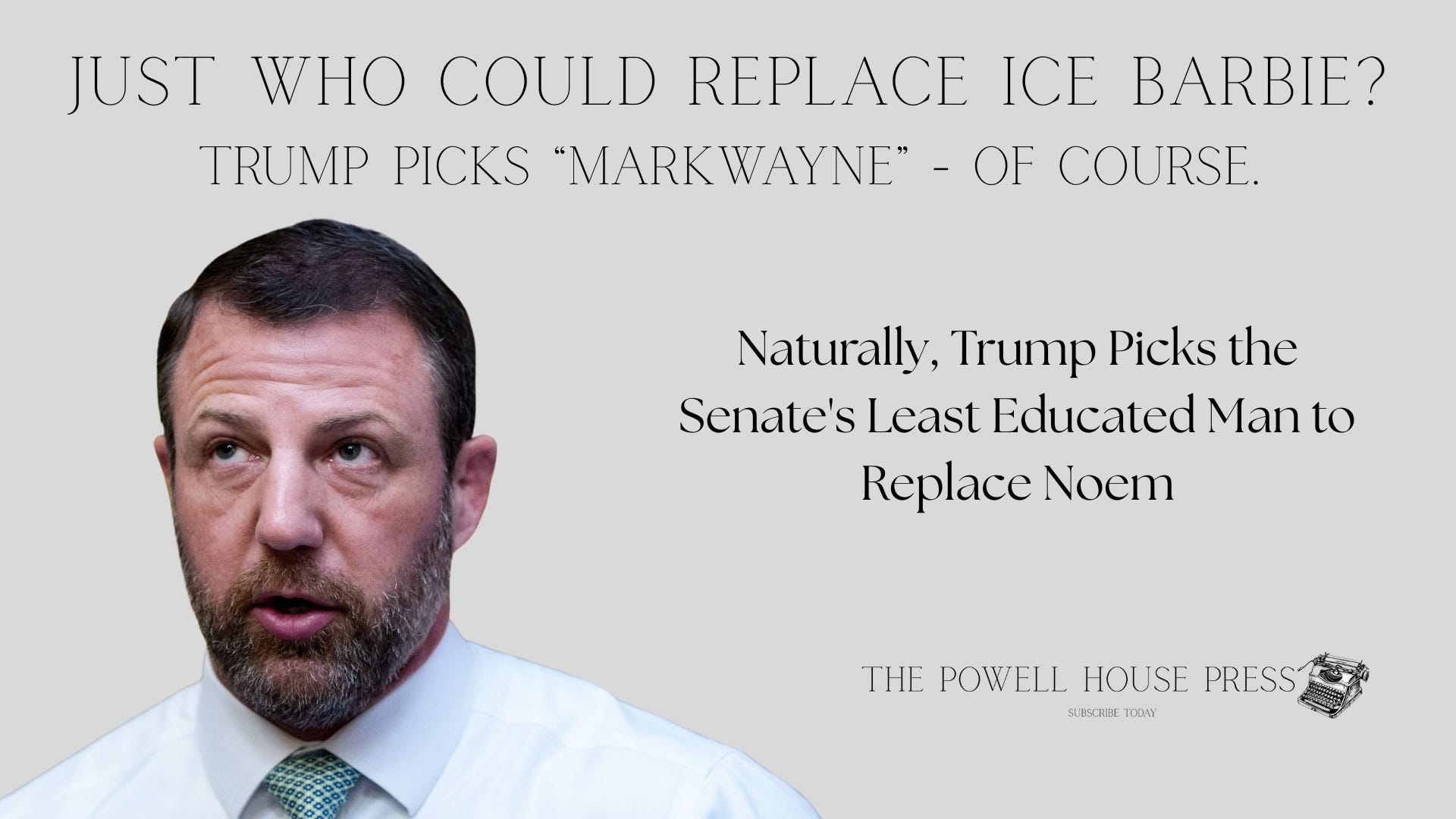
Trump the Genius Picks America's Least Educated Senator to Run America's Biggest Department
Markwayne Mullin doesn't know who runs Iran, thinks he's smelled combat, and told Rand Paul he deserved to get his ribs broken.
Donald Trump is handing the keys to the Department of Homeland Security to a former plumber from Oklahoma who challenged a union boss to a fistfight on the Senate floor, waxed lyrical about the smell of a war he never fought, publicly endorsed the premise of a violent assault on a sitting senator, and has spent years accumulating a record of impulsive, combative behavior that makes his confirmation one of the more consequential gambles of an administration that has made recklessness a governing philosophy. Washington has seen many things. It has not quite seen this.
Picture the scene, if you will. It is a crisp Thursday afternoon in Washington, the kind of day the capital does well: monumental, self-regarding, vaguely threatening. Kristi Noem, the former beauty queen turned ice queen of American immigration enforcement, has just been sacked for the sin of starring in too many of her own commercials. The cameras assemble. The Truth Social post drops. And into the vacancy strides Markwayne Mullin: plumber, rancher, wrestler, MMA fighter, United States senator, and now, God save the republic, the man the president has chosen to safeguard the homeland.
Trump, deploying the encomium factory that substitutes for vetting in his administration, called Mullin “a MAGA Warrior” and “former undefeated professional MMA fighter” who “truly gets along well with people.”This last quality, one feels compelled to note, is not entirely supported by the available evidence.
The available evidence includes, but is not limited to: a televised near-brawl with the president of the Teamsters union in a Senate committee room; a declaration that he understood the impulse behind a violent assault on a sitting colleague; a Fox News monologue about the primal sensory horror of combat delivered by a man who has never been near combat; the casual conflation of two different Ayatollahs during a week when American planes were bombing Iran; and a years-long pattern of altercations, confrontations, and ethical entanglements that his supporters describe as authenticity and his critics describe as a temperament problem. All of this, mind you, stretches well beyond the last ten days.
Washington loves a character. It is less sure what to do with a caricature.
The Making of a MAGA Warrior
Markwayne Mullin did not arrive at the doors of the Department of Homeland Security by the usual route. He did not attend the Naval Academy or clerk for a federal judge or run a state through a hurricane. He went to college on a wrestling scholarship, left without finishing when his father fell ill (apparently now a qualification is a sick or dead father as a reason to leave college), and took over the family plumbing business in Tulsa. He built it into a regional operation, hosted a home improvement segment on talk radio, and at some point decided that the Senate was the natural next step.
He is, in certain lights, a genuinely Trumpy American story: the self-made man, the blue-collar boy done good, the brawler who made it. He is the only Native American currently serving in the Senate. He has a wrestling Hall of Fame plaque and a 5-0 MMA record that he mentions with the frequency other senators reserve for Harvard Law. His Senate biography lists his fighting record with the same weight it gives his committee assignments, which tells you something about how Mullin wants to be seen: as a man who does not back down or a bully. Take your pick.
This, in the Trump era, is not a liability. It is a calling card. But the Department of Homeland Security, a $60 billion apparatus of 260,000 employees encompassing border control, counter-terrorism, cybersecurity, disaster response, and port security, has not historically been run by men whose primary credential is an inability to walk away from a fight. But, let's remember: after Kristi — well, not killing dogs and Americans is a step up.
The Ethics Investigation
Before Mullin was a senator he was a congressman, and before his confirmation hearings there was a House Ethics Committee investigation that produced one of the more detailed portraits of how he understood the relationship between public office and private gain.
The investigation, which spanned several years of his time in the House, focused on multiple categories of alleged misconduct. Investigators examined whether Mullin had continued to receive income distributions from Mullin Plumbing, the family business he had built into a regional operation, while simultaneously voting on legislation that affected the plumbing and construction industries. Federal law prohibits members of Congress from receiving outside compensation connected to their official duties; the question was whether Mullin had taken pains to observe that distinction or had treated it as an inconvenient technicality.
The committee also examined whether Mullin had used his congressional office and official position to promote his private business. Investigators found evidence that his company’s marketing materials had referenced his congressional status, that the business had benefited from the visibility of his public profile in ways that raised uncomfortable questions about the line between legitimate prominence and official endorsement, and that Mullin had made personal appearances and media placements that seemed designed as much to advertise Mullin Plumbing as to serve his constituents.
A third line of inquiry concerned a rodeo event in which Mullin reportedly participated using funds that originated from campaign or official sources, a relatively modest allegation by the standards of congressional ethics investigations but one that added to the general portrait of a man who found the rules of the institution somewhat elastic when they applied to him.
The committee concluded its review without recommending punishment. It did find that Mullin’s arrangements raised what it described, with the careful language of an institution reluctant to condemn its own members, as “novel questions” about the application of the relevant House rules. It noted that some of the conduct at issue had not previously been examined by the committee and suggested the rules might benefit from clarification. This is, in the argot of congressional oversight, about as close to a mild rebuke as you can get without it being called one.
Mullin’s defenders argued at the time that the investigation had been politically motivated and that the ultimate absence of formal punishment proved the allegations were without merit. His critics noted that the absence of punishment said less about the merits than about the House Ethics Committee’s well-documented reluctance to hold its members accountable for anything short of outright criminality.
What the record shows, stripped of the procedural hedging, is that Mullin spent years in the House treating the boundary between his public role and his private business as a matter of personal judgment rather than institutional obligation. The instinct that produced the investigation has not obviously been left behind.
‘This Is the Time, This Is the Place’
To understand Markwayne Mullin, you must understand what happened in Room 430 of the Dirksen Senate Office Building on November 14, 2023. The Senate Health, Education, Labor and Pensions Committee had gathered, under the chairmanship of Sen. Bernie Sanders, to discuss how unions improve working families’ lives. It was not intended to be a sporting event.
Mullin, who has the compressed energy of a man who has never quite accepted that the Senate chamber is not an octagon, used his allotted question time to read aloud, with visible satisfaction, a series of social media posts that Teamsters president Sean O’Brien had aimed at him. One ended: “You know where to find me. Anyplace, Anytime cowboy.”
What the senator from Oklahoma said next will be replayed at many a Washington dinner party for years to come. “Sir, this is a time, this is a place,” Mullin told O’Brien, who was seated at the witness table. “You want to run your mouth, we can be two consenting adults. We can finish it here.”
He then removed his wedding ring. He placed it on the table in front of him. He rose from his seat.
O’Brien, to his credit or discredit depending on your appetite for spectacle, accepted. Both men rose. Bernie Sanders, who has been in American public life since approximately the Truman administration, began banging his gavel with what one imagines was genuine existential despair. “You’re a United States senator!” he shouted at Mullin. “This is a hearing. God knows the American people have enough contempt for Congress. Let’s not make it worse.”
It is worth pausing on what had just happened. A sitting United States senator, in the middle of an official congressional hearing, had removed his wedding ring and stood up to fight a private citizen who had been called to testify. The hearing was about labor rights. The senator was on the committee of jurisdiction. He threatened a witness.
Mullin, asked afterward whether senators should be held to a higher standard, offered perhaps his most clarifying remark: “I’m still a guy.”
There it is. The whole philosophy in four words. The cabinet nominee in miniature. He is still a guy.
This was not an isolated incident. Colleagues who have served alongside Mullin in both chambers describe a man who is quick to take offense, slow to de-escalate, and constitutionally resistant to the idea that the dignity of his office might require him to behave differently than he would in a Tulsa bar. He has interrupted hearings with sharp personal attacks on witnesses. He has used his social media accounts to mock and demean colleagues across party lines. His floor speeches have, on more than one occasion, required colleagues nearby to visibly wince.
The Smell of War and Lies
This week brought fresh material. Mullin appeared on Fox News to discuss the American military strikes on Iran, strikes that have produced the first U.S. combat deaths of the operation and about which the administration has offered contradictory accounts of their legal basis and strategic aims, and decided to speak about the existential texture of war.
“War is ugly,” he declared, in the cadences of a man who has watched Apocalypse Now perhaps once too often. “It smells bad. And if anybody has ever been there and been able to smell the war that’s happening around you, and taste it, and feel it in your nostrils, and hear it, it’s something that you’ll never forget.”
Rep. Pat Ryan of New York, a West Point graduate who completed two combat tours in Iraq, responded on social media with the restraint appropriate to a man who has actually smelled war: “What the actual f*** are you talking about?” VoteVets, less restrained, suggested Mullin’s olfactory reference point for combat was Mountain Dew and couch cushions. Veteran and activist Charlotte Clymer noted that Mullin was 24 on September 11 and 25 when the United States invaded Iraq, an able-bodied young man who chose his father’s plumbing business over service. All of this is true, and none of it is complicated.
In the same broadcast, Mullin referred to Defense Secretary Pete Hegseth as “President Hegseth” twice before catching himself. And on CNN later that afternoon, he displayed a confident belief that Ayatollah Khamenei had been Iran’s Supreme Leader since 1979, a claim incorrect by a decade, conflating him with the Islamic Republic’s founder. This from a member of the Senate Armed Services Committee, during an active American military operation. He later clarified that he had done “special assignments” outside the Department of Defense that informed his perspective. The nature of these assignments was not disclosed.
Washington’s relationship with competence has always been complicated. But even by the low bar of the current moment, this was a week.
The Snake in the Room
And now, the confirmation. Mullin will need to be approved by the Senate Homeland Security and Governmental Affairs Committee, the body that will examine his qualifications to manage a department in the middle of a funding shutdown, a legal war with its own inspector general, and an ongoing controversy over whether its immigration enforcement agents shot and killed two American citizens in Minneapolis in January.
The committee is chaired by Sen. Rand Paul of Kentucky.
Three weeks ago, at a breakfast gathering in Tulsa, Mullin offered his considered assessment of Paul. “I respect Bernie Sanders because he’s an open socialist, and you know that he’s a communist, so you know what you’re getting,” he said, a sentence that already tells you something about how Mullin navigates political nuance. “Rand Paul’s a freaking snake. And I understand completely why his neighbor did what he did. And I told him that to his face.”
The neighbor in question is the man who, in 2017, tackled Paul from behind and broke several of his ribs in a dispute over lawn clippings. The attacker went to jail. Paul suffered recurring pneumonia and long-term respiratory damage. Mullin told Paul, directly, that he gets it.
Let that settle for a moment. The man nominated to lead the Department of Homeland Security publicly stated that he understood the motivation behind a physical attack on a United States senator, then repeated that statement to the senator’s face. The same man once removed his wedding ring and stood up to fight a union official in a congressional hearing room. The same man is now asking that senator to preside fairly over his confirmation.
This is the social dynamic that Washington will be watching.
The Inheritance
The Department of Homeland Security that Mullin is inheriting is not in good shape. It has been without annual appropriations funding since February 14. Its prior secretary was fired, in part reportedly because she appeared in a $220 million taxpayer-funded advertising campaign on horseback at Mount Rushmore. Its immigration enforcement operations are under legal challenge in multiple federal courts. Democrats are conditioning funding negotiations on reforms to ICE following the Minneapolis shootings. The department’s own inspector general has complained of interference.
The last DHS secretary to arrive from the Senate was, well, there hasn’t been one. Secretaries have typically come from law enforcement, national security, the military, or executive government. Mullin comes from a different tradition entirely: the tradition of the quasi self-made American man (who takes over Daddy’s business) who believes that character and toughness are the only credentials that matter, that the institutions are there to be bent to the will of the man who runs them, and that anyone who questions this is either a snake or someone who needs to stand their butt up.
Mullin has his fans. John Fetterman has already said he will vote to confirm. Lindsey Graham called him “one of the most prepared people President Trump could’ve picked.” With endorsements like these, coming from Fetterman and Graham, what's not to love?
Some might think preparation would involve knowing which war you’re talking about, who the Supreme Leader of Iran is, and perhaps not publicly endorsing the premise of a violent assault on the senator who will preside over your confirmation. In Trump’s America preparation involves the logic of the octagon; there’s no need to bother with the ethical obligations that come with holding a seat in the United States Senate.
Markwayne Mullin is Trump’s guy. Just like Kristi was his gal.
Why Your Subscription Matters
Independent journalism answers to readers—not advertisers, corporations, or access-hungry editors. No story gets killed because it upsets a sponsor. No punch gets pulled because someone important made a phone call.
Your support makes possible sharp commentary, fearless satire, and reporting that follows the story wherever it leads. In an era of manufactured narratives and algorithmic blandness, that independence isn’t a luxury—it’s a necessity.
Subscribe to The Powell House Press. Or settle for content that tells you what someone else wants you to hear.
©2026 The Powell House Press | Josh@thepowellhousepress.com


Your headline says it all and it got me laughing, which is a really important thing to do right now, as the world just gets scarier and scarier and scarier.
Trump said during his victory speech in 2016
“We won with young. We won with old. We won with highly educated. We won with poorly educated. I love the poorly educated.” 
Somethings never change