
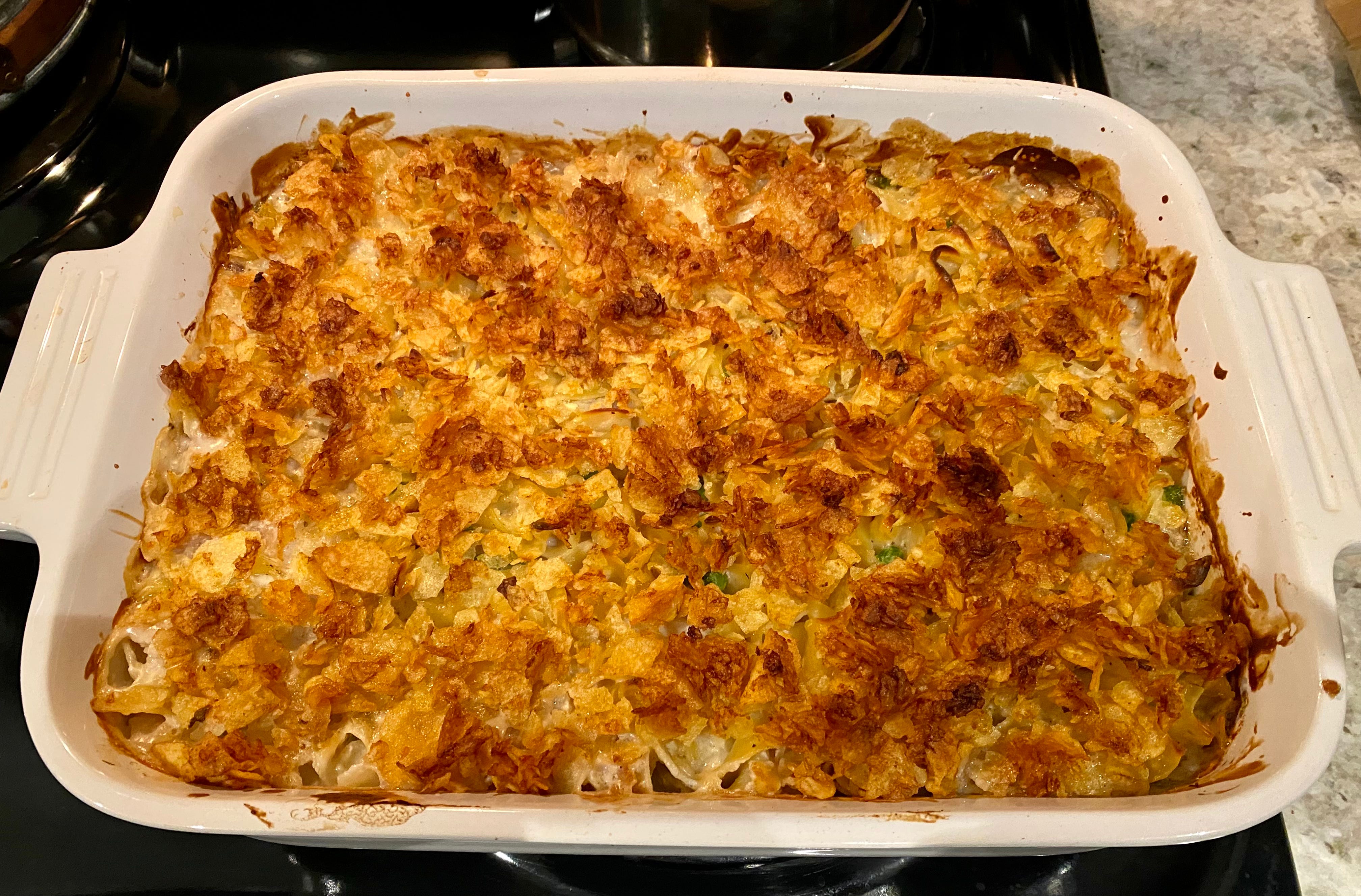
Tuna Noodle Casserole, Without the Apology
There is no shame in this meal. Well, there could be. Depends on how you do it.
Tuna Noodle Casserole is a paradoxical dish. If you go for the standard tuna noodle casserole with the can of Campbell’s it’s white trash food right up there with spray cheese. Cream of mushroom soup. Noodles cooked to mush. Crushed Ritz on top. The whole thing arrives in a 9x13 pan like a war crime.
The dish has good bones. Pasta, fish, dairy, salt, crunch. A credible architecture. The original just leans on convenience products that were never very good and when mixed somehow get worse. Strip those out, and the casserole is worth eating.
Start with the tuna, because most of what’s wrong with the dish starts there. Buy good water-packed tuna. Wild Planet or Safe Catch. The supermarket value pouches will not do. Good water-packed tuna is firm, pink, and tastes like fish that lived a full life. It also has the virtue of not bringing competing oil to the casserole. This is key. The oil is a deal breaker. The sauce is the only fat that belongs here.
And the oil is not a passive passenger. A cream sauce is an emulsion: fat, water, and dairy proteins held in suspension by the starch from the flour. Pour in a slug of canned-tuna oil (which is usually soybean or sunflower oil that has been sitting with salt and fish proteins for months) and you push the emulsion past what it can hold. The fat breaks out. The sauce goes grainy and slick, with little oil slicks pooling on the surface. You can sometimes save it with a furious whisk and more starch. The cleaner move is not to invite the problem.

Drain the cans well, pressing the lid against the fish to get the last of the water out. Two cans, about eight ounces of drained fish.
The noodles should be wide egg noodles. The bag will say “extra wide.” The casserole was built around them: they drink up sauce, hold their shape under heat, and have the right nostalgic shape for a dish that, no matter how seriously you take it, is still a casserole.
The egg is doing real work. Plain semolina pasta relies on gluten and starch alone, and twenty-five minutes in a wet, hot casserole reduces it to glue. Egg noodles add coagulated egg protein to the matrix, a fine edible scaffolding running through each strand. That scaffolding sets when it hits heat and resists breaking down even under prolonged moisture. It is what lets egg noodles take the abuse a casserole inflicts. It is also why egg noodles handle stroganoff and beef and barley and semolina can’t.
Cook them two minutes shy of the package time. They finish in the oven.
Now the cream of mushroom soup, made from scratch in a heavy pot. The canned version is the original sin of this dish. Replacing it takes twenty minutes. There is no good excuse not to.
Melt four tablespoons of butter over medium-high heat. Add a pound of sliced mushrooms (cremini and shiitake, in roughly equal parts) and a pinch of salt. Don’t crowd them. If the pan can’t hold them in mostly a single layer, work in batches. Cook hard, stirring only occasionally, until they’re deeply browned and have given up their water and reclaimed some of it as flavor. This takes longer than seems reasonable and cannot be rushed. Browning is what separates this soup from the gray sludge in the can.
Add two minced cloves of garlic and a teaspoon of fresh thyme leaves. Stir for thirty seconds. Pour in a half cup of dry sherry and let it reduce until the pan is almost dry. Add three tablespoons of flour and stir constantly for two minutes, until the mushrooms look coated and slightly pasty.
The two minutes are not arbitrary. Raw flour carries volatile aldehydes from lipid oxidation (chiefly hexanal, the molecule responsible for the grassy, faintly fatty smell you pick up when you stick your face in a bag of flour) that evaporate quickly in the heat of the pan. That’s the chalky, papery flavor leaving.
At the same time, the butterfat is doing structural work. It coats each starch granule in a thin hydrophobic shell. Without that shell, dry granules clump the moment they hit milk: the outside of each granule hydrates faster than its center, forming a sticky surface gel that glues it to the dry granules around it. The result is lumps with doughy centers. Coated in fat, the granules disperse cleanly into the liquid and then hydrate uniformly, swelling and releasing amylose into the sauce to thicken it as the milk warms.
Cook past two minutes and the starch itself begins to break down. Sustained heat cleaves the long amylose and amylopectin chains into shorter dextrins. That’s where the nutty flavor of a darker roux comes from, and also why a brown roux has roughly half the thickening power of a white one: the long chains that swell and trap water have been chopped into pieces too short to do the job. For a cream of mushroom soup you want full thickening capacity and minimal toasting. Two minutes is the window.
Pour in a cup of chicken stock and two cups of whole milk, whisking. The mixture will tighten and then loosen as the milk warms. When it simmers, kill the heat. Stir in a cup of grated Gruyère and a half cup of grated Parmigiano-Reggiano. Taste before you reach for the salt. Both cheeses bring significant salt of their own, the Parmigiano-Reggiano especially. The sauce may not need any. If it does, add in small pinches. Pepper. A small grating of nutmeg.
The soup should be loose, glossy, and full of mushroom pieces. If you don’t like the texture of mushroom in the finished dish, run the whole soup through an immersion blender until completely smooth, then push it through a fine-mesh sieve. The sieve catches the last of the skin and fiber and leaves you with a velvety, woods-flavored cream that gives you all of the mushroom flavor and none of the bite. For a middle path, blend half and stir it back in. Most people don’t bother.
While the soup cooks, work the rest of the vegetables in a separate pan. Sweat a sliced leek and two shallots in butter until they collapse. Off the heat, stir in a small handful of chopped tarragon, which is the herb that makes the dish, and is non-negotiable. Frozen peas, a generous cup, go in last and still frozen. They’ll thaw in the casserole and stay green.
The lemon is the move. Zest one whole lemon into the bowl when you assemble. Stop there. Do not add the juice. The acid will break the cream sauce in the oven the same way the tuna oil would, except faster, and you’ll pull out a grainy curdled mess instead of dinner. The zest is the move because it carries the lemon’s essential oil, which is the part that perfumes the dish, without the citric acid that destabilizes the emulsion.
Now the topping, which is the part that makes this version actually different. Use a five-ounce bag of Cape Cod Original kettle chips. Plain is the right call: it lets the casserole speak. A flavored bag works if you want one. Sea salt and pepper is excellent. Whatever you reach for, kettle-cooked only. The thin, machine-stamped chips go soggy in eight minutes and slide off the top in defeated little drifts. Crush them in the bag. Coarse, not pulverized. You want pieces.
Then the step that matters: toss the crushed chips with three tablespoons of melted butter in a bowl, until every piece is glossy. The butter is what gives the topping its color and what keeps it from blowing off the casserole. Don’t skip it.
Assembly is straightforward. Fold the noodles, the tuna (broken into large flakes, not mashed into pâté), the leek-and-shallot mixture, the peas, the lemon zest, and the mushroom soup together in a large bowl. Taste. Be careful with the salt if you add more. The chips will have salt! The mixture should be slightly looser than seems right, because it tightens in the oven. Transfer to a buttered baking dish. Cover the top with the buttered chip mixture in a layer thick enough to hide the casserole entirely.
Bake at 375°F for 25 minutes, until the top is browned and the edges are bubbling. Rest for five minutes. Otherwise it pours.
And in these Trumpian times, where costs are out of control this is a great way to stretch a buck.
Why Your Support Matters
Independent journalism answers to readers—not advertisers, corporations, or access-hungry editors. No story gets killed because it upsets a sponsor. No punch gets pulled because someone important made a phone call.
Your support makes possible sharp commentary, fearless satire, and reporting that follows the story wherever it leads. In an era of manufactured narratives and algorithmic blandness, that independence isn’t a luxury—it’s a necessity.
Subscribe to The Powell House Press. Or settle for content that tells you what someone else wants you to hear.
©2026 All Rights Reserved | The Powell House Press | josh@thepowellhousepress.com


