Very Bad Men and My Not So Terrible Disease
We've all waged war. Are the spoils worth it?
It has been a genuinely disorienting month, one of those stretches where “WTF” stops being a reaction and starts feeling like a baseline.
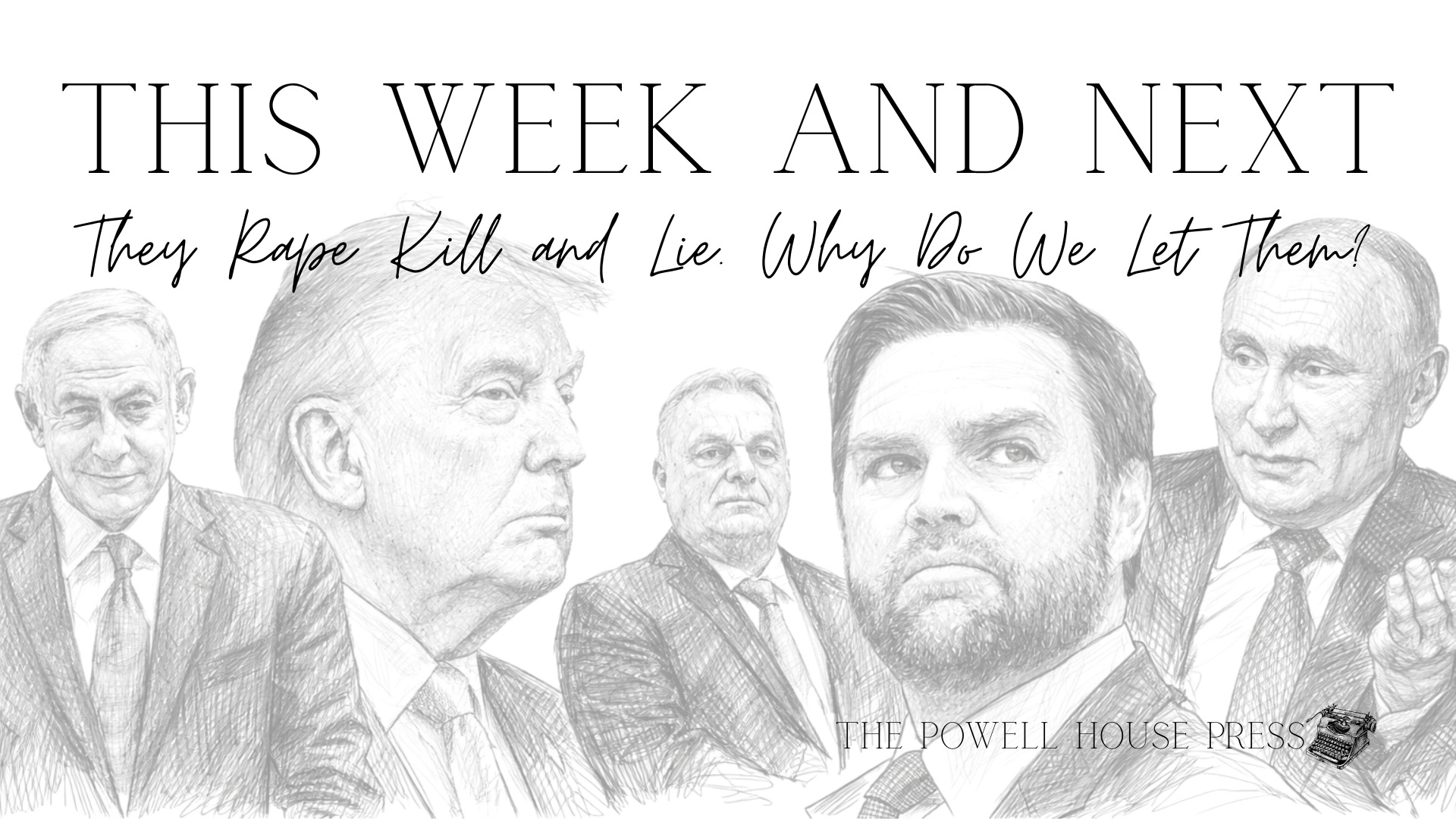
We are being maneuvered toward war, nudged and framed into it, with Netanyahu playing his familiar game of escalation and inevitability. Trump, operating in his own gravitational field, has managed to rattle global markets while simultaneously raising the temperature on conflict, casually invoking war crimes and even picking rhetorical fights with the Vatican. JD Vance, ever the ideological contortionist, turns up abroad lending legitimacy to strongmen dressed as reformers. And Putin continues, methodically and without pause, to grind down both Ukrainians and his own people.
What’s most unsettling is not just that all of this is happening. It’s that it’s happening in plain sight, in real time, and still feels insufficiently confronted.
Meanwhile, at home, the erosion is just as stark. Public health policy is incoherent at best, destructive at worst. The Justice Department feels absent. Education is being hollowed out. The military is being shaped by ideology rather than discipline. Environmental policy is handed to those with neither expertise nor restraint. And Homeland Security sits in the hands of someone visibly out of their depth.
It’s not one crisis. It’s a cascade, and the through line is a kind of institutional unraveling that no one seems willing, or able, to stop.
Come on. Don’t we all have our own shit to deal with? I know I do.
Grace(less) Under Fire
A friend called last week. The kind of friend who periodically texts to announce that she owes you a call, as though the announcement itself constitutes the debt paid. Tedious doesn’t begin to cover it. Although, on reflection, it ranks marginally above the friends who forward links to miracle cure articles about Parkinson’s Disease (those breathless dispatches from the wellness industrial complex, via TikTok), forwarded with a heart emoji as a substitute for actual presence.
What these people cannot grasp is that I have arrived, after considerable turbulence, at genuine indifference. The diagnosis (a tremor, fifteen years ago; the full PD, three years back) is simply the terrain now. You navigate it or you don’t.
Parkinson’s, incidentally, is becoming something of an antiquated umbrella. The medical conversation has shifted toward a constellation of symptoms, severities, and origins. Environmental triggers. Traumatic brain injury. Genetic predisposition. The numbers are climbing in ways that cannot be explained away by expanded diagnostic criteria, the way autism spectrum numbers can. Something else is happening. For now, my physical symptoms are manageable and not the point of this story.
The point is the friend.
The preamble to these resurfaced calls follows a script so consistent I think people Google “How to talk to Josh.” Busy life. The children. Demanding work. Insert variable. Then the obligatory contrition, the solicitous questions about how I am managing, what I do with my days. I have my own algorithm in response. I simply don’t mind anymore. It is far less exhausting to accept the tidal nature of friendship than to stand on the shore cataloguing the retreats.
This wasn’t always my position. There was a period, unbecoming in retrospect, when the lunch invitations that dissolved into silence left a genuine mark. Worse was the particular cruelty of knowing that they knew and had chosen the clean getaway of pretending otherwise. But that specific sting eventually produces a useful residue: the hot stove teaches without requiring a lecture. Not the consolation-prize wisdom of now you know who your real friends are. That aphorism belongs on a motivational calendar, not in an adult life. The truth is that most of us have been lousy friends at some point. The shame of that creates its own distance. There’s no need to prosecute it.
I appreciate how evolved I sound. Allow me to dismantle that immediately.
A recent conversation with a former colleague offered a corrective. He’d been dealing with his own health situation. Was I the model of attentive friendship I’d been describing? I was not. I sent resources. Transactional. The shoe on the other foot.
When we finally spoke properly, he told me he was sure I was handling everything gracefully. I laughed. Actually laughed. Because the professional version of me had apparently projected such fluent composure that the performance had outlasted the room.
The performance had its origins in a conference room on a high floor in midtown, during my first deposition. A noncompete violation. The stakes were significant, and I was, beneath the Hugo Boss and the Hermès tie, a man who spent the morning cycling between aggression toward opposing counsel and the outer edges of a panic attack. My own lawyer delivered his pep talk at the adjacent urinal (as an aside, I don’t know why men talk at urinals) and advised me to answer the questions literally and stop being a dick.
I took lunch alone. A booth in the lobby restaurant. Bloody Mary. BLT. One Ativan. Fleetwood Mac in my ears until the panic subsided. Then the walk to the garage for an Altoid, the glimpse of myself in the car window (the focused eyes, the well-cut suit), and the Mercedes chirping its small, ridiculous affirmation as I locked it.
My old boss, the man suing me, was waiting at the elevator. I grinned and winked. “Hi, Val.”
That afternoon I was bulletproof.
It took four more years to win. Six years of life, more or less, surrendered to the victory. The grace everyone had observed was a German car and a controlled substance. A different kind of script. Today I would settle, or find another position entirely. The insight, hard-won and now freely given: grace is not performance. It isn’t a suit or a pharmaceutical. It’s the judgment to identify which battles are actually worth the cost of fighting. Most aren’t. Distance, it turns out, is often less a defeat than a decision. One to be respected on both sides.
Why Your Subscription Matters
Independent journalism answers to readers—not advertisers, corporations, or access-hungry editors. No story gets killed because it upsets a sponsor. No punch gets pulled because someone important made a phone call.
Your support makes possible sharp commentary, fearless satire, and reporting that follows the story wherever it leads. In an era of manufactured narratives and algorithmic blandness, that independence isn’t a luxury—it’s a necessity.
Subscribe to The Powell House Press. Or settle for content that tells you what someone else wants you to hear.
©2026 All Rights Reserved | The Powell House Press


