
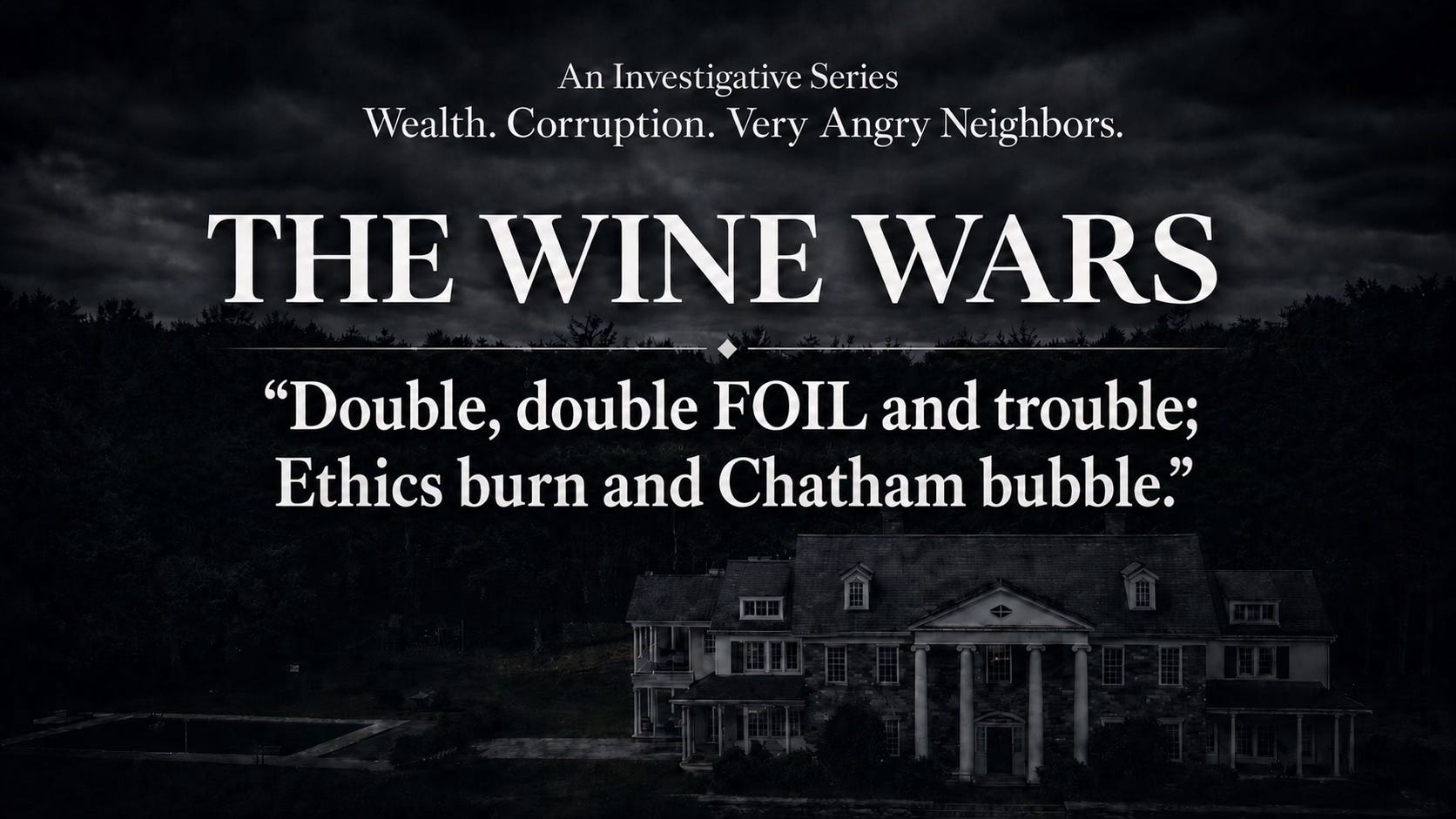
The Wine Wars: Double, double FOIL and trouble; Ethics burn and Chatham bubble.
Next week's town board meetings will include letters from the publics. Let's see how they tackle some of these questions.
Call it what it is. This isn’t partisan bicker. It’s math.
Two hundred thirty-six people signed a petition against a luxury estate wedged into a protected agricultural district on the strength of a vineyard covering one percent of the property. Forty-six neighbors wrote letters. Not one soul wrote in support. Fact.
The Zoning Board of Appeals said no to the tasting room. Case closed, some thought. It isn’t. The Williams’ own lawyer told the board in May exactly how to route around that no: New York State’s Department of Agriculture and Markets. Unpleasant to report, but true. The lawyer is right.
Meanwhile, the Williams have filed for a Farm Liquor License. And thanks to Donal Collins, who declined to mention it to the board or to the public, nobody found out until later that the plan all along was to fold a lux manse into an ag district under the name Fox Hill Estate and Vineyard. One percent vineyard. Full protection. These are, again, facts, not opinions.
To its credit, the town says it wants more transparency now. Late, and a little cheap, but better than nothing. Progress earns encouragement, even when it shows up after the fact.
For months, The Powell House Press has asked the Town Board for its communications on this matter. So has nearly everyone else. The answer has always been the same: it’s being handled. Handled how, no one says. The town itself has now said the answer is to release everything ahead of the next meeting. Fine. Here is mine:
THE POWELL HOUSE PRESS
July 9, 2026
Town of Chatham
Town Board
488 State Route 295
Chatham, NY 12037
Sent via email to Chatham@chathamnewyork.gov for inclusion in the public record
Re: 509 Bashford Road Tasting Room Application
Dear Town of Chatham:
I am writing on the record to the entire board. I have done this before and received no response concerning the proposed tasting room at 509 Bashford Road. I have asked these questions repeatedly. I am asking again now, under the town’s new policy of posting all correspondence publicly.
Some background on the level of public interest in this matter: the town has received 46 letters and a petition with 237 signatures, all opposing the project. There is no letter of support in the file, and none was supplied to me in the documents the town provided in response to my FOIL request.
I would ask the board to respond to the following questions:
1. Conflict of interest. In response to a FOIL request, it was discovered that John Wapner raised the issue of a conflict involving Mr. Collins related to his relationship with Dr. Williams in August 2025. This was raised well before the Williamses submitted their application to include their property in an Ag District (a decision made by the county Board of Supervisors, on which Mr. Collins sits). Mr. Collins did not address the conflict at that time. He has claimed, in the winter of 2026, that he recused himself. When, exactly, did that recusal occur, and where is the written record of it? Recusals must be on the record and in writing, and neither the town nor the county has produced one in response to two FOIL requests. How will the Town Board address this, and prevent future ethical lapses?
2. At the February 19, 2026 Town Board meeting, there was public outcry over the inclusion of 509 Bashford Road in an Agricultural District. The 303-b application cited Mr. Collins as the tenant farmer. Mr. Collins was also notified, as Chatham Town Supervisor, as required by law, that the Williamses were seeking this designation. This raises the following questions:
a. When a fellow board member asked why Mr. Collins had not reported this in his “County Report” at the previous board meeting, his reply was: “I didn’t have to.” This contradicts Town Board Resolution 72-24, in which the board explicitly required the Town Supervisor to report back on county business affecting the town. How will the board address this violation, and prevent similar ones going forward?
b. Mr. Collins claims he recused himself at the county level, which shows he knew about both the application and the conflict. The 303-b application contained representations that were not factual. Mr. Collins knows, for example, that there are no cattle at 509 Bashford Road. Why was this discrepancy not brought to the county’s attention? Is it appropriate for a luxury estate, with only a small fraction of its property used for hay and an even smaller fraction for grape production, to be included in a designated agricultural district?
c. Mr. Collins has himself acknowledged deficiencies in the county’s notice process. The county, however, did provide notice of this application to the town, as required by law. Knowing the community’s concern about this issue, and having himself acknowledged the flaws in the notice being used, why did Mr. Collins not share this development with his fellow board members and the community, given his awareness of the community’s concern about a commercial enterprise developing at 509 Bashford Road? What measures, if any, will the town take to notify its citizens of significant county-level changes affecting the town?
d. This issue goes back years. Another board member, Wapner, raised both the conflict and the public interest at stake as early as August 2025. Mr. Collins knew, said nothing, and let the application proceed in silence, only surfacing what he knew after the fact and only in response to public pressure. How does the board believe notice procedures need to change, and what does it intend to do about a supervisor who sat on information the community had every right to have?
3. The inclusion of the property in Agricultural District 10 now gives the property owners significant leverage to open their tasting room, a point the Williamses’ own lawyer raised in his appeal to the ZBA. How will the board respond if the Williamses go to Ag and Markets to bypass the ZBA?
4. Had this process gone through the proper channels, using for example the template set by Silver Bros. on Shaker Museum Road, it would have allowed for proper public comment and spared private citizens the cost of legal counsel. That cost is damage in itself. What steps will the town take to avoid matters like this in the future?
5. Related to question 4, pursuing the same project simultaneously through:
a. The Planning Board, without providing its required materials;
b. The building department; and
c. The county
in order to avoid legal and regulatory requirements resembles “segmentation,” which becomes a costly battle for the town. What safeguards will be put in place to prevent this in the future?
6. There is significant concern about the soil and environmental impact of this development. Vineyard operations are pesticide-intensive, and 509 Bashford Road sits on DEC-regulated wetlands. The process the Williamses used resulted in a SEQR review being waived, meaning no Environmental Assessment Form, no Negative Declaration, and no public environmental record was ever produced for this project. What are the board’s plans to protect public health and the water supply for neighboring residents on and around Bashford Road if this enterprise proceeds? It should be noted that the Planning Board itself raised this exact question and never received an answer, and the property has now been folded into an agricultural district, affording it those protections without ever undergoing SEQR review. What is the board’s plan to remedy this?
I look forward to the board’s response, on the record.
Respectfully,
Joshua Powell
The Powell House Press
There is also the very real question as to if the Williams have gone to Ag and Markets to appeal the ZBA. The following was sent to NYS:
Records Access Officer
New York State Department of Agriculture and Markets
FOIL@agriculture.ny.gov
Re: Freedom of Information Law Request – Records Concerning 509 Bashford Road, Chatham, New York
Dear Records Access Officer:
Pursuant to the New York Freedom of Information Law (Public Officers Law, Article 6), I request copies of all records maintained by the New York State Department of Agriculture and Markets relating to the property located at 509 Bashford Road, Chatham, New York, and/or the owners, Edwin Williams and Cherie Williams, from January 1, 2025, through the date this request is processed.
This request includes, but is not limited to:
Any complaint, request for review, request for assistance, request for an advisory opinion, inquiry, appeal, or petition submitted to the Department concerning the Town of Chatham’s regulation, denial, restriction, or approval of a proposed vineyard, winery, farm winery, tasting room, retail sales, accessory agricultural use, or other farm operation associated with this property.
Any records relating to a review conducted or requested under Agriculture and Markets Law Article 25-AA, including but not limited to Section 305-a, or any other provision of the Agriculture and Markets Law concerning this property or proposed use.
All correspondence, including emails, letters, memoranda, notes, or attachments, between the Department and:
Edwin Williams;
Cherie Williams;
their attorneys, consultants, engineers, or representatives;
the Town of Chatham;
Columbia County;
or any other governmental agency regarding this property or the proposed winery, vineyard, or tasting room.
Any internal Department correspondence, memoranda, legal analyses, recommendations, staff notes, investigative materials, or communications concerning this property or any request for Department involvement.
Any determinations, findings, advisory opinions, letters, reports, recommendations, or decisions issued or prepared by the Department concerning the property or the proposed winery, tasting room, or related agricultural activities.
Any records reflecting whether the Department has accepted, declined, closed, or is currently reviewing any request concerning this matter.
If any records are withheld in whole or in part, please identify the statutory exemption relied upon and provide all reasonably segregable portions of otherwise responsive records.
I request that all responsive records be provided electronically whenever possible.
If the cost of fulfilling this request will exceed $25.00, please notify me before processing.
Thank you for your attention to this request. I look forward to your response within the time required by the Freedom of Information Law.
Sincerely,
Joshua Powell, The Powell House Press
Their response is due at the begining of next week.
There’s been a lot of distraction around this issue from the usual suspects. None of it resolves the public’s right to know. The board has offered nothing on the public’s concerns. Nothing on the public’s health either.
One theory making the rounds is that this is partisan. It isn’t. Another is the “private property” defense: the Williamses should get to do as they like on their own land. Sorry. That is not how a town works. One man’s folly does not get to write the script for everyone else on the road. That is the entire point.
Early in this series there was a piece on Nassau Lake (it’s linked below), and on what one man’s vision for his own private property did to that community. Dewey Loeffel’s private disposal decisions poisoned the Valatie Kill, which feeds Kinderhook Lake, the Creek, and eventually the Hudson. Decades later, it is still an active Federal Superfund site. Cleanup estimates run $7 million to $8.2 million.
This is why planning boards exist. This is why environmental review is required for major projects, not optional depending on who you know at the county.
Add this to the long list of unanswered questions in this letter, and Mr. Collins’s and the Williamses’ conduct on this project starts to look less like an oversight and more like a pattern. And that is putting it kindly.
The Wine Wars Part 2: Dewey Loeffel Killed Nassau Lake, Countless Wildlife and Most Likely Some People.
I wrote this a few years ago, after my friend EB and I went on one of our little explorations. I’ve updated it. This week demonstrated to me just how important this story remains and how crucial it is to protect the environment. It also illustrates how a single person’s financial gain becomes a community issue. While the toxins maybe different than those used on grapes, they are damaging all the same. Everyone deserves to know if their neighbors are using substances that have the potential to cause harm.
©2026 All Rights Reserved | The Powell House Press | Josh@thepowellhousepress.com


